Independent Body Makes First Draft Determination on MLA Pay
Independent Body Makes First Draft Determination on MLA Pay.pdf (391.56 kb)
19 February 2026
Issued on behalf of the Independent Remuneration Board
The new Independent Remuneration Board (the Board), which is responsible for setting the salaries and pensions of Members of the Legislative Assembly (MLA), has made its first draft determination.
The Board is now inviting views and feedback on its draft determination from MLAs, the Assembly Commission and the Assembly Members’ Pension Trustees, as part of a two-week consultation. Once this consultation closes on 5 March 2026, the Chairperson and members of the Board will take time to reflect on the responses received and present a final determination to the Assembly Commission for publication and implementation.
The Board has proposed an uplift in salaries for MLAs from £53,000 to £67,200 per year (26.8%), from 1 April 2026. The details of the draft determination have been published today on the Board’s webpage. *
In recognition of public frustration at ‘stop-start government’, the Board has also signalled significant financial sanctions that would apply if an Executive is not formed following the next and subsequent elections - or if at any time the offices of First Minister and deputy First Minister become vacant.
Alan Lowry, Chairperson of the Board said: “The Board's objectives are to provide MLAs with a level of remuneration which fairly reflects the complexity and importance of their work and does not deter anyone from seeking election on financial grounds.
“Our MLAs are elected to demanding roles which they perform within their own constituencies and at Parliament Buildings. They make important decisions around legislation, holding Ministers and Departments to account and their work on the Assembly’s scrutiny committees. It is important this work, as well as representing the views and concerns of their constituents, is recognised and valued.
“It is not appropriate, or fair, to expect MLAs to set their own salaries and the Board operates completely independently of the Assembly and the Assembly Commission.
“We want to ensure that public money is spent with probity, accountability, value for money and transparency. We have made this draft determination having regard to the current financial circumstances in Northern Ireland.
“As a Board, we have taken time to consider the evidence, based on the parameters of legislation. We have taken account of the requirements of the Assembly Members (Independent Financial Review and Standards) Act 2011 - and the report of the Ad Hoc Committee on the Assembly Members’ Remuneration Board Bill, particularly its recommendation to consider the wider financial circumstances of Northern Ireland.
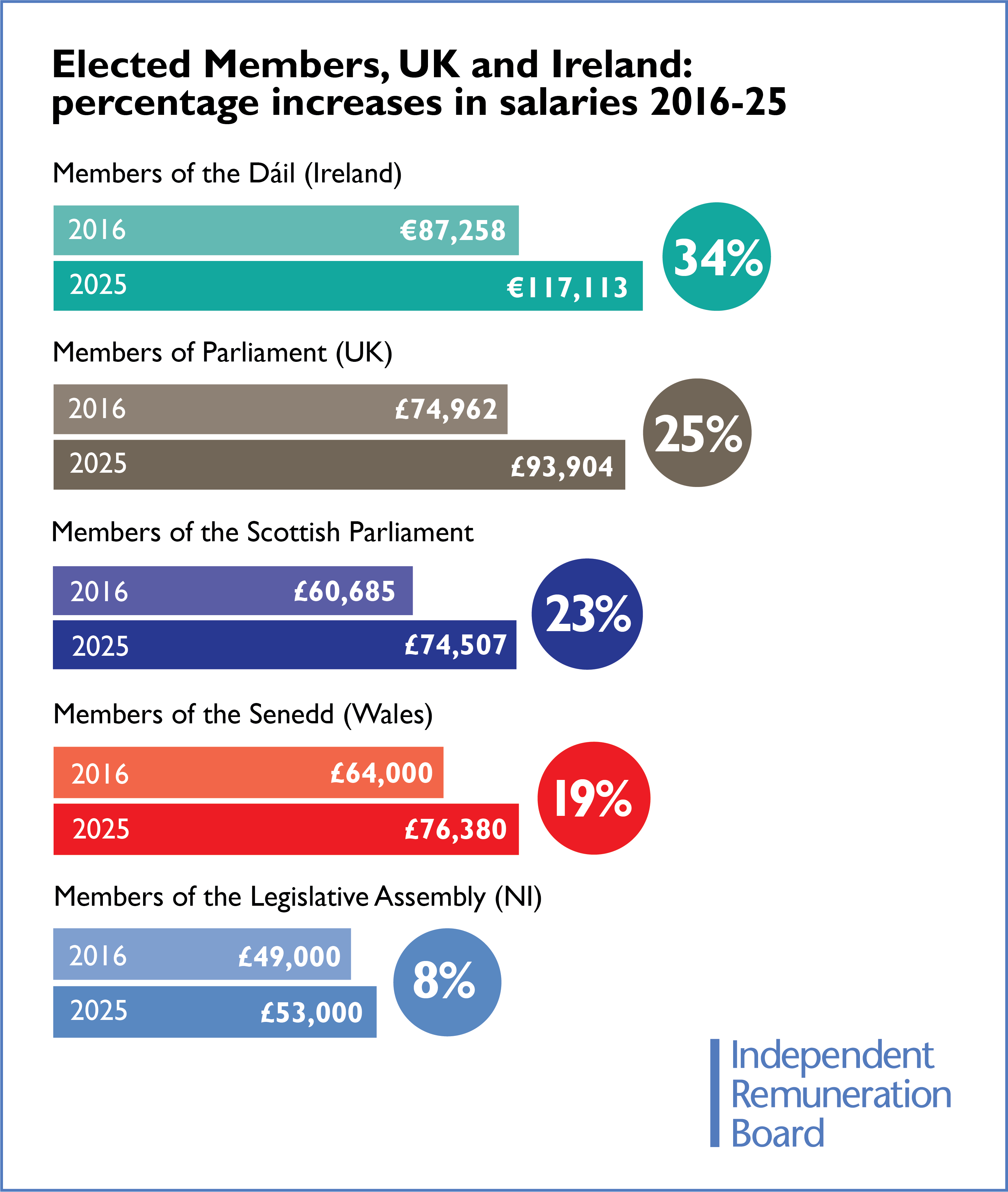
“In reaching our determination, we also took into account the current salaries of elected representatives in the Scottish and Welsh Parliaments as well as those in Westminster and Dublin. Between 2016-25, an MP’s salary went up by 25%, while Members of the Welsh Senedd, Scottish Parliament and Irish Dáil saw increases of 19%, 23% and 34% respectively. In the same period, MLA pay increased significantly less, by 8%.
“With the previous Independent Financial Review Panel last making a determination in 2016, it is clear the system of MLA pay has not been functioning normally for a decade. Today’s announcement is a corrective measure and, without prejudicing future determinations, the Board would expect those to be considerably smaller adjustments, and more in line with inflationary and other pay trends of the day.
“We recognise these proposals come at a time when public confidence has been impacted by periods in recent years when our political institutions were not sitting and working normally. That is why, as a Board, we were determined that although MLAs should be paid more, that should only be on the basis of them doing their full jobs.
“Informed by the actions the Secretary of State for Northern Ireland took in 2022 on Members’ pay, our draft determination proposes that, should a government not be formed after the 2027 election, MLA salaries will be reduced. In addition, if at any time the offices of First Minister and deputy First Minister become vacant, MLA salaries will also be reduced.
“A reduction of 10% would be applied to MLA salaries after six weeks and again at weeks 12 and 18 - if a government had not been formed in line with the Northern Ireland Act 1998 which allows six months for its formation.” **
ENDS
For further information please contact Felicity Templeton, Assembly communications office: felicity.templeton@niassembly.gov.uk / 07977 635930
Notes to editors:
*You can read the Board’s draft determination here https://lk.nia.fyi/IRB and find further information on the work of the Board here
** The determination can gradually reduce salaries of members / office holders by 10% after week 6, week 12 and week 18. Note: the reduction is on the immediately preceding sum (so the reduction in the second period is a reduction of 10% on the salary in the first period, not a further 10% on the starting (initial period) salary i.e. initial period: £67,200; first period: £60,480; second period: £54,432; third period: £48,988.90
- The Board is due to make a total of three determinations in the 2026 calendar year. The other two - on MLA salaries in respect of the 2027-32 mandate and separately on MLA pensions - will be made in the latter half of this year.
- The Board does not make determinations in respect of MLA allowances. In 2020, the Assembly conferred powers on the Assembly Commission to determine allowances payable to Members. See the 2025 Determination by the Assembly Commission here .
- The Board considered annual earnings in Northern Ireland as detailed in the Annual Survey of Hours and Earnings (ASHE) survey - considered the most comprehensive source of information on the structure and distribution of earnings in the UK. You can read the Office for National Statistics’ (ONS) ASHE survey here .
The Independent Remuneration Board
- The new Board replaces the Independent Financial Review Panel and its responsibility is more limited i.e. to make determinations on MLA pay and pensions.
- The Board is required to make a determination in respect of the current Assembly (2022-27).
- The Board will make its determinations on salaries and pensions only once in respect of each Assembly. However the 2011 Act does make provision for exceptional circumstances.
- The role of the Board is to make determinations in relation to all aspects of salaries and pensions for MLAs as well as the remuneration of officeholders including the Speaker, Deputy Speakers, Assembly Commission Members and Committee Chairpersons - as well as the remuneration of members of the Northern Ireland Executive (the First Minister, deputy First Minister, Ministers) and Junior Ministers.
- The Board is made up of a Chairperson and two other members who are each appointed for a five-year term. Read more about the Board here .
- On 16 September 2025 the Assembly Members (Independent Remuneration Board) Act (Northern Ireland) 2025 received Royal Assent, making provision for the establishment of an Independent Remuneration Board. Details can be found on here .
Please note that it modified provisions of the Assembly Members (Independent Financial Review and Standards) Act (Northern Ireland) 2011.
Inflationary considerations
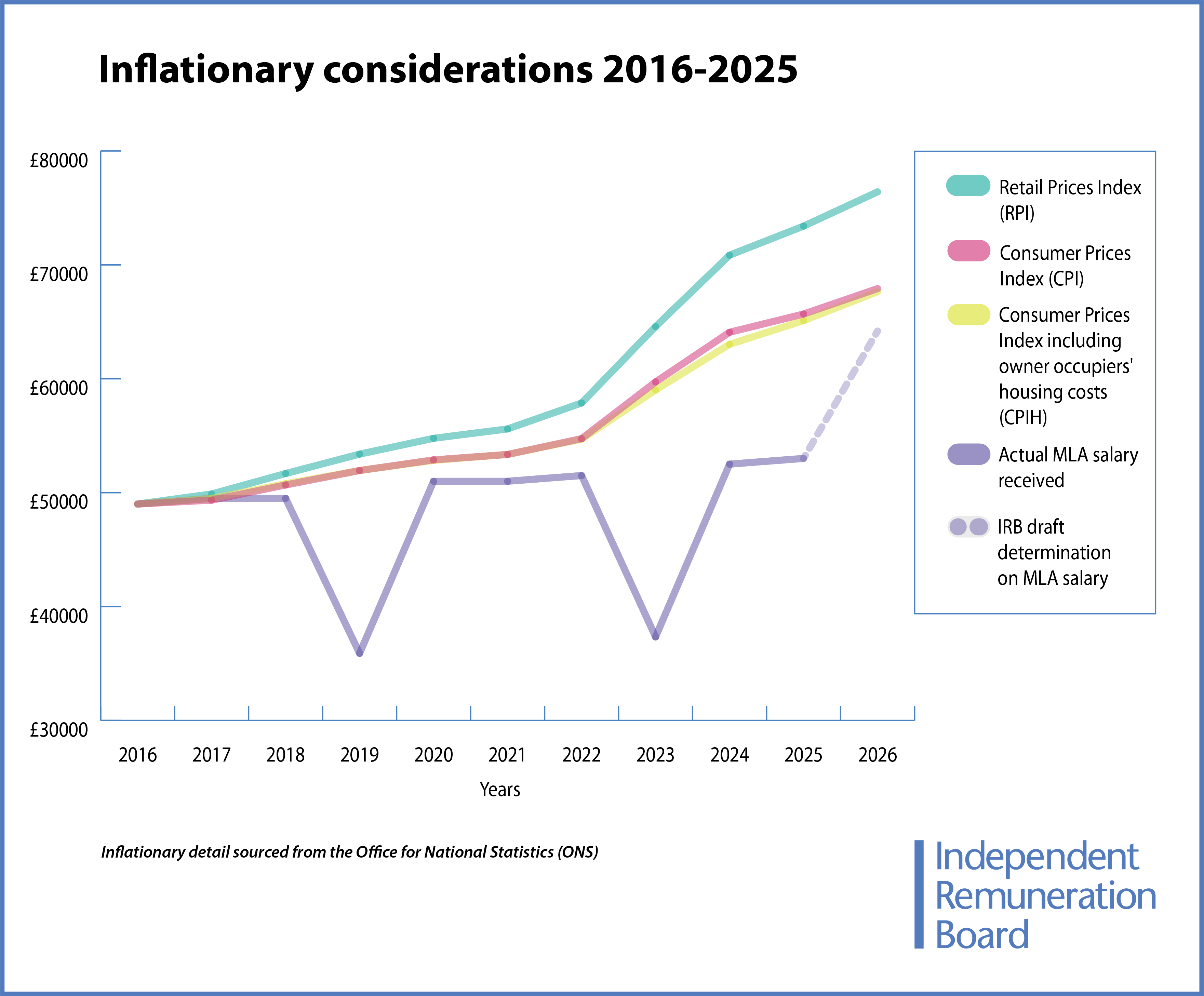
The Board considered a number of metrics for maintaining real-term wages – including the application of external indicators such as the Retail Prices Index (RPI) and the Consumer Prices Index (CPI). The Board considered what MLA salaries would have been each year since 2016, had they increased in line with measurements such as RPI, CPI or CPIH.
RPI measures consumer inflation. CPI is the measure used by the UK Government to set the Bank of England's target for inflation. CPIH is similar to CPI, but includes the costs of owning, maintaining and living in a home. Please see the graphic below - note that figures have been rounded.
In 2016, an MLA’s salary was £49,000. If external measurements (CPI, CPIH or RPI) had been applied to it every year, the pay level would have seen a cumulative increase over the period. An MLA salary in 2026 would then have been £67,916, £67,643 or £76,410 - had it been indexed linked. However, in real terms, MLA salaries have increased by a much smaller margin – £4,000 in a decade.
Politicians’ salaries: London, Scotland, Wales and Dublin
The graphic below shows the percentage change in elected representatives’ salaries across the UK since 2016. Over this period, Members of Dáil Éireann received the highest percentage increase at 34%. MLA salaries increased by 8% over the same period.