Committee for Justice
End of Session Report 2025-2026
Committee for Justice End of Session Report 2025-2026.pdf (522.96 kb)
Contents
Contents
Powers
Membership
Justice Bill
Criminal Justice (Sentencing etc) Bill
Victims and Witnesses of Crime Bill
The Police and Criminal Evidence (Northern Ireland) Order 1989 (Codes of Practice) Order 2025
The Justice (2011 Act) (Amendment of Schedule 4) Order (Northern Ireland) 2026
Family Courts
Enabling Access to Justice
Other policy issues
Visits, events and informal meetings
Informal meetings
Visits
Likely key priorities for the next session
Powers and Membership
Powers
The Committee for Justice is a Statutory Departmental Committee established in accordance with paragraphs 8 and 9 of the Belfast Agreement, Section 29 of the Northern Ireland Act 1998 and under Standing Order 48. The Committee has a scrutiny, policy development and consultation role with respect to the Department of Justice and has a role in the initiation of legislation.
The Committee has power to:
- consider and advise on Departmental budgets and annual plans in the context of the overall budget allocation;
- consider relevant secondary legislation and take the Committee stage of primary legislation;
- call for persons and papers;
- initiate inquiries and make reports; and
- consider and advise on any matters brought to the Committee by the Minister of Justice.
Membership
The Committee has nine members including a Chairperson and Deputy Chairperson and a quorum of five.
The membership of the Committee since 1 September 2025 has been as follows:
- Mr Paul Frew MLA, DUP (Chairperson)[1]
- Miss Emma Sheerin MLA, Sinn Féin (Deputy Chairperson)[2]
- Mr Doug Beattie MLA, Independent
- Mr Maurice Bradley MLA, DUP
- Ms Connie Egan MLA, Alliance
- Mrs Ciara Ferguson MLA, Sinn Féin
- Miss Aoife Finnegan MLA, Sinn Féin[3]
- Mr Brian Kingston MLA, DUP[4]
- Mr Patsy McGlone MLA, SDLP[5]
Overview
1. This End of Session Report covers the work of the Committee for Justice from 1 September 2025 to 31 August 2026.
2. The Committee considered a range of subordinate legislation, legislative consent motions and policy issues during the session, concluded its scrutiny of the Justice Bill, began its scrutiny of the Criminal Justice (Sentencing etc) Bill and undertook preparatory work for the Committee Stage of the Victims and Witnesses of Crime Bill.
3. The Committee met formally on 35 occasions. At 18 of these meetings, the Committee received legal and procedural advice, or deliberated on the Justice Bill, in closed session. All other business at formal Committee meetings was conducted in public session.
4. The Committee also held a number of ad-hoc or informal meetings and held one meeting externally, at the Inn of Court, Royal Courts of Justice, Belfast.
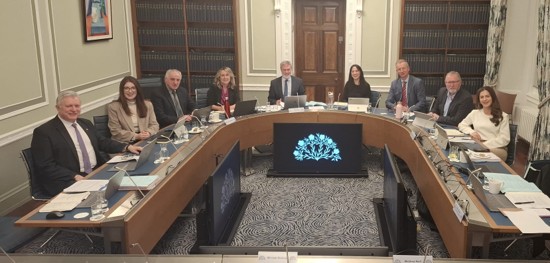
Members of the Committee for Justice pictured at the Committee meeting on 29 January 2026. Members pictured (L-R): Patsy McGlone, Connie Egan, Maurice Bradley, Ciara Ferguson, Paul Frew (Chairperson), Emma Sheerin (Deputy Chairperson), Brian Kingston, Doug Beattie, Aoife Finnegan.
Primary legislation
5. Primary legislation constituted a significant part of the Committee’s work during the period covered by this report. The Committee concluded its scrutiny of the Justice Bill during the session, began scrutiny of the Criminal Justice (Sentencing etc) Bill and issued its call for evidence on the Victims and Witnesses of Crime Bill.
Justice Bill
6. Throughout this session, the Committee continued its Committee Stage scrutiny of the Justice Bill. The Committee considered the Bill at 24 meetings, hearing evidence from stakeholders or the Department during 11 of those meetings.
7. The Committee agreed to bring forward a number of Committee amendments to the Bill, including:
- an enabling power for the Department to bring forward regulations for the retention and use of photographs within five years of the Bill achieving Royal Assent;
- a requirement for the provisions of Part 1 of the Bill to be commenced within five years of Royal Assent;
- amendments to Clauses 4, 5 and 6 to add ‘vulnerabilities’ to the list of matters to be considered by the police and courts when making decisions relating to bail and custody for children; and
- inserting a new Clause to provide for the review of the operation of Live Links in police custody.
8. The Committee was disappointed that a timescale for the commencement of Clause 8, which provides that bail for children and young people could not be refused purely due to the absence of suitable accommodation, had not been included in the Bill, and has urged the Minister of Justice and the Minister of Health to work together and take all necessary steps to commence these important provisions at the earliest opportunity.
9. The Committee also sought and obtained Ministerial agreement to bring forward two amendments to the change of delegated powers at two sections of the Bill from negative resolution to the draft affirmative procedure.
10. The Committee engaged extensively with the Minister and Department and others, including the Lady Chief Justice and representative bodies of the legal profession, in relation to concerns regarding Clause 28 of the Bill, which deals with changes to the taxation of legal aid spending. Towards the end of the Committee Stage, the Minister indicated that she would propose that Clause 28 no longer stand as part of the Bill and bring forward a further amendment on taxation reform. The Committee did not receive the text of the Minister’s proposed amendment in time to consider it fully within the Committee Stage.
11. Aside from the matters outlined above, the Committee was broadly content with the Clauses of the Bill and planned amendments as drafted, with the exception of Clause 28 relating to the taxation of legal aid. The report on the Bill was agreed by the Committee on 26 March 2026.
Criminal Justice (Sentencing etc) Bill
12. The Criminal Justice (Sentencing etc) Bill (‘Sentencing Bill’) was introduced to the Assembly on 3 March 2026 and completed Second Stage on 16 March 2026 when it was passed to the Committee for Justice for consideration. A motion to extend the Committee Stage to 27 November was agreed by the Assembly on 27 April.
13. The Committee began taking oral evidence on the Sentencing Bill in May, with evidence sessions scheduled to run until early October before the deliberations on the Bill and consideration of the evidence received begins.
Victims and Witnesses of Crime Bill
14. The Victims and Witnesses of Crime Bill was introduced on 22 June 2026 and completed its Second Stage on 30 June 2026, after which it was passed to the Committee for Committee Stage scrutiny.
15. The Bill seeks to establish a statutory office for the Commissioner for Victims and Witnesses of Crime and sets out the powers and obligations of that office, as well as introducing a number of protections for victims of crime, including protections from cross-examination by the perpetrator in cases of hate crime.
16. The Committee agreed to issue a call for evidence on the Bill, which opened on 3 July and will close on 25 September, after which the Committee will begin taking oral evidence on the provisions of the Bill.
Delegated Legislation
17. During the session, the Committee considered 23 proposals for Statutory Rules and 24 Statutory Rules that had been laid.
18. A new process began on 31 January 2026 to provide for enhanced scrutiny of delegated legislation. The Committee considered proposals for eight rules under this new process.
19. Delegated legislation scrutinised during this period includes:
The Police and Criminal Evidence (Northern Ireland) Order 1989 (Codes of Practice) Order 2025
20. As outlined in the End of Session Report for the period 3 February 2024 – 31 August 2025, the Committee’s consideration of proposals to amend the Police and Criminal Evidence Codes of Practice (known as the ‘PACE Codes’) began at its meeting on 27 February 2025. The Committee received oral evidence from the Northern Ireland Human Rights Commission (NIHRC) and Departmental officials and corresponded with the NIHRC, the Department and the PSNI on a range of issues.
21. Following the Supreme Court ruling in For Women Scotland Ltd v The Scottish Ministers Supreme Court on 16 April 2025, the Minister of Justice met informally with the Chairperson and Deputy Chairperson to set out options for the way forward on the PACE Codes that would be impacted by the judgment. The Committee subsequently engaged with the Department on the best way to proceed, but did not reach a final position by the end of the 2024-25 Assembly Session.
22. Having considered a further update from the Department, the Committee agreed to ask if consideration could be given to incorporating interim guidance from the National Police Chief’s Council (NPCC) on the searching of transgender detainees – and, in particular, a ‘no detriment’ safeguard – into the PACE Codes. The Committee was advised that this could not be referenced as it is an operational issue and is not within the legislative scope of the PACE Codes. However, it could be included in a note to be published alongside the PACE Codes.
23. On 19 March 2026, the Committee considered a revised draft note to be published alongside the Codes which had been revised following iterative engagement with the Department. The note highlighted that there will be no career detriment to any officer or staff member who declines to conduct a search involving a transgender person, or to a transgender officer exempt from searching.
25. DUP and UUP members indicated they were content with the Codes and the draft note, while Sinn Féin members highlighted that they did not accept codes H and I. After division, the Committee agreed by four votes to three that it was content with the proposal for the statutory rule to bring changes to the PACE codes into effect.
25. At the Meeting on 25 June 2026, the Committee formally considered SR 2026/107 The Police and Criminal Evidence (Northern Ireland) Order 1989 (Codes of Practice) Order 2026 and agreed it had no objection to the Rule.
The Justice (2011 Act) (Amendment of Schedule 4) Order (Northern Ireland) 2026
26. This rule sought to allow the Police Service of Northern Ireland (PSNI) to issue Penalty Notices under Part 6, Chapter 1 of Schedule 4 for a broader range of offences. The proposals will add four additional offences, namely:
- Common Assault;
- Possession of Class A drugs;
- Possession of Class B drugs; and
- Possession of Class C drugs.
27. The proposals would also increase the penalty amounts for all offences to £120, with the exception of Common Assault and the Possession of Class A drugs, which will be set at £150 and being drunk in a public place, which will be set at £50.
28. The consultation on the proposed expansion of out of court disposals had included providing the PSNI with powers to issue a Penalty Notice for the offence of assault on a police officer. The Committee received written and oral evidence on the outcome of the consultation and the way forward, and assaults on police officers was to be included within the scope of the changes. However, some Committee Members raised concerns with that proposal and the potential impact on public confidence.
29. The Committee engaged with the Department and the PSNI, who provided the Police Federation’s views on the proposals; however, concerns remained for some Members. The Committee therefore divided on the proposal to give powers to the PSNI to issue Penalty Notices for the offence of assault on a police officer. However, there was no majority either way, so the Committee did not reach an agreed position on the proposals.
30. The proposal for the statutory rule subsequently received by the Committee did not include the offence of assaults on a police officer. The Committee agreed it was content with the proposed Rule on 2 July 2026.
Legislative Consent Motions
31. During the period of this report, the Committee considered and agreed to support a second LCM in relation to a range of provisions in the Crime and Policing Bill.
32. The provisions included in the second LCM included:
- Child criminal exploitation offence and civil prevention orders
- Restrictions on granting replacement driving licences to Registered Sex Offenders (RSOs)
- A new offence in relation to child sexual abuse image-generators
- A new offence of child abduction by retention of a child abroad without appropriate consent
- Stalking protection orders on acquittal and conviction
- New stalking guidance about disclosure of information by PSNI
- Access to remotely stored electronic data for law enforcement agencies
- Provision regarding bulk and suspicious sales of knives
- Removal of the supervision exemption from the definition of regulated activity (Department of Health measure)
- Access to driver licensing information measure to expand the lawful purposes for which the police can access the DVLA driving license database
- An enabling power to allow regulations to be made which will provide defences to certain offences for authorised testing of child sexual abuse material
- New offences to criminalise the possession or publication of pornography portraying strangulation or suffocation
33. The Committee sought further information on several of the provisions in written and oral evidence, including the potential interference of access to remotely stored data with Article 8 rights. The Department considered this to be necessary and proportionate, and advised that it would be underpinned by a code of practice to be developed by the Home Office. The Committee was assured that, while the code of practice would not be in place before the LCM was agreed by the Assembly, these provisions would not be commenced until the code is agreed.
34. The Committee had been advised of the intention to create barred and advisory lists for the PSNI by way of amendment to the Crime and Policing Bill as part of this LCM. While concerned that the lists would be only for the PSNI and not other relevant law enforcement bodies in Northern Ireland, which could potentially mean a safeguarding gap, Members were nevertheless disappointed when this could ultimately not be progressed through the LCM process. The Committee therefore asked the Minister to consider bringing an amendment to the Justice Bill to make provision for relevant bodies in Northern Ireland. The Minister welcomed the Committee’s support for this matter and agreed to table the relevant amendments, which were subsequently made during Consideration Stage of the Justice Bill.
35. While not required to do so under Standing Orders, the Committee agreed to publish a report on the second LCM for the Crime and Policing Bill, given its engagement with the Department and the importance and sensitivity of the provisions that it was proposed should be extended to Northern Ireland.
Budget Scrutiny
36. The Committee held three oral evidence sessions on budgetary matters, including the 2025-26 budget, the draft three-year budget, the in-year monitoring process, transformation funding, future years exercise, the five-year plan and general financial updates from the Department.
37. The Department’s budget and financial position were also discussed during other evidence sessions with the Minister and the Permanent Secretary.
38. In its response to the draft multi-year budget for 2026-27 to 2029-30, the Committee welcomed the proposal to bring forward a multi-year budget which will provide a degree of certainty and enable better planning by departments. However, the Committee remained concerned about the implications of the proposed allocation for the Department of Justice, which would equate to year-on-year increases of 2.9%, 4.0% and 1.9% against the 2025-2026 opening budget baseline, bringing total resource DEL allocation in 2029 to £1,525.7 million.
39. The Department has informed the Committee that it is highly probable that it will overspend its resource budget in each of the next three years. Difficult decisions on prioritisation and service provision will be required to minimise the remaining pressures.
Policy Scrutiny
40. The Committee has considered a wide range of policy matters and Departmental consultations during the Assembly session. Some of the key policy areas considered include:
Family Courts
41. Throughout the previous session, the Committee had been approached by and considered evidence from individuals expressing concerns at delays and problems within family courts.
42. The Committee commissioned a paper from Assembly Research and Information Service (RaISe) reviewing research and literature in relation to domestic abuse experienced by victims/survivors and children who have been involved in private law family court proceedings.
43. The research paper titled “Rapid Literature Review: Domestic Abuse in Private Family Law Proceedings,” was provided to the Ministers for Justice, Health and Finance for their views on the key issues.
44. The Commissioner Designate for Victims of Crime Northern Ireland (CVOCNI) also provided oral evidence to the Committee on the research report “Totally Invisible” relating to the experiences of domestic violence and abuse victims/survivors and children engaging with private family law court processes. The Committee heard about the issues arising within the system and agreed to ask for systematic updates from the Lady Chief Justice on the review of the domestic abuse guidance for Family Court proceedings.
45. The Committee continues to engage with the Department, the judiciary, justice partners and individuals about delays and issues within the family court system.
Enabling Access to Justice
46. Following on from the previous session, the Committee continued its consideration of the Department’s Enabling Access to Justice programme.
47. The Committee approved the proposal for the statutory rule to provide an uplift to certain legal aid fees in May 2025, but was disappointed that it did not come into effect in June 2025 as had been originally indicated. The Committee was concerned at the impact the ongoing delay might have on the legal profession and on access to justice, and pressed the Department for clarification on the delay in implementation of the uplift and when the necessary business case would be completed. The statutory rule was subsequently laid on 16 December 2025 and came into operation on 7 January 2026.
48. Further industrial action by the Criminal Bar Association and the impact on delays in the justice system raised some concerns for the Committee. While not wishing to become entangled in negotiations, the Committee sought assurance that the Department was making every effort to fully engage with the Bar of Northern Ireland, the Law Society and other relevant stakeholders on these issues.
49. An Accelerated Review of Criminal Legal Aid was undertaken in response to the further industrial action by the Criminal Bar Association. The Minister has accepted all the recommendations and the Department launched a targeted consultation on the proposed changes. The Committee will consider this further in the next session.
Other policy issues
50. Other key policy and performance areas scrutinised by the Committee included:
- The work of Criminal Justice Inspection Northern Ireland (CJINI) – in particular, the report on Transforming the Criminal Justice System in Northern Ireland
- Review of the Northern Ireland Policing Board
- Draft Programme for Government 2024-27
- The Victims and Witnesses of Crime strategy
- Restorative Justice
Visits, events and informal meetings
Informal meetings
51. The Chairperson and Deputy Chairperson, on behalf of the Committee, held two informal meetings with the Minister of Justice.
52. The first was to discuss the Enabling Access to Justice programme, including taxation reform, and progressing the delegated legislation to make changes to the PACE Codes (see above).
53. The second meeting on 28 April 2026, held via Teams, was to discuss options for making provision to criminalise non-consensual sexually explicit deepfake images via primary legislation. The Minister subsequently appeared before the Committee on 2 July to give oral evidence on making the provisions by way of amendment to the Criminal Justice (Sentencing etc) Bill.
Visits
54. The Committee held a meeting in the Inn of Court, Royal Courts of Justice, on 22 January 2026.
55. The Committee heard evidence from the Lady Chief Justice, Dame Siobhan Keegan, and the Taxing Master, Master Joe Moore, on delays in the Criminal Justice System and on the issue of taxation and the reform of legal aid. This was used to inform the Committee’s scrutiny of the Justice Bill and address the Committee’s interest in improving access to Justice and addressing delays and issues in family court proceedings.
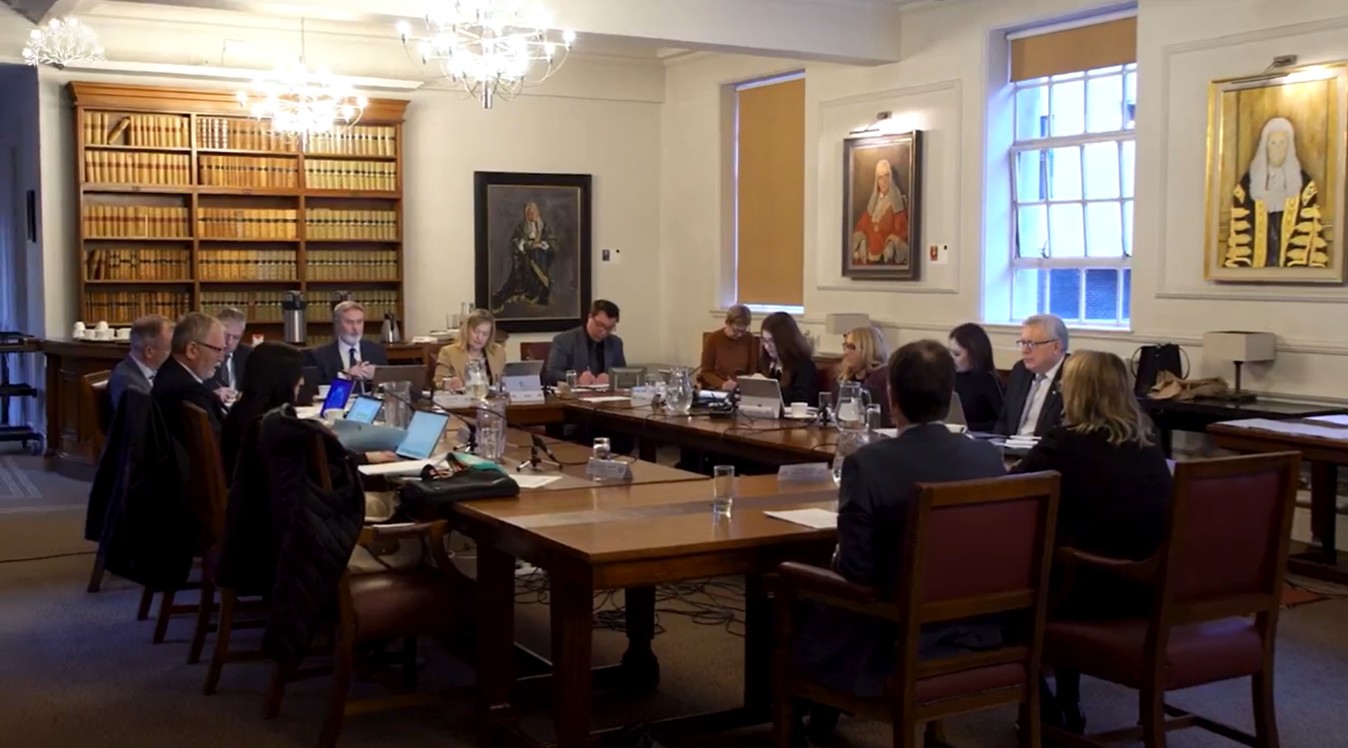
The Committee meeting with the Lady Chief Justice and the Taxing Master in the Inn of Court, Royal Courts of Justice, 22 January 2026
Likely key priorities for the next session
56. Primary legislation is again likely to dominate the Committee’s workload in the next session, as it completes its work on the Sentencing Bill and the Victims and Witnesses of Crime Bill. In the limited capacity remaining, other likely priorities will be:
- Enabling Access to Justice
- Legal Aid – Reform; and Remuneration
- Family Court issues – including the work of the cross-departmental Family Court Task and Finish Working Group established by CVOCNI to look at more focussed, trauma informed family court procedures
- Scrutiny of budget and financial pressures
- Delegated legislation:
- Proposal to amend Schedule 3 of the Justice Act 2011 to update references to football bodies, championships and leagues
- Police Officer Misconduct and Vetting Procedures
- Potential Legislative Consent Motions:
- Armed Forces Bill
- Financial Services and Markets Bill
- Police Reform Bill
ANNEX A
Committee for Justice
Expenditure for the period 1 September 2025 – 31 August 2026
|
Budget area |
Details |
Expenditure |
|
Committee Travel - committee members and staff travel and subsistence in relation to visits and meetings outside Parliament Buildings |
Travel expenses for an external Committee meeting at the Inn of Court |
£21.07 |
|
Advertising – the cost of public notices relating to committee inquiries, the committee stage of Bills and meetings held outside Parliament Buildings |
Advertising the call for evidence for the:
|
£1711.68 |
|
Refreshments & Hospitality |
Refreshments for Committee meetings |
£864.32 |
|
Total Expenditure |
£2597.07 |
|
Notes:
1. It is not necessary to break down costs for individual visits, reports etc. These should be described under “details”, with only totals included in the “expenditure” column.
2. It is not necessary to include budget areas on which there has been no expenditure.
3. Committees may want to draw attention to any significant expenditure which has occurred and provide some background information, e.g. to highlight costs associated with broadcasting external meetings, or stakeholder engagement activities with harder to reach communities.
[1] With effect from 15 September 2025, Mr Paul Frew replaced Ms Joanne Bunting as Chairperson
[2] With effect from 24 November 2025, Miss Emma Sheerin replaced Miss Deirdre Hargey as Deputy Chairperson
[3] With effect from 20 January 2026, Miss Aoife Finnegan replaced Mr Danny Baker.
[4] With effect from 23 September 2025, Mr Brian Kingston replaced Mr Stephen Dunne
[5] With effect from 8 September 2025, Mr Patsy McGlone replaced Mr Justin McNulty


