Committee for Justice
End of Session Report for the period - 3 February 2024 – 31 August 2025
Committee for Justice - End of session report.pdf (772.59 kb)
Contents
Powers
Membership
The Coronavirus Act 2020 (Extension of Provisions Relating to Live Links for Courts and Tribunals) Order (Northern Ireland).
The Damages (Process for Setting Rate of Return) Regulations (Northern Ireland) 2024.
The Electronic Monitoring Requirements (Responsible Officer) (Amendment) Order (Northern Ireland) 2025.
The Police and Criminal Evidence (Northern Ireland) Order 1989 (Codes of Practice) Order 2025.
Post Office (Horizon System) Offences Bill
Arbitration Bill
Border, Security, Asylum and Immigration Bill
Crime and Policing Bill
Mental Health.
Enabling Access to Justice.
Domestic Abuse.
Family Courts.
Other policy issues.
Visits, events and informal meetings.
Visits
Events
Informal meetings.
Likely key priorities for the next session.
Powers and Membership
Powers
The Committee for Justice is a Statutory Departmental Committee established in accordance with paragraphs 8 and 9 of the Belfast Agreement, Section 29 of the Northern Ireland Act 1998 and under Standing Order 48. The Committee has a scrutiny, policy development and consultation role with respect to the Department of Justice and has a role in the initiation of legislation.
The Committee has power to:
- consider and advise on Departmental budgets and annual plans in the context of the overall budget allocation;
- consider relevant secondary legislation and take the Committee stage of primary legislation;
- call for persons and papers;
- initiate inquiries and make reports; and
- consider and advise on any matters brought to the Committee by the Minister of Justice.
Membership
The Committee has nine members including a Chairperson and Deputy Chairperson and a quorum of five.
The membership of the Committee since 3 February 2024 has been as follows:
- Mr Paul Frew MLA, DUP (Chairperson)[1]
- Miss Deirdre Hargey MLA, Sinn Féin (Deputy Chairperson)[2]
- Mr Danny Baker MLA, Sinn Féin[3],[4],[5]
- Mr Doug Beattie MLA, UUP
- Mr Maurice Bradley MLA, DUP
- Mr Brian Kingston MLA, DUP[6],[7]
- Ms Connie Egan MLA, Alliance[8]
- Mrs Ciara Ferguson MLA, Sinn Féin
- Mr Patsy McGlone MLA, SDLP[9]
Overview
- This End of Session Report covers the work of the Committee for Justice from 3 February 2024 to 31 August 2025.
- The Committee considered a range of subordinate legislation, legislative consent motions and policy issues during the session and began its scrutiny of the Justice Bill.
- The Committee met formally on 46 occasions. At 23 of these meetings, the Committee received legal and procedural advice in closed session, many of which related to the Justice Bill. All other business at formal Committee meetings was conducted in public session.
- The Committee also held a number of ad-hoc or informal meetings, held two events, conducted five visits and held a concurrent Committee meeting with the Committee for Health.
Primary legislation
- The Committee was provided with details of a proposed 'mixed content' Bill on 8 March 2024, which would include provisions relating to bail and remand for children; the retention of biometric material; adjustments to Police and Criminal Evidence (PACE) detention review provisions by video link; and a number of administrative amendments.
- The correspondence also set out provisions that the Department proposed to bring forward by way of amendment at Consideration Stage. These related to live links in courts and tribunals; new offences of directing and participating in serious organised crime; court approval of minor settlements; and repeal of vagrancy legislation. Subsequent correspondence from the Department on 22 March outlined amendments in additional policy areas that the Department proposed to make at Consideration Stage, which related to restorative justice; the rehabilitation of offenders; and AccessNI filtering.
- From the outset, the Committee noted its concern about the implications of the proposed approach for effective scrutiny of the Bill and for its ability to advise and assist the Minister. The Committee was of the view that the Bill should contain all the provisions at introduction.
- The Justice Bill was subsequently introduced on 17 September 2024 and was referred to the Committee on 2 October. It included only the four parts as set out in the initial correspondence. In oral evidence to the Committee in advance of the Second Stage debate, the Committee was advised that it had been identified that amendments would be required to the biometrics provisions that had been included in the Bill as introduced.
- The Minister and Departmental officials committed to providing the text of the planned amendments at the earliest opportunity. In order to afford stakeholders the opportunity to consider and engage on the Bill and the planned amendments, the Committee sought a lengthy extension until 27 March 2026, which was approved by the Assembly. The call for evidence was issued on 7 February 2025, having been delayed until the text of all planned amendments was available from the Department.
- Scrutiny of the Justice Bill and the planned amendments has been the Committee's primary focus since January 2025. The Committee received 47 written submissions in response to the call for evidence and, in addition to receiving oral evidence from Departmental officials, has held 18 formal oral evidence sessions to hear from key stakeholders. Informal events were also held with grassroots organisations and with children and young people.
- The Committee has considered 10 papers from the Assembly's Research and Information Service (RaISe), receiving oral briefings from the Research Officer on a number of these papers. The Assembly Legal Services Office has also attended the Committee's meeting on seven occasions to provide advice on the human rights implications of the Bill and the planned amendments.
- The Examiner of Statutory Rules has also provided advice on two separate occasions on the delegated powers in the Bill. Based on the advice, the Committee successfully challenged the Assembly control that the Department proposed for one of the delegated powers, with the Department agreeing to amend it from negative resolution to draft affirmative resolution at Consideration Stage.
- The Committee will continue its scrutiny of the Justice Bill in the next Assembly session.
Secondary Legislation
- During the session, the Committee considered 27 proposals for Statutory Rules and 48 Statutory Rules, a number of which were laid in the previous mandate.
- Secondary legislation scrutinised during this period includes:
The Coronavirus Act 2020 (Extension of Provisions Relating to Live Links for Courts and Tribunals) Order (Northern Ireland)
- The Committee considered three separate Statutory Rules relating to the extension of live links for courts and tribunals during the period covered by this report. They are part of a series of sequential Rules to allow the continuation of court and tribunal hearings by video link, which was first introduced in the Coronavirus Act 2020 during the Covid-19 Pandemic.
- When considering the first of the three proposals, the Committee asked the Department if it considered the continuous use of the powers in the Coronavirus Act 2020 to be proportionate and appropriate in a post-Covid environment. The Department advised it was satisfied that there remained a clear role for the continued use of the provisions, to tackle the backlog of cases that accrued as a result of the pandemic, and confirmed that permanent provision would be made in the first Departmental Bill. The continued use of the powers was therefore an interim measure until the provisions in primary legislation are brought into effect. In view of this, the Committee agreed to support the three proposals to allow for the continued use of live links in courts and tribunals.
- The provisions for live links for courts and tribunals were not included in the Justice Bill which was introduced in September 2024 but the Minister instead proposes to make them by way of amendment to the Bill.
The Damages (Process for Setting Rate of Return) Regulations (Northern Ireland) 2024
- The Committee considered the proposal for the above Regulations at meetings in April and May 2024, which included oral evidence session from Departmental officials and from officials the Government Actuary's Department (GAD), who outlined GAD's advice to the Department on this matter. The Committee agreed to recommend that the Statutory Rule be approved by the Assembly.
- The Committee also wrote to the Department to advise that it supported the principle of 100% compensation. While supporting the Statutory Rule, the Committee highlighted that, during its scrutiny, it had noted that a CPI+ (Consumer Price Inflation) model was the preferred option for many but legislation did not allow for it; officials had advised, however, of a commitment to review the legislation before the next review of the discount rate to determine if more flexibility on inflation could be provided. The Committee also drew attention to the concerns expressed about insurance premiums and about the potential implications for public bodies.
The Electronic Monitoring Requirements (Responsible Officer) (Amendment) Order (Northern Ireland) 2025.
- The Committee considered the proposal for this Statutory Rule to appoint a new provider for electronic tagging at meetings in January and February 2025 and took oral evidence from Departmental officials on 27 February. Members sought clarification on a number of matters, including: monitoring of those who have been tagged; whether the appointed service provider will have a physical presence in Northern Ireland; transition to the new provider; and contract and performance management. Following the evidence session, the Committee agreed it was content with the proposal for the Statutory Rule.
- Tagging location and GPS functionality were also discussed during the evidence session and officials advised that the Department would be keen to introduce this during the lifetime of the contract this Statutory Rule relates to. The Committee is aware that the Department has made a successful bid to the transformation fund relating to electronic monitoring and intends to scrutinise progress on this matter.
The Police and Criminal Evidence (Northern Ireland) Order 1989 (Codes of Practice) Order 2025
- The Committee first considered the proposal to amend the Police and Criminal Evidence Codes of Practice (known as the 'PACE Codes') at its meeting on 27 February 2025 and took oral evidence from the Northern Ireland Human Rights Commission (NIHRC) and Departmental officials on 3 April. The Committee sought follow-up information on gender identity and strip searches from the NIHRC and requested further information from the Department on a number of issues, including the policing of protests, what constitutes 'national security' and the 28-day detention periods in new Code I.
- The Committee took further oral evidence on the PACE codes on 22 May. It was noted that the For Women Scotland Ltd v The Scottish Ministers Supreme Court ruling was issued on 16 April 2025, which required an amendment to the draft Codes initially provided to the Committee. At the end of the session, the Committee sought further information from both the Department and from the Police Service of Northern Ireland (PSNI) on a wide range of issues.
- The Minister of Justice met informally with the Chairperson and Deputy Chairperson to set out options for the way forward on the PACE Codes, which were to wait on the Equality Commission's guidance on the Supreme Court judgement, or to implement an interim Annexes to the PACE Codes to make it clear that, while under review, it is for the Chief Constable to decide if a person should be treated as male or female for the purposes of a search and the dignity of all parties should be respected.
- The Committee subsequently discussed the PACE Codes at four further meetings. At the final meeting before summer recess, it was noted that the Equality Commission intends to seek clarification through the High Court. The DUP Members indicated that their party is not in a position to agree to the current draft codes; Members of the SDLP, Sinn Féin and the UUP indicated their preference to await further information on the Equality Commission's guidance; and the Member from the Alliance party advised her party would be content with the proposal for interim guidance which can be updated when the information is received from the Equality Commission. The Committee has therefore not yet reached a decision on whether it is content with the proposal for the Statutory Rule.
Legislative Consent Motions
- During the period of this report, the Committee considered four legislative consent motions (LCMs) on:
Post Office (Horizon System) Offences Bill
- The Government announced on 22 April 2024 that the Post Office (Horizon System) Offences Bill would be extended to Northern Ireland. The provisions to be extended would quash convictions for certain offences in Northern Ireland alleged to have been committed while the Horizon system was in use and provide for the deletion of cautions given here for such offences. A duty would also be placed on the Department of Justice to identify and notify individuals within the scope of the legislation.
- Having received oral and written evidence from the Department of Justice, the Committee agreed that it was content to support the proposal to extend the provisions to Northern Ireland. The Committee’s report to the Assembly is available at Report on the Legislative Consent Memorandum on the Post Office (Horizon System) Offences Bill
Arbitration Bill
- The Arbitration Bill gave effect to the recommendations of the Law Commission to amend the Arbitration Act 1996 as it applies in England and Wales, and in Northern Ireland, subject to devolved consent. The intent of the Bill was to further the principle of obtaining the fair resolution of disputes by an impartial tribunal without unnecessary delay or expense.
- The Committee sought the views of the Law Society of Northern Ireland and the Bar of Northern Ireland on the proposed legislative consent memorandum on the Arbitration Bill and also provided the written briefing to the Committee for Finance and the Committee for the Economy, as some provisions in the Bill related fell within their Departments' remits. Responses received from the Law Society and from the Federation of Small Businesses (FSB) Northern Ireland were broadly supportive of the legislation.
- The Committee took oral evidence from Departmental officials and received clarification on a number of issues before agreeing that it was content to support the proposal to extend the provisions to Northern Ireland. The Committee's report to the Assembly is available at Report on the Legislative Consent Memorandum on the Arbitration Bill.
Border, Security, Asylum and Immigration Bill
- The Border Security, Asylum and Immigration Bill creates a framework of new and enhanced powers and offences aimed at improving UK border security and the asylum and immigration systems. The Committee took evidence on the proposal to extend certain provisions in the Bill to Northern Ireland, including the sharing of trailer data by the Driver and Vehicle Licencing Agency, articles for use in serious crime and breaches of Interim Serious Crime Prevention Orders in non-terrorism cases. The Committee was content to support the Minister in seeking consent to extend the relevant provisions to Northern Ireland. A short report on the Committee's consideration of the LCM is available at Committee for Justice Reports.
Crime and Policing Bill
- The Committee also agreed to support an LCM in relation to a range of provisions in the Crime and Policing Bill. These included: offences relating to cuckooing (where criminals take control over the home of another person to use it for criminal activity), the possession of advice or guidance about creating child sex abuse images, spiking, and the use of electronic devices in vehicle theft; strengthening the notification requirements for the management of registered sex offenders (RSO); the implementation of international law enforcement sharing agreements; and matters relating to the Proceeds of Crime Act (POCA) 2002.
- The Committee received oral evidence from the Department of Justice and sought clarification on a number of issues relating to these matters and from the PSNI in relation to the notification requirements for RSOs before agreeing it was content for the provisions to be extended to Northern Ireland. The Committee's report on its consideration of the LCM is available at Report on the Legislative Consent Memorandum on the Crime and Policing Bill.
- The Committee was also advised by the Department that a second LCM in relation to a number of amendments that will be made to the Crime and Policing Bill during its passage through Westminster is likely to be required in the next Assembly session.
Budget Scrutiny
- The Committee held six oral evidence sessions on budgetary matters, including the 2024-25 and 2025-26 budgets, the in-year monitoring process, transformation funding and general financial updates from the Department. The Department's budget and financial position were also discussed during other evidence sessions with the Minister and the Permanent Secretary.
- In its response to the 2024-25 budget, the Committee noted its deep concern at real-terms cuts to the Department's budget and that, as the majority of spend is demand led, the Department had limited scope to make additional savings. It was also noted that the criminal justice system is increasingly no longer a place of last resort, which places further burdens on the challenging budget position.
- The Committee sought the views of the Department's non-departmental public bodies to inform its consideration of the 2025-26 budget. In those responses, and from evidence received on other policy matters, the Committee was repeatedly advised of the need for greater investment across the justice sector and that, while the proposed uplift to the Department's budget was welcome, the position was still challenging. The need for more collaborative working on key issues with partners and organisations outside the justice system was also frequently raised and the Committee has highlighted the need for a joined-up, cross-departmental approach to health and social care in particular that could prevent individuals from entering the justice system or provide better outcomes for those that do.
- A number of significant projects are underway across various parts of the justice system, which the Committee believes have the potential to modernise and transform services across various parts of the justice system. Significant investment will be required to achieve their aims and objectives but they should, in the longer term, achieve efficiencies and provide better services for all stakeholders. Members visited the Northern Ireland Courts and Tribunals Service (NICTS), where they received an update on the IT replacement project known as THEMIS and a demonstration on the use of Sight Link, which underpins the use of live links. Members also visited the Royal Courts of Justice (RCJ) and Belfast Old Town Hall and heard about the plans to modernise the RCJ and NICTS estates.
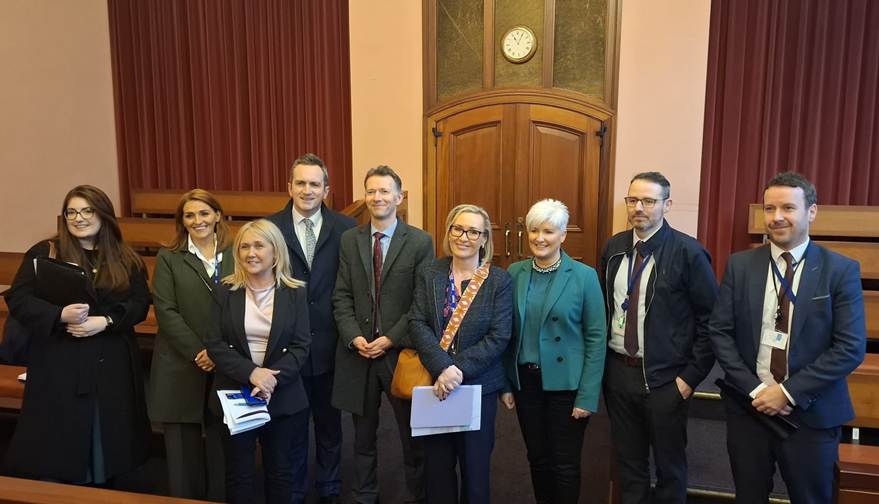
Members of the Committee for Justice with staff from the NICTS and RCJ in Belfast Old Town Hall
Policy Scrutiny
- The Committee has considered a wide range of policy matters and Departmental consultations during the Assembly session. Some of the key policy areas considered include:
Mental Health
- Mental health in the justice system was identified as a key priority for the Committee when planning for the Assembly session. Many individuals in contact with the justice system are repeat offenders who often experience poor mental health, presenting significant challenges across the justice sector.
- The Committee commissioned two Research papers to inform its consideration of this issue - the first presented an overview of the key issues and impacts associated with mental ill-health and the criminal justice system and the second related to mental health courts. Oral evidence was received from the Youth Justice Agency and from Professor Andrew Forrester of Cardiff University. The Committee also heard from the Executive Programme of Paramilitarism and Organised Crime about trauma-informed practice. A concurrent meeting was held with the Committee for Health on 7 November 2024 to take oral evidence from the PSNI on the Right Person, Right Care model and from the Departments of Health and Justice on collaborative working.
- To see the impact of mental health first-hand, the Committee visited Inverary House, which is a hostel providing safe accommodation and support for individuals with mental health problems within a residential setting.
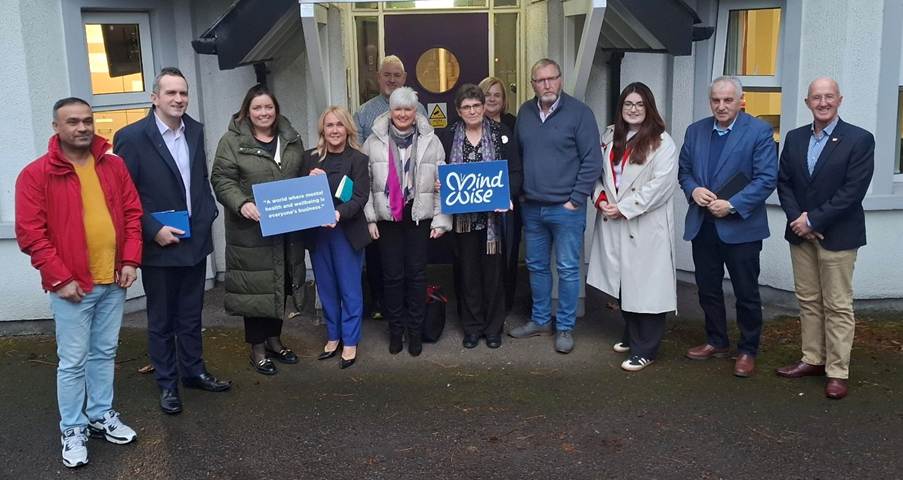
Members of the Justice Committee pictured with staff and residents on the visit to Inverary House
- The Committee has also scrutinised written briefings and updates, in particular the progress report on the Improving Health Within the Criminal Justice Strategy and Action Plan. The Committee raised a number of concerns about progress and cross-departmental working and requested further information and clarification from the Department of Justice, the Department of Health and the PSNI on various matters. The Committee's engagement with those Departments and the PSNI on these important matters remains ongoing.
Enabling Access to Justice
- The Committee has taken a keen interest in the Enabling Access to Justice (EAJ) Programme, which has five key themes: improve access to justice; ensure appropriate quality services; ensure value; manage public funds; and oversight. The Committee took oral evidence from Departmental officials on two occasions, the second of which included the Burgess Review of Criminal Legal Aid, and heard from the Law Society of Northern Ireland and the Bar of Northern Ireland. The Committee also took the opportunity to discuss aspects of the Programme during an oral briefing from the Minister of Justice.
- A key issue was legal aid remuneration, which had not been reviewed for some time and which took on added significance as the Criminal Bar Association (CBA) announced in October 2024 that a series of industrial action measures, including strike action, would begin in November 2024 in protest over legal aid funding rates. In noting the CBA voted in January 2025 to extend the action over what it described as the Department's "failure to engage meaningfully", the Committee sought information and assurances from the Department that it was making every effort to fully engage with the Bar, the Law Society and/or solicitors firms on these issues generally and, in particular, to avoid further industrial action.
- The Committee considered the draft consultation on the proposed interim uplift to legal aid fees in January and sought assurances that the uplift would be in place by June 2025. The report on the outcome of the consultation was considered on 8 May and, on the same date, the Committee approved the proposals for the necessary subordinate legislation to implement the uplift. However, those Statutory Rules were not laid by the end of the Assembly session. The Committee will pursue this matter in the next session and will continue with its wider scrutiny of the EAJ Reform Programme.
Domestic Abuse
- Domestic abuse matters have been of key importance to the Committee during the session. The Committee has considered several written briefings, updates and items of correspondence from the Department. The Committee took oral evidence on the Domestic and Sexual Abuse Strategy and commenced its post-legislative scrutiny of the Domestic Abuse and Civil Proceedings Act (Northern Ireland) 2021. Domestic abuse was also discussed with the Minister of Justice when she appeared before the Committee.
- The Committee received correspondence in December 2024 raising concerns at the lack of a serious case review in respect of the murder of Katie Simpson by Jonathan Creswell. In noting that the Minister of Justice had advised that of her commitment to a bespoke review of the case, the Committee requested clarification on the status of the review along with information on who would conduct the review and details of their background and expertise in safeguarding, and considered the Terms of Reference. The Committee also sought assurances that the experience of other vulnerable people or young people that Mr Creswell may have interactive with would be considered as this could identify if there were further opportunities to identify risks at an earlier stage.
- Given that the victim also had involvement with the Health Service, the Committee considered it essential that the review extended beyond the Department of Justice. In response to a request from the Committee, the Minister of Health advised that a representative from a Health Trust would participate and his Department would contribute to the review as and when appropriate. The Department of Justice also confirmed that the review was broad in nature, and other agencies may be invited to participate at the discretion of the Independent Reviewer.
- The Terms of Reference indicated that the review is expected to be completed within a six-month period. The Committee will therefore return to this issue in the next Assembly session.
Family Courts
- The Committee received correspondence from several individuals raising concerns about matters relating to family courts and/or domestic abuse. While the correspondence involved individual complaints, similar themes were raised which pointed to wider systemic issues that were of interest and concern to the Committee. Members therefore held separate informal meetings with the Minister of Justice and with the Lady Chief Justice and judicial colleagues to discuss these issues. Given the role of others, such as social workers, in the family courts system, the Committee has suggested holding a concurrent meeting in the next Assembly with the Committee for Health to discuss these matters.
Other policy issues
- Other key policy and performance areas scrutinised by the Committee included:
-
- Implementation of recommendations in the Gillen Review of Serious Sexual Offences
- The work of Criminal Justice Inspection Northern Ireland (CJINI) - in particular, the report on Transforming the Criminal Justice System in Northern Ireland
- Northern Ireland Civil Service (NICS) sickness absence policy as applied to prison service staff
- Review of the Northern Ireland Policing Board
- Injury on Duty
- Draft Programme for Government 2024-27
- Victims and witnesses of crime
Visits, events and informal meetings
Visits
- The Committee conducted five visits during the session to support its policy scrutiny. In addition to the visits to the NICTS and Inverary House detailed above, this included:
-
- Two visits to Maghaberry Prison, where Members learned about support services available to those with mental health issues and had the opportunity to discuss rehabilitation, healthcare, funding and prison capacity.
- A visit to the Remote Evidence Centre, which has live link facilities for use by vulnerable victims and witnesses, including children, in serious sexual offence cases.
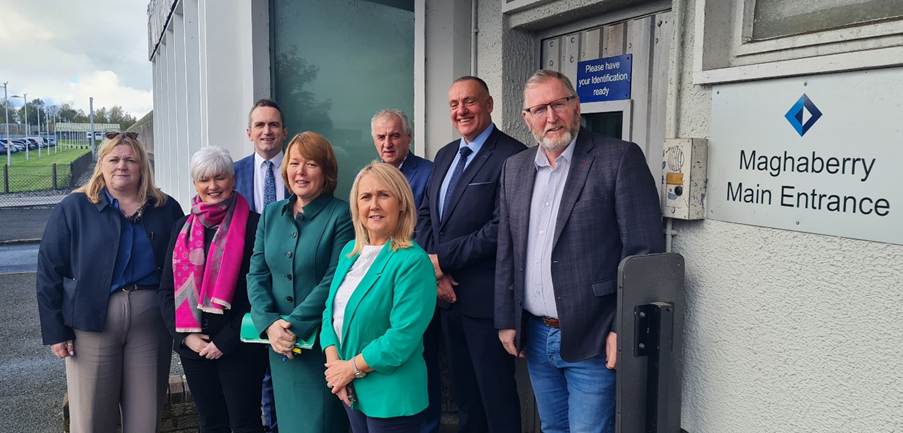
Justice Committee members pictured on visit to Maghaberry prison on 17 October 2025 - (left to right) Tracey Megrath - Governor of Maghaberry, Joanne Bunting, Stephen Dunne, Beverley Wall - Director General of Northern Ireland Prison Service, Ciara Ferguson, Maurice Bradley, David Kennedy - Director of Prisons, Doug Beattie
Events
- The Committee held two roundtable events during the session, both of which related to the Justice Bill. The first was an event with grassroots organisations to enable the Committee to hear the views of those working directly with communities about how the provisions of the Bill might impact on their work.
- The second event was with children and young people. While the Bill includes provisions directly related to children, there are other provisions such as biometrics, that will also impact on them. Planning for the event was assisted by Voice of Young People in Care (VOYPIC) and Include Youth and the discussions were facilitated by representatives from a number of support organisations.
Informal meetings
- Committee Members, or the Chairperson and Deputy Chairperson on behalf of the Committee, have held a number of informal meetings with key stakeholders over the session, including:
-
- Northern Ireland Policing Board
- Lady Chief Justice
- Criminal Justice Inspection Northern Ireland
- United Kingdom Supreme Court
- Minister of Justice
- Association of British Insurers (joint informal meeting with the Committee for the Economy)
Likely key priorities for the next session
- The Committee's key priorities for the next session are likely to include:
-
- Justice Bill - Committee Stage
- Sentencing Bill - expected to be introduced before the end of 2025
- Victims and Witnesses Bill - expected to be introduced before the end of the session
- Mental health in the justice system
- Domestic abuse
- Family Courts
- Enabling Access to Justice
- CJINI report - Transforming the Criminal Justice System in Northern Ireland
- PACE Codes
ANNEX A
Committee for Justice Expenditure for the period 3 February 2024 - 31 August 2025
|
Budget area |
Details |
Expenditure |
|
Advertising - the cost of public notices relating to committee inquiries, the committee stage of Bills and meetings held outside Parliament Buildings |
Justice Bill advertising |
£ 855.83 |
|
Refreshments & Hospitality |
Committee meetings Informal meetings and lunches Refreshments for strategic planning day at the Stormont Hotel Refreshments for grassroots and young people events in Parliament Buildings |
£ 2,527.78 |
|
General expenses |
Room hire for strategic planning day at the Stormont Hotel |
£ 291.67 |
|
Total Expenditure |
£ 3,675.28 |
|
[1] With effect from 15 September 2025, Mr Paul Frew replaced Ms Joanne Bunting as Chairperson
[2] With effect from 28 May 2024, Miss Deirdre Hargey replaced Mrs Sinéad Ennis as Deputy Chairperson
[3] With effect from 15 May 2024, Mrs Sinéad Ennis replaced Miss Deirdre Hargey as Deputy Chairperson
[4] With effect from 2 December 2024, Miss Jemma Dolan replaced Mrs Sinéad Ennis
[5] With effect from 10 January 2025, Mr Danny Baker replaced Miss Jemma Dolan
[6] With effect from 16 September 2024, Mr Stephen Dunne replaced Mr Alex Easton
[7] With effect from 23 September 2025, Mr Brian Kingston replaced Mr Stephen Dunne
[8] With effect from 11 November 2024, Ms Connie Egan replaced Mr Stewart Dickson
[9] With effect from 8 September 2025, Mr Patsy McGlone replaced Mr Justin McNulty


