Committee for the Economy
Report on the Committee Stage of the RHI (Closure of Non-Domestic Scheme) Bill
20260226 Committee Stage Report RHI Closure of Non Domestic Scheme Bill.pdf (654.23 kb)
This report is the property of the Committee for the Economy.
Ordered by the Committee for the Economy to be published on 25 February 2026
Report: NIA 148/22-27 Committee for the Economy
Powers and Membership
Powers
1. The Committee for the Economy is a Statutory Departmental Committee established in accordance with paragraphs 8 and 9 of Strand One of the Belfast Agreement and under Assembly Standing Order No 48. The Committee has a scrutiny, policy development and consultation role with respect to the Department for the Economy and has a role in the initiation of legislation.
2. The Committee has power to:
- consider and advise on Departmental budgets and Annual Plans in the context of the overall budget allocation;
- approve relevant secondary legislation and take the Committee Stage of relevant primary legislation;
- call for persons and papers;
- initiate enquiries and make reports; and
- consider and advise on matters brought to the Committee by the Minister for the Economy.
Membership
3. The Committee has nine Members, including a Chairperson and Deputy Chairperson, and a quorum of five Members. The membership of the Committee is as follows:
Mr Phillip Brett MLA (Chairperson)
Ms Diane Forsythe MLA[7] (Deputy Chairperson)
Ms Diana Armstrong MLA[1][2][3]
Mr Jonathan Buckley MLA
Mr Pádraig Delargy MLA
Ms Jemma Dolan MLA[4][5]
Mr David Honeyford MLA
Ms Sinéad McLaughlin MLA
Ms Kate Nicholl MLA[6]
[1]On 17 June 2024 Mr Doug Beattie MC replaced Mr Mike Nesbitt
[2] On 9 September 2024 Mr Colin Crawford replaced Mr Doug Beattie MC
[3] On 7 October 2024 Ms Diana Armstrong replaced Mr Colin Crawford
[4] On 10 February 2025 Ms Emma Sheerin replaced Mr Philip McGuigan
[5] On 24 November 2025 Ms Jemma Dolan replaced Ms Emma Sheerin
[6] On 9 September 2024 Ms Kate Nicholl replaced Ms Sorcha Eastwood MP
[7] On 24 February 2026 Ms Diane Forsythe replaced Mr Gary Middleton
Executive Summary
4. The Committee for the Economy undertook the Committee Stage of the RHI (Closure of Non-Domestic Scheme) Bill.
5. The Committee noted that the Bill included only 1 active clause which set out fairly high-level regulation-making powers and that consequently the Bill included no detail on key RHI Non-Domestic Scheme closure issues including: the closure tariffs, the use of historic RHI data and the banding arrangements. Members felt that even where they might be dissatisfied with the closure arrangements, it would likely not be practicable to make useful amendments to the Bill in those regards.
6. The Committee noted that Members could, as appropriate, seek to make use of recently revised Assembly delegated legislation processes in order to highlight the need for possible revisions to the anticipated RHI closure regulations, as required.
7. The Committee noted that the Bill was designed to address the findings of the RHI Inquiry in respect of the application of reasonable controls on RHI payments and on the nature of the Scheme and that the use of historic data and banding arrangements would likely: limit the costs of the Scheme; comply with State Aid and Treasury requirements; and greatly limit the likelihood of an additional charge against the Northern Ireland block.
8. Although not included in the Bill, the Committee felt that the tariffs were apparently calculated on a rational basis and did not appear to generate either unreasonably high or unreasonably low returns for boiler owners and thus met the requirements of the court. The Bill provided the Department with the power to make regulations which could allow for all necessary corrective changes and which could clawback payments or suspend the Scheme, should this be required. These regulation-making powers would be subject to the Assembly’s approval.
9. The Committee concluded that the overall intent of the Bill was to provide for controls in respect of RHI payments which were proportionate and struck a fair balance between the general public interest of the community and the private interests of persons who have accredited RHI installations.
Background
10. The Non-Domestic Renewable Heat Incentive (RHI) Scheme was launched in 2012 with the aim of increasing the uptake of renewable heating technologies and contributing to a reduction of carbon emissions in businesses by subsidising the difference in cost between more expensive renewable heating systems and lower cost, less environmentally friendly fossil fuels. In 2015, further regulations were passed which introduced cost control measures for small and medium biomass installations.
11. On 1 July 2016, the Northern Ireland Audit Office (NIAO) published a report dealing with the then Department of Enterprise, Trade and Investment (DETI) Resource Accounts for the financial year 2015-16. That report also considered the development and performance of the Northern Ireland Non-Domestic Renewable Heat Incentive (RHI) Scheme. It was estimated that owing to errors in the establishment of the Non-Domestic RHI Scheme and the setting of tariff payments for heat generation, it would produce a deficit in the finances of the Northern Ireland Executive over the subsequent five years of around £140m.
12. Further to the above, DETI suspended the Scheme for new applicants from February 2016. An inquiry into the Non-Domestic RHI Scheme was launched in January 2017.
13. On 1 April 2017, the successor Department – the Department for the Economy - introduced some changes to the scheme affecting installations in Northern Ireland accredited before 18 November 2015. These changes introduced tiering and capping for small and medium biomass installations where payments were capped at the 1,314 hour threshold and the tariff payable was reduced. These changes significantly reduced the cost of the Non-Domestic RHI Scheme. It appears that tariffs were then subject to small indexation adjustments annually.
14. In October 2019, the Department sought applicants for a voluntary buy-out for users of the scheme. This process was halted in March 2020.
15. The inquiry into the Non-Domestic RHI Scheme reported its findings in March 2020. The findings were wide-ranging and dealt with governance issues in the Northern Ireland Civil Service. In respect of the Scheme itself, the inquiry found:
Finding 203: “The failure to include effective budget control and/or appropriate powers to suspend the scheme in the 2015 Amended Regulations…. meant that DETI was not only particularly exposed to a further spike, but also to the ongoing lack of control in the scheme and to any decrease in the funding to be made available by HMT resulting from DECC’s revised forecasts, over which DETI had no control.”
Finding 288: “While not preventing the carrying out of a review, the failure to incorporate a specific power to review the NI RHI scheme in the NI RHI regulations, even if this was absent from the original GB RHI regulations, was an unfortunate omission on the part of DETI considering that it had knowingly introduced NI-specific tariffs, had received multiple warnings about the uncertainty of assumptions and modelling, and had knowledge of the market volatility of fuel prices.”
Finding 293/4: “Despite the warning from Ofgem in June 2012, none of the successive budget control amendments to the GB RHI regulations were adopted in Northern Ireland, so the NI RHI scheme operated without the type of protective mechanisms GB had put in place to keep control of its budget. A grant-based scheme would have included an inherent and immediate mechanism to suspend spending, namely the power to stop making grants. No such equivalent mechanism to suspend payments to individuals was part of the incentive-based NI RHI scheme. Thus the need to have budget control mechanisms designed and implemented at the scheme level was all the more pressing”
16. It is understood that as part of the New Decade, New Approach agreement in 2020, closure of the Non-Domestic RHI Scheme was endorsed. In 2021, a consultation was undertaken on the closure of the Scheme and the provision of compensation.
17. In 2020-21 the Non-Domestic RHI Scheme reported an underspend of £26m, which was to be returned to HM Treasury – it seems the Scheme cost around £5m for that year compared to the AME ring-fenced fund of around £33m pa. This may be compared with the position four years earlier, in 2016-17, when the overspend position for the Scheme was £27m, which was funded by the NI Executive.
18. The Department advised in April 2024 that “a judgment from the Court of Appeal in February 2023 has also placed an onus on Government to arrive urgently at a ‘proper permanent solution’”. Further to this, the Department indicated that changes were to be made to the Non-Domestic RHI Scheme in respect of a revised tariff and that in support of this a related business case had been developed.
19. The Department also wrote to the Economy Committee (on 4 April 2024) advising that Ofgem which administers the RHI Scheme had indicated in November 2023 that it was to discontinue its administration role. Ofgem later clarified that this would be a fairly lengthy process which was to commence in 2025 and conclude in April 2026. (The Department subsequently advised during the Committee Stage that the conclusion of Ofgem’s involvement had been delayed to June 2026.)
20. The Committee was advised that the Department had accrued legal costs of around £90k associated with RHI related court action and that the costs of developing and maintaining an IT and administrative system for RHI (to replace the Ofgem arrangements) would be around £5m.
21. Given the imperative placed on the Executive by the court to amend the tariffs and develop a ‘proper permanent solution’ and the prospect of the discontinuation of Ofgem IT and administrative support, it is understood that the Executive agreed, during summer recess 2024, termination arrangements for the Non-Domestic RHI scheme to be in place in April 2026.
22. The Department then brought forward regulations to more than double the tariff for the Tier 1 support payments made under the Scheme to accredited medium biomass installations. The increases were for heat generated from 1 November 2024. The proposed rule would have fixed the tariffs for these installations for heat generated up to the end of March 2025, and those tariffs would then have been adjusted in line with increases or decreases in the Consumer Price Index to give the tariffs for later financial years.
23. The Department estimated that those revised tariffs would have increased the cost of the Scheme from £5m pa to £15m pa and this was within the £33m pa of ring-fenced AME. The Department indicated that if the Scheme continued to run until its natural conclusion, the revised tariffs would have increased the overall cost of the scheme from £65m to £160m. The Department indicated in submissions to the Committee (received September 2024) that these revised tariffs “are intended to also deliver an internal rate of return of 12% on the additional capital investment.”
24. The revised tariffs would have applied from 1 November 2024 and would not have applied to the period between 2019 and 2024 which appeared to have been the subject of legal dispute. The Assembly subsequently voted down the related regulations on 21 October 2024.
25. The Department then brought forward the RHI (Closure of Non-Domestic Scheme) Bill. The Bill does the following:
- it allows the Department to make regulations to close, partially or completely the Non-Domestic RHI Scheme and/or to prevent anyone else joining the Scheme and/or to restrict or cancel aspects of the Scheme;
- it allows regulations to be made to vary the sums payable by the Department to Scheme participants until the Scheme is completely closed. These sums may be paid as one-offs, periodically or in instalments;
- it allows regulations to be made which may, subject to conditions, take into account a deemed or notional generation of heat based on how non-domestic RHI boilers were used in the past, in order to determine future payments to Scheme participants;
- it requires the regulations to be subject to draft affirmative resolution – meaning that they will have to be debated in and passed by the Assembly in order for them to come into effect; and
- it allows the regulation-making powers to come into effect immediately after Royal Assent.
26. The explanatory and financial memorandum didn’t include a regulatory, financial or rural needs assessment of the Bill. The Department argued that these assessments would be undertaken for the relevant regulations.
27. The Department advised that the regulations would likely follow immediately after the Bill received Royal Assent and not long after 1 April 2026 when Ofgem was to stop administering the Non-Domestic RHI Scheme. The Bill included provision for the regulations to apply retrospectively. The Department launched a consultation on the RHI closure regulations on 29 September 2025. This closed on 24 November 2025.
28. The proposed RHI closure regulations indicated that the Department would:
- make annual payments to Scheme participants based on records of average historic heat usage during the period 2017-2019. These would be obtained from the Energy Heat Output recorded by Ofgem from meter readings for quarterly periods with an end date falling during the period 1 April 2017 to 31 March 2019. The time period appears to have been selected in response to the tariff cut in 2019 which may have led to a distortion/reduction in boiler use by operators.
- no longer require participants to continue to record and submit quarterly meter readings. Thus the current ongoing obligations in respect of metering, placed on participants by the regulations, would no longer apply. However participants would still have to keep some records of boiler use.
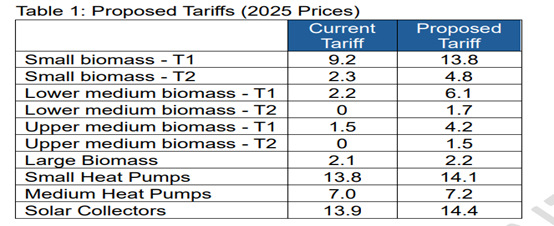
- make payments based on the revised tariffs set out in the table below. Tier 1 applies to the first 1314 hours of historic heat output. Tier 2 applies to any further historic heat output up to a cap of 400,000kWthrs.
- increase tariffs in line with the Consumer Price Index.
- make payments annually in arrears, linked to the date of the installation’s original accreditation, and continuing until 20 years after the original accreditation, provided the installation continues to be utilised in line with the Scheme regulations and guidance. As new applicants to the Scheme stopped in February 2016 – these payments would therefore end in or before 2036.
- require participants to make a declaration in respect of whether the boiler is continuing to be used in its historic mode. If the boiler’s hours of operation were more than 50% of the historic level, then the calculation of payment was to be based on 100% of historic operation at the revised tariffs. If the boiler’s hours of operation were less than 50% of the historic level but more than 5%, then the calculation of payment was to be based on 50% of historic operation at the revised tariffs. If the boiler’s hours of operation were less than 5% of the historic level then the calculation of payment was to be based on 5% of historic operation at the revised tariffs.
The Department subsequently indicated that it was to revise this 3 band model to 4 bands.
29. The Department advised that it is to carry out inspections and request evidence of heat production, e.g. records of eligible fuel purchased. Inspections would check that installations remain in use, declarations are accurate, and participants comply with scheme regulations and guidance. Participants were to be notified in advance if selected for inspection. Non-compliance could lead to suspension of payments, recovery of previous payments, or exclusion from future payments.
30. The Department’s previous on-line statistical information showed that 1864 installations i.e. 88% of Non-Domestic RHI Scheme participants operate lower medium solid biomass boilers. Their tariffs would increase from 2.2p to 6.1p for Tier 1 and from zero to 1.7p for Tier 2. The regulations appear to cover payments for up to the next 10 years i.e. 20 years from accreditation but didn’t appear to address boiler owners’ disputes relating to tariff payments between 2019 and November 2025. The Minister advised that the closure tariffs would cost a maximum of £196m in Capital AME plus £17m in Resource DEL until 2036.
31. The Department introduced regulations to apply interim revised tariffs from December 2025 until the closure regulations would come into effect. The revised tariffs are understood to be identical to the closure tariffs.
Committee Approach
32. The RHI (Closure of Non-Domestic Scheme) Bill was introduced at the Assembly on 6 October 2025. The 2nd Stage was completed and the Committee Stage commenced on 20 October 2025. The Assembly agreed on 1 December 2025 to extend the Committee Stage until 27 February 2026.
33. The Committee launched a call for evidence on 22 October 2025 which closed on 1 December 2025. A small number of responses were received.
34. The Committee took oral evidence on the Bill from Professor Rooney (26 November 2026); and the Renewable Heat Association Northern Ireland and the Ulster Farmers Union (3 December 2025).
35. The Committee considered advice from the Northern Ireland Assembly Examiner of Statutory Rules (10 December 2025) on the regulation-making powers in the Bill.
36. The Committee considered feedback from the Department (14 January 2026) on its consultation on the draft RHI closure regulations.
37. The Committee also considered written information from the Northern Ireland Assembly Legal Services (11 February 2026) on the interaction between the Bill and the European Convention on Human Rights and Article 2(1) of the Windsor Framework.
38. The Committee deliberated informally and undertook informal clause by clause scrutiny of the Bill on 11 February 2026. It undertook formal clause by clause scrutiny of the Bill on 18 February 2026. The Committee considered a draft of its report on the Committee Stage (i.e. this report) at its meeting of 25 February 2026 and ordered that this report should be published.
39. Minutes of Proceedings are at Appendix 1. The Minutes of Evidence are included at Appendix 2. Written submissions are included at Appendix 3. Submissions from the Department are at Appendix 4. Relevant research papers are at Appendix 5. A list of witnesses to the Committee Stage is given at Appendix 6.
Consideration of the Bill
Tariffs
40. The Minister advised on 20 October 2025 during the 2nd Stage of the Bill that in “previous court proceedings…the judge indicated that the (RHI) tariff needed to be amended. We have worked alongside industry experts to develop the proposed tariffs. Those have been modelled and described by departmental officials and Professor David Rooney to ensure that where we are proposing to go with the tariffs is the correct way forward.”
41. Even though the tariffs are not specified in the Bill and in order to better understand the basis for the revised tariff levels and structure, the Committee took evidence from the Department and from Professor Rooney from the Centre for Advanced Sustainable Energy at Queens University Belfast (QUB) in order to compare and contrast his tariff model with that developed by the Department.
42. Taking the 99kW or lower medium Tier 1 revised tariff, the Committee noted that the Department had assumed that 130,175kWhr will be generated pa and that the differences between biomass and oil boilers would be about £7,940 broken down as follows:
- £4.5k in annualised capital costs;
- £820 in annualised operating costs;
- £1541 in annualised fuel costs; and
- £1k for the total barrier cost differential pa.
43. Based on the above, the Committee noted that the Department had determined that a matching annual subsidy of around £7,940 was required. This translated to a tariff of 6.1p per kWh – based on 130,175 kWhr pa. The Department argued that the price of biomass had stabilized at the February 2025 level and this had been used to inform the Department’s assumptions of RHI fuel costs. In respect of oil (or kerosene) costs, the Department used a longer-term average. It is evident that the Department had assumed that biomass will be more expensive than oil (kerosene).
44. The Department advised that the tariffs had been calculated to provide a prospective IRR of 12% “assuming a 20-year fresh start approach, i.e. the rate of return does not take into account periodic support payments previously received to date.” The Committee understood this to mean that previous uncapped higher payments, before changes were made to the RHI scheme, were not included in the calculation of IRR. The Department also advised that it is “not possible to set a single technology/capacity tariff that will deliver the same rate of return to all participants.” and that the tariffs provide the appropriate rate of return only “when measured at a scheme population level.”
45. The Committee noted that Professor Rooney’s model (the Rooney model) differed in that it was described as bottom-up – this was understood as meaning that costs have been estimated based on reported installation usage rather than on spot prices and market average estimates which were used by the Department. The Rooney model was used to calculate a Tier 1 tariff of 7.1p for a lower biomass boiler capped at 15% load factor (and with no Tier 2 tariff) which would generate an internal rate of return of 12% over 20 years.
46. The Committee noted that the Rooney model was informed by data from RHI installations which reported their installation capacity and value of payments made to 28 February 2017. An estimate for the fuel cost differential was made using historic data for LPG rather than oil (kerosene) as used by the Department. This generated a biomass fuel differential benefit of around 0.5p per kWhr in the Rooney model compared to an approximate 1p disbenefit in the Department’s model for lower biomass boilers.
47. The Rooney model also used capital expenditure (CAPEX) costs from the Grant Thornton report. This gave a lower biomass boiler as costing £47,213 including ancillary equipment as opposed to the Department for the Economy capital estimate of £42,171. The Rooney model assumed a 5% operational expenditure (OPEX) for maintenance and hassle costs yields - an operational cost of £2,850 for 2020 was estimated.
48. Professor Rooney argued that if the net benefit tariff was 1.6 p/kWh for 2020 then a 99kW boiler capped at a 15% load factor would result in an income of £2,081 for the year i.e. a cashflow of -£769. The Rooney model showed a typical net cashflow dropping from £6k pa in 2016 (tariffs at 6.7p) to almost zero in 2023 (tariffs at 2.2p).
49. The Rooney model with a Tier 1 tariff of 7.1p for a lower biomass boiler capped at 15% load factor (and with no Tier 2 tariff) estimated overall costs at around £126.5m over the next 10 years compared to DfE estimates of £141.5m based on 1210-1263 active lower biomass boilers.
50. The Committee considered both models and agreed that they provided a rational basis for revised RHI Non-Domestic Scheme tariffs which were likely to provide a reasonable rate of return to boilers owners while not incentivising inappropriate boiler use. The Committee noted that in the event of inappropriate use or excessive returns, the Bill would allow for regulations to be made with the Assembly’s approval, which in turn would provide for suspension or clawback of payments and/or allow for exclusions from the Scheme by the Department.
51. The Committee expressed some confusion in respect of the calculation of the Internal Rate of Return (IRR). The Department had advised that its revised tariffs of 2024 which included a Tier 1 lower biomass payment of 4.9p generated an IRR of 12%. The Department subsequently advised in 2025 that the closure Tier 1 lower biomass payment of 6.1p also generated an IRR of 12% “assuming a 20-year fresh start approach”.
52. The Committee understood that the IRR of 12% was a limit which must be adhered to in order to avoid the categorisation of the RHI payments as State Aid. The Committee therefore noted with interest repeated Departmental assurances that the closure tariffs indeed complied with State Aid rules and that HM Treasury had also advised that it was likely to continue to provide AME funding for the Scheme based on these closure tariffs.
53. The Committee agreed to rely upon these repeated reassurances from the Department that returns paid to boiler owners would not be classed as State Aid and would therefore not be subject to a challenge from Treasury or lead to a potential repayment liability against boiler owners or the Northern Ireland block grant.
Historic Data / Banding
54. The Committee noted that historic metered data (for individual boilers collected by Ofgem from the period 2017-19) along with a declaration from owners in respect of the actual level of boiler use (compared to a number of bands) rather than real-time metered data was to be used in order to determine the level of payouts to Scheme participants. Even though the proposed historic data / banding arrangements are not specified in the Bill and in order to better understand their rationale, the Committee also considered the basis of these proposed arrangements.
55. The Department advised that it was likely to employ a 4-band model rather than 3 as originally planned. It appears that for boilers operating at over two thirds of their historic level, payments will be based on 100% of historic operation at the revised tariffs. Those operating at more than one third will receive payments based on two thirds of historic operation at the revised tariffs. Those operating at less than one third (but over 5%) will receive a payment based on one third of historic operating hours at the revised tariff. Finally, those operating at a de minimis level of less than 5% will receive a payment based on 5% of historic levels at the new tariff.
56. The Department provided the following worked example:
A poultry farmer with a 99kW boiler had 2,190 run hours per year on average between 2017-2019. Their closure payment will be based on their heat use continuing at this level and, at the 100% band, they will be entitled to an annual closure payment of:
- Tier 1 @ 6.1p for the first 1,314 hours = £8,015
- Tier 2 @ 1.7p for the remaining hours = £1,489
- Total: £9,504
However, if the boiler in the poultry house is out of use for part of the year, the farmer is able to declare down to either 1/3 or 2/3 of their average run hours (2,190 x 66.6% = 1,460 hours or 2,190 x 33.3% = 730 hours) and they will be entitled to a closure payment of:
For 2/3
- Tier 1 @ 6.1p for the first 1,314 hours = £8,015
- Tier 2 @ 1.7p for the remaining hours = £246
- Total: £8,261
For 1/3
- Tier 1 @ 6.1p for 730 hours = £4,408
If they use very few run hours but continue to maintain the installation, they will be entitled to the de minimis payment:
- Tier 1 @ 6.1p for 5% of 8,760 = 438 hours = £2,671
57. The Committee understood that participants would be able to move from 1 band to another in different years. The Committee also understood that the Department may permit a limited number of participants to use the 2018 historic metering period and would also allow for an appeals process for participants in respect of payments. The Committee noted repeated assurances from the Department that in respect of the use of the 2018 data and the appeal process, these would be available in only a limited number of circumstances and would have a minimal impact on the overall cost of the Scheme.
58. Professor Rooney indicated that his model and the Department’s diverged over the closure period due to the fuel cost differentials used. As the Department’s model assumed a negative cost to the fuel, lowering consumption results in less expenditure and hence closure payments drop as fuel usage decreases. However, the Rooney model assumed a positive fuel differential cashflow and hence if consumption drops income drops and closure payments would need to increase to retain the IRR. Thus officials argued that the use of historic data and banding arrangements would limit the uncertainty and keep the costs of the Scheme for the Department and the returns from the Scheme for boiler owners, steady.
59. Although UFU and RHANI welcomed the historic data / banding proposals, they indicated that real-time metering information could readily be provided and were keen to do so. The Department countered however that meters were in many cases no longer in calibration and the provision of obligatory metering information would be difficult in the absence of Ofgem administrative support and would therefore increase the non-heat generating costs of the Scheme.
60. The Committee expressed some concern at the use of historic data as opposed to real-time metering information in order to calculate Scheme payments. The Committee understood that this would provide a level of certainty in respect of the heat generating costs of the Scheme and would limit administrative costs. Nonetheless the Committee agreed to seek an assurance from the Department that guidance to Scheme participants would allow for the use of reliable metering data to be provided (where available) along with usage declarations and evidence of biomass purchase.
61. The Committee also expressed concern at the use of the 4 band model as the basis for RHI payments. Members struggled to understand why a Scheme participant generating at two thirds of their historic level should receive a level of payment as if they were generating at 100% of their historic level. This seemed at odds with purpose of the Scheme which was to encourage renewable heat generation. However Members also recognised that a significant increase in the number of bands would likely require real-time metering in order to establish with accuracy which band boilers were operating in and this would require a replacement for the Ofgem monitoring system with the attendant costs.
62. The Committee recalled that evidence to the Inquiry had referred to limited expertise in the then Department in respect of the management of the 3rd party compliance regime for the then Non-Domestic RHI Scheme. Members noted that Ofgem was to discontinue its support for the Scheme in 2026 and the Department would be obliged to either replicate the Ofgem arrangements including real-time metering or adopt a much simplified historic data approach with a streamlined 3rd party compliance regime. The Committee had received no evidence to suggest that the current Department’s expertise in this regard had improved or was likely to do so. Thus Members felt that the historic data/banding arrangements might well prove to be the most serviceable option going forward given the Department’s limited capacity and previous record in this regard.
63. In any event, Members noted that as the detail on the use of historic data and banding was not specified in the Bill, it would likely not be practicable to make useful amendments to the Bill in this regard. Members noted that they could, as appropriate, seek to make use of recently revised Assembly delegated legislation processes in order to suggest changes to the anticipated RHI closure regulations in respect of these matters.
Compliance Regime
64. The Committee noted that during the RHI inquiry, reference had been made to the reported inappropriate use of the Non-Domestic RHI Scheme and the generation of excessive levels of heat for wasteful purposes. Even though the compliance regime is not specified in the Bill, the Committee recognised the importance of public confidence in the closure arrangements for the Scheme and therefore considered how the closure Scheme’s audit, inspection and compliance regime would operate.
65. As indicated above, the Department advised that as meters were no longer always still in operation in RHI installations and as Ofgem were no longer providing administrative support and in order to provide predictability in respect of costs, payments would be based on historic metering data previously collected by Ofgem. The Department indicated that boiler usage declarations would be made by participants, backed up by record-keeping, inspections and audits. The Department was to develop “a review mechanism to ensure fairness and transparency”.
66. In its evidence UFU supported increased inspection activity including randomised site visits with 24 hours’ notice as well as enhanced annual statements including copies of fuel supply and maintenance records. UFU suggested that in addition to providing metering data, generators could be required to use approved biomass fuel providers. UFU supported information submissions being made using the new DfE portal on the understanding that consultants could make submissions on behalf of generators supported by enhanced DfE guidance on the compliance process.
67. As indicated, the Committee felt that public confidence in the RHI closure arrangements was essential and it therefore sought evidence on the audit, inspection and compliance regimes in other jurisdictions e.g. the Support Scheme for Renewable Heat in the Republic of Ireland. A related Assembly Research paper is appended.
68. The Committee urged the Department to be clear on the robust and pragmatic nature of the compliance regime and to publish relevant statistics in order to reassure the public that the closure Scheme was operating appropriately.
69. As with the historic data and banding arrangements, the Committee noted that the detail of the compliance regime was not specified in the Bill. Also, as above Members noted that it would likely not be practicable to make useful amendments. Members noted that they could, as appropriate, seek to make use of recently revised Assembly delegated legislation processes in order to suggest changes to the anticipated RHI closure regulations in respect of these matters.
Departmental Discretion
70. The Committee noted that the Bill included wide-ranging regulation-making powers some of which were retrospective in nature and including: the ability to make reductions in sums payable; the restriction or cancellation of scheme elements; the clawing back of payments; and the conferring of functions on 3rd parties.
71. UFU/RHANI indicated concern at the wide-ranging and retrospective nature of the regulation-making powers in the Bill. RHANI also called for so-called grandfathering of minimum payment guarantees to allow RHI generators to plan ahead, as the Bill (and regulations) would seem to preclude RHI generators from seeking more generous tariffs at any point in the future. UFU/RHANI suggested amendments to address the above and provide safeguards for RHI generators including some level of controls on banding which would prevent the Department from imposing downgrades. RHANI supported a further backdated payment to be made using unspent AME to cover the period 2019 to 2025.
72. The Department clarified that the regulation-making powers were designed to: address the findings of the RHI Inquiry including the ability to review and suspend payments; allow for retrospective payments to be made covering the transition from the existing Scheme to the closure arrangements; and provide for 3rd party inspection and audit. As indicated above, the Department advised that as any regulations would be subject to the approval of the Assembly, it was most unlikely that unreasonable changes to tariffs or banding would be made.
73. The Department clarified that a further payment for the period 2019-2025 would not be made. The Department argued that the proposed tariffs reflected the Court of Appeal decision and provided a fresh start 12% Internal Rate of Return for Scheme participants which is in line with State Aid restrictions and Treasury expectations. Thus any change including additional payments could simply not be provided.
74. The Department subsequently advised that it was to continue to review the differential between the biomass and oil boiler costs and that it may use regulation-making powers to adjust tariffs accordingly. As above, any such changes would be subject to Assembly approval. The Department also undertook to monitor the impact of the closure tariffs on rural groups and to update impact assessments, as required prior to the introduction of the regulations.
75. Witnesses to the Committee also called for clear processes to allow for change of boiler ownership owing to sale or inheritance and for Scheme membership to continue following the change of location of an RHI boiler. The Department advised that it would bring forward policy in this regard. It was understood that the above would not allow like-for-like replacement of installations but would allow for ongoing maintenance and replacement of parts.
76. The Committee noted that the RHI Inquiry was highly critical of the then Department for failing to provide for a review and suspension mechanism for the Non-Domestic RHI Scheme and for failing to include a mechanism to recover payments. The Committee therefore felt it reasonable that these measures be included in this legislation.
77. The Committee noted clear and repeated Departmental assurances that the relevant delegated legislation would swiftly follow Royal Assent for the Bill, subject to Assembly approval. Thus the period for which retrospective measures might be required, where real-time metering data wasn’t being collected by Ofgem and the closure arrangements based on historic data were not formally in effect, would be limited.
78. The Committee noted repeated Departmental assurances that tariff or banding arrangement would not be subject to unreasonable changes following the passage of the Bill and that in any event any such changes would be subject to Assembly scrutiny, debate and approval.
79. The Committee noted that the Bill indeed allowed for a considerable degree of Departmental discretion in respect of the above. However the Committee noted also that these wide-ranging regulation making powers would be subject to a revised and enhanced scrutiny process at Committee and debate at plenary. Members felt that these enhanced Assembly controls provided for reasonable limits on the Department’s discretion.
Convention Rights
80. The Committee considered information from Assembly Legal Services on the interaction of the Bill with the European Convention on Human Rights. The Committee noted that:
- the Bill was designed to address the findings of the Inquiry in respect of reasonable controls on RHI payments and on the nature of the Scheme;
- the use of historic data and banding arrangements would likely limit the costs of the Scheme to £196m AME plus £17m DEL over the next 10 years and this would comply with State Aid and Treasury requirements, thus limiting the likelihood of an additional charge against the Northern Ireland block;
- the tariffs were apparently calculated on a rational basis and did not appear to generate either unreasonably high or unreasonably low returns for boiler owners and thus met the requirements of the court. Indeed the Committee concluded that in the eventuality of unreasonably high returns being generated, the Bill provided the Department with the power to make regulations which could allow for all necessary corrective measures and to clawback payments as required. These regulation-making powers would be subject to the Assembly’s approval;
- although the use of historic data, the banding arrangements and revised compliance regime would not optimally promote CO2 savings, they were also unlikely to incentivise inappropriate or wasteful use of RHI boilers. Indeed the Committee concluded that in the eventuality of inappropriate use of boilers, the Bill provided the Department with the power to make regulations which could allow for all necessary corrective measures and even to suspend the Scheme as required. These regulation-making powers would be subject to the Assembly’s approval;
- given the costs and the risks for the Department associated with developing an alternative to Ofgem’s expertise in respect of IT and administrative support for the Scheme, the use of historic data, the banding arrangements and revised compliance regime are likely the most serviceable option going forward; and
- the closure arrangements would likely free up unused AME funding from the UK Government to support renewable energy development in Northern Ireland.
81. Further to this, the Committee felt that the intent of the Bill was indeed to provide for controls in respect of RHI payments which were proportionate and struck a fair balance between the general public interest of the community and the private interests of persons who have accredited RHI installations. The Committee consequently felt that the interaction of the Bill with the European Convention on Human Rights was not contentious.
Clause by Clause Scrutiny of the Bill
82. The Committee’s formal clause by clause scrutiny of the RHI (Closure of Non-Domestic Scheme) Bill is set out below.
Clause 1: Power to make regulations
Agreed: The Committee agreed that it was content with Clause 1 as drafted.
Clause 2: Commencement and short title
Agreed: The Committee agreed that it was content with Clause 2 as drafted.
Long title
Agreed: The Committee agreed that it was content with the Long Title of the Bill as drafted.
Appendices
Appendix 1 - Minutes of Proceedings
Appendix 2 - Minutes of Evidence
Appendix 3 - Written Submissions


