Committee for Communities
End of Session Report: 2024 – 2025
Committee for Communities-End of Session Report 2024-2025.pdf (1.12 mb)
This report is the property of the Committee for Communities. Neither the report nor its contents should be disclosed to any person unless such disclosure is authorised by the Committee.
Ordered by the Committee for Communities to be published XX October 2025
Contents
Delivery Against Strategic Priorities
Likely Key Priorities for 2025-26 Session
Remit, Powers and Membership
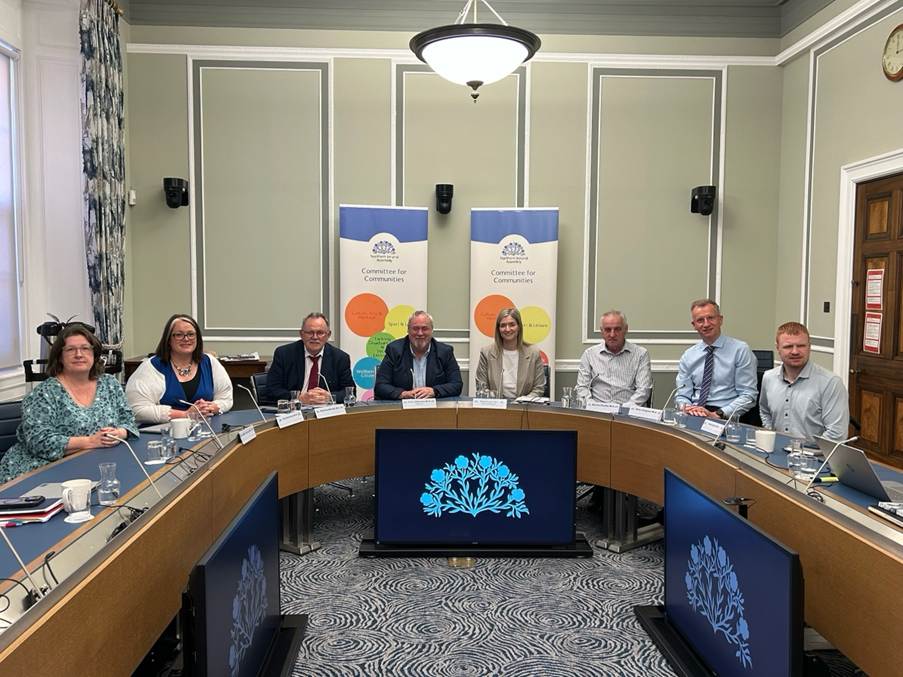
The Committee for Communities meeting in its regular location, Room 29, Parliament Buildings.
Remit
The Committee for Communities' remit is to scrutinise the work of and assist in developing policy for the Department for Communities in Northern Ireland. A key aspect of this role is to review and advise on proposed legislation and policy on the wide range of matters within the Department's portfolio. The Committee is committed to public consultation and actively engages with the public and relevant stakeholders to gather evidence and feedback to inform its work. The Committee's remit covers a broad range of subjects, including:
- Housing: Addressing social housing provision and supply, the revitalisation of the Northern Ireland Housing Executive, tenant rights, homelessness, and regeneration.
- Social Welfare: Overseeing the social security system, including support for vulnerable and disadvantaged groups, welfare reform mitigations, and the delivery of an Anti-Poverty Strategy.
- Arts, Culture, and Heritage: Supporting the arts, culture, museums, libraries, and the creative industries.
- Sport: Scrutinising the delivery of stadia programmes and investment in grassroots sport.
- Communities: Supporting the voluntary and community sector, local government, and social inclusion.
- Languages: Scrutinising strategies for the Irish and Ulster Scots languages, as well as for Sign Language.
Powers
The Committee for Communities is a Statutory Departmental Committee established in accordance with Paragraphs 8 and 9 of Strand One of the Belfast Agreement and under Assembly Standing Order No 48. The Committee has a scrutiny, policy development and consultation role with respect to the Department for Communities and has a role in the initiation of legislation.
The Committee has power to:
- consider and advise on Departmental budgets and Annual Plans in the context of the overall budget allocation;
- approve relevant secondary legislation and take the Committee Stage of relevant primary legislation;
- call for persons and papers;
- initiate enquiries and make reports; and
- consider and advise on matters brought to the Committee by the Minister of Communities.
Membership
The Committee has nine members, including a Chairperson and Deputy Chairperson, and a quorum of five members. The membership of the Committee is as follows:
- Colm Gildernew MLA (Chairperson)
- Nicola Brogan MLA (Deputy Chairperson)1
- Andy Allen MBE MLA
- Kellie Armstrong MLA
- Maurice Bradley MLA
- Brian Kingston MLA
- Sian Mulholland MLA
- Daniel McCrossan MLA
- Maolíosa McHugh MLA
¹ Miss Nicola Brogan replaced Mrs Ciara Ferguson as Deputy Chairperson on 3 February 2025.
Introduction
- This report summarises the work of the Committee for Communities for the Assembly session from February 2024 to July 2025. It was a substantial and productive period, during which the Committee focused its work on a set of agreed key strategic priorities.
- The Committee fulfilled its core functions of scrutiny and policy development across the wide remit of the Department for Communities. A significant legislative workload saw the Committee complete its Committee Stage scrutiny of two Executive Bills and two Legislative Consent Memoranda, as well as commencing detailed scrutiny of the landmark Sign Language Bill.
- Beyond its legislative work, the Committee demonstrated an innovative approach to engagement. It initiated a major inquiry into the challenges facing the Arts and Culture sector, using a "World Café" format to engage directly with stakeholders, which culminated in a published report containing seven key recommendations for the Department. The Committee also engaged with the Youth Assembly to hear directly from young people on proposed changes to pensions legislation.
- Throughout the session, the Committee held 53 formal meetings. To ensure it heard directly from communities and key sectors, three of these meetings were held outside of Parliament Buildings.
- This report details the outputs and outcomes of the Committee's work, demonstrating a strategic and evidence-based approach to holding the Department for Communities to account. Committee expenditure for the period is provided at Annex A.
Delivery Against Strategic Priorities
- Upon its establishment in February 2024, the Committee's first action was to hear evidence from the Department's Permanent Secretary and key stakeholder groups to understand the most pressing issues. This evidence-gathering informed a dedicated strategic planning session in May 2024, where the Committee identified and ranked its key priorities for the mandate. This strategic plan, which was reviewed in October 2024, guided the Committee's work programme throughout the session.
- Key priorities for the session included the Housing Executive Revitalisation Programme, the Independent Review of Welfare Mitigations, the Irish and Ulster Scots Languages strategies, Casement Park and the Sub-Regional Stadia Programme, and the various Social Inclusion Strategies. The work detailed throughout this report was undertaken in line with these agreed objectives.
Meetings and Engagement
- The Committee held 53 formal meetings during the session. While most took place in Parliament Buildings, the Committee held three external meetings to engage directly with stakeholders and sectoral leaders on location.
- Derry/Londonderry (12 December 2024): The Committee met at Clooney Hall to hear from the North West Methodist Mission and First Housing Aid and Support Services. The visit provided direct insight into the challenges of frontline service delivery and the work being done to support people experiencing homelessness in the North West.
- Public Record Office of Northern Ireland (PRONI), Belfast (22 May 2025): The Committee met at PRONI to receive a briefing from the Assembly's Research and Information Service (RaISe) on the parliamentary oversight of the retention and disposal of public records, helping to inform the Committee's own scrutiny in this area.
- Ulster Folk Museum, Cultra (5 June 2025): The Committee met at Cultra Manor to receive a briefing from National Museums NI on its work, outreach programmes, and future plans in a challenging financial climate
- The Committee also held three informal meetings to receive detailed briefings on complex policy issues: the financing of social housing by Housing Associations; an update on the operational complexities of Universal Credit; and an upcoming Legislative Consent Motion on the Westminster Pensions Schemes Bill
- In addition to its meetings, the Committee undertook three significant stakeholder engagement events:
- Deaf Community Engagement Event (27 June 2024): Ahead of the introduction of the Sign Language Bill, the Committee led a major engagement event for members of the Deaf community. This was a collaborative, cross-Assembly initiative, with staff from numerous business areas coming together to ensure the event was accessible and welcoming. The event in the Great Hall and Long Gallery included a session on the legislative process, tours of Parliament Buildings, and engagement with Committee members. The feedback was exceptionally positive, with many attendees visiting Parliament Buildings for the first time and feeling truly included in the political process. The event provided a very valuable pre-legislative scrutiny opportunity, allowing the Committee to hear directly from the community that the upcoming Bill would most affect.
- Youth Assembly Engagement (8 October 2024): The Committee held an online session with members of the Northern Ireland Youth Assembly to discuss the Pensions (Extension of Automatic Enrolment) Bill. The event allowed the Committee to hear directly from the young people most affected by the legislation on key issues such as lowering the enrolment age and the need for better financial education.
- Arts Sector Engagement (13 February 2025): The Committee hosted a major "World Café" style event for the arts and culture sector in the Long Gallery, Parliament Buildings. This event, supplemented by a public call for information, informed a detailed Committee report on the challenges facing the sector.
- The Committee's meetings were held in public session, with occasional sessions held in closed session only where required, for example to receive legal advice on legislation or to consider draft reports. Out of the 53 meetings, 15 contained a period of closed session. The time spent in these sessions ranged from just five minutes to nearly two hours, depending on the agenda item. No meetings were held entirely in closed session.
Primary Legislation
- The Committee undertook a significant primary legislative workload, completing its scrutiny of two Bills and commencing work on a significant third.
Pensions (Extension of Automatic Enrolment) Bill
- The purpose of this Bill was to provide powers to lower the age for automatic enrolment in workplace pensions from 22 to 18 and to remove the lower earnings limit so that contributions are calculated from the first pound earned. The Committee considered the Bill at eight meetings, taking evidence from stakeholders including the Association of British Insurers (ABI), the Chartered Institute of Personnel and Development (CIPD), and the Youth Assembly. A key concern raised in evidence was the potential for employers to recoup increased pension costs from employees' take-home pay and the need for a formal review of the legislation's impact after implementation.
- After the Minister declined to bring forward an amendment for a statutory review, the Committee successfully brought forward its own amendment. This places a statutory duty on the Department to lay a report before the Assembly on the effects of the changes within 36 to 42 months of their commencement. The Committee published its report on the Bill on 7 November 2024.
Child Support Enforcement Bill
- This Bill aimed to improve the child maintenance system by replacing the lengthy court-based liability order process for arrears with a faster, in-house administrative process, reducing the average time from 22 weeks to approximately 6 weeks. The Committee's scrutiny included evidence sessions with Departmental officials and considering research from RaISe.
- The Committee agreed to the Bill as drafted but made several recommendations for its implementation. These included a call for a clear communications strategy, ensuring safeguards for victims of domestic abuse, and a recommendation that the Department review the new system after 12 months of operation and report back to the Committee. The Committee published its report on the Bill on 28 November 2024.
Sign Language Bill
- In February, the Committee began its Committee Stage scrutiny of the landmark Sign Language Bill. The Bill provides for the official recognition of British Sign Language (BSL) and Irish Sign Language (ISL) and places duties on public bodies to promote the languages and provide accessible services.
- Recognising the importance of co-design, the Committee undertook an extensive and innovative consultation process, including public engagement events across Northern Ireland and taking evidence in live-interpreted sessions.
- The Committee has heard detailed evidence from key stakeholders including the British Deaf Association, the National Deaf Children's Society, Action Deaf Youth, and Adapt NI, who raised important issues regarding education, employment rights, and the need for robust consultation mechanisms. The Committee's scrutiny of this Bill is ongoing and will be a key priority for the 2025-26 session.
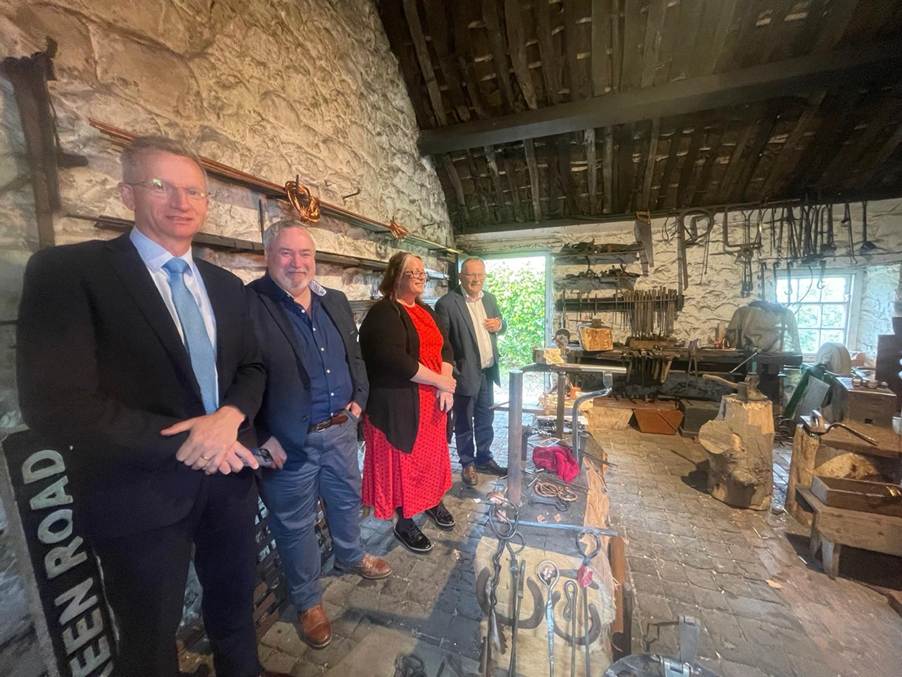
Committee members during their external meeting and visit to the Ulster Folk Museum in June 2025.
Legislative Consent Memoranda
- The Committee considered and reported on two Legislative Consent Memoranda (LCMs), where the Assembly was asked to consent to Westminster legislating on devolved matters.
The Pensions (Special Rules for End of Life) Bill 2024
- This Westminster Private Members' Bill proposed to extend the definition of "terminal illness" for accessing certain pension compensation schemes from a life expectancy of six months to twelve months, aligning pensions legislation with recent changes in social security legislation. The Committee sought evidence from Marie Curie, which welcomed the change. While noting its preference for legislation to originate in the Assembly, the Committee agreed that an LCM was the most pragmatic approach to ensure people in Northern Ireland could benefit from this compassionate change at the same time as those in Great Britain, and supported the motion.
The Employment Rights Bill
- This LCM related to several Northern Ireland provisions in a wide-ranging Westminster Bill, including proposals to enhance Statutory Sick Pay (SSP) by making it payable from the first day of sickness and removing the Lower Earnings Limit for eligibility. The Committee heard evidence from trade unions and the Equality Commission, who raised concerns about the need for local accountability for the new UK-wide Fair Work Agency also established by the Bill. The Committee was reassured that an amendment would protect the Assembly's consent for any future extension of the agency's remit.
- The Committee supported the LCM but expressed its discontent with the very tight timescale for scrutiny and recommended that the Committee on Procedures examines the possibility of extending the deadline for committees to report on an LCM.
Inquiries and Reports
Engagement with the Arts Sector
- In response to significant concerns being raised by an arts and culture sector under immense pressure from standstill funding and rising costs, the Committee undertook a major engagement exercise in February 2025. This involved a public call for information via the Citizen Space platform, which received over 40 responses, and a "World Café" style stakeholder event in Parliament Buildings.
- Following this engagement, the Committee published its 'Report on Engagement with the Arts Sector' on 3 July 2025. The report made seven key recommendations to the Minister for Communities, including:
- To immediately address the funding crisis by implementing a multi-annual funding model of at least three years, with timely funding notifications, to allow organisations to plan strategically instead of operating on a year-by-year survival model.
- To increase the proportion of core funding and conduct an urgent review of per-capita arts investment in Northern Ireland compared to other jurisdictions.
- To develop a new cross-departmental Arts and Culture Strategy and ensure it is embedded within the Programme for Government to provide the necessary political prioritisation.
- To establish a strategy for sustainable creative infrastructure and the implementation of fair pay for arts workers.
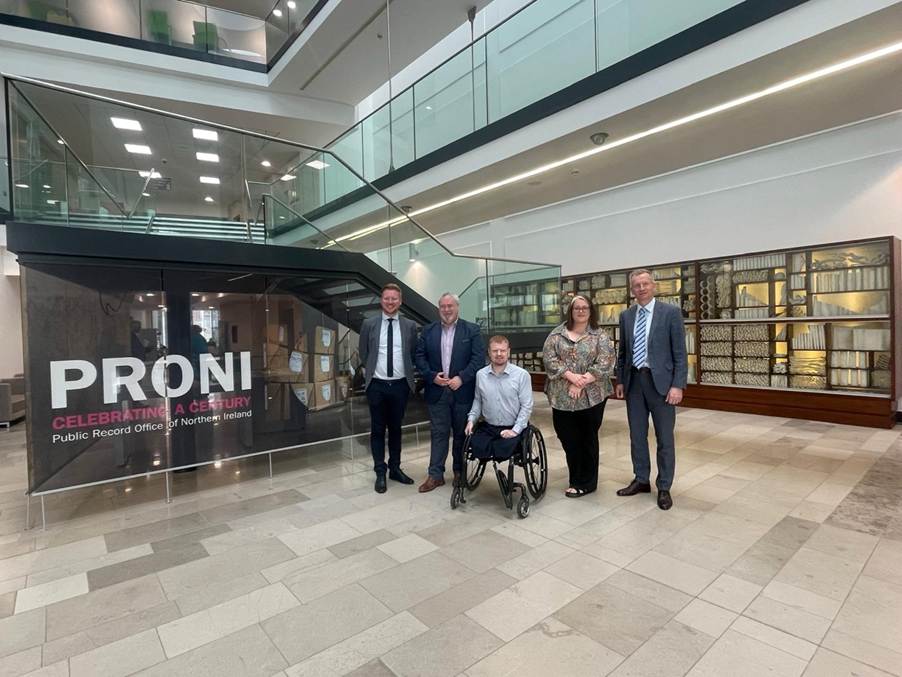
Committee members during their external meeting at the Public Record Office of Northern Ireland (PRONI) in May 2025.
Subordinate Legislation
- The Committee undertook a substantial volume of work on subordinate legislation, considering 38 proposals for Statutory Rules (SL1s) and 35 Statutory Rules (SRs). Given the high volume, this report highlights key themes and examples of detailed scrutiny. The Committee scrutinised rules covering a wide range of policy areas, including the annual up-rating of pensions and benefits, the extension of welfare mitigations, housing, and gambling.
- A key area of concern was the Social Fund Winter Fuel Payment Regulations (NI) 2024, which restricted the payment to those on Pension Credit. The minutes show that the Committee deferred its decision and requested the full Equality Impact Assessment (EQIA) to ensure proper scrutiny. When this was not provided, the Committee expressed its disappointment, feeling it had been left in an "untenable position" but agreeing to the rule to ensure some pensioners would receive support.
- In another example of its scrutiny function, the Committee deferred its decision on The Gaming (Gaming Machines in Registered Clubs) Regulations (NI) 2025 until it received further information from the Department to address its concerns.
Budget and Policy Scrutiny
- The Committee fulfilled its core scrutiny function by examining the Department's budget and its delivery of key policies, informed by its strategic priorities.
Budget Scrutiny
- From its first meeting, the Committee sought clarity on the challenging budget situation facing the Department. It scrutinised spending plans through evidence sessions with the Minister and senior officials on the main 2024-25 and 2025-26 budgets, and in-year monitoring rounds.
- Key lines of inquiry included the adequacy of funding for new social housing, the cost of extending welfare reform mitigations, the impact of departmental staff vacancies on service delivery, and the financial pressures facing the voluntary and community sector.
Policy Scrutiny
- Upon its formation, the Committee immediately began taking evidence on the most pressing issues within the Department's remit, with a particular early focus on the housing crisis and welfare mitigations. Throughout the session, the Committee scrutinised a wide range of policy areas:
- Housing and Homelessness: In line with its top strategic priority, the Committee consistently pressed the Department and the Housing Executive on the need for a revitalised Housing Executive, tackling the social housing waiting list, improving standards in temporary accommodation (including the use of "glamping pods"), and scrutinising the ongoing issue of defective building blocks.
- Welfare Reform: The Committee scrutinised the continued delay in producing an Anti-Poverty Strategy, the extension of welfare mitigations, Carer's Allowance overpayments, and the potential impact of the UK Government's 'Pathways to Work' Green Paper on disability benefits in Northern Ireland.
- Social Inclusion Strategies: The Committee expressed repeated frustration at the lack of progress on the suite of Social Inclusion Strategies (covering disability, gender, and sexual orientation) and the failure of the Department to engage meaningfully with co-design groups who had invested significant time and expertise.
EU Scrutiny
- EU-related matters did not feature heavily in the Committee's work this session. However, the Committee did note the impact of the loss of European funding on the voluntary and community sector and scrutinised its replacement through the UK Shared Prosperity Fund.
- It also considered subordinate legislation, such as the Emergency Fuel Payment Regulations, which contained provisions relating to benefit entitlements for qualifying persons resident in Europe.
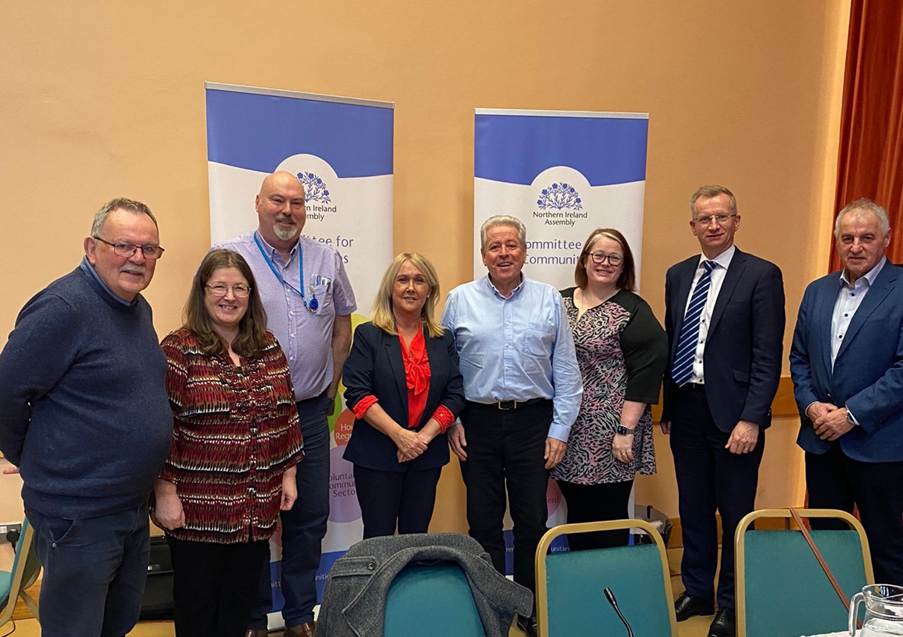
Members at their external meeting at Clooney Hall, Derry-Londonderry, in December 2024, where they heard evidence on homelessness support services.
Likely Key Priorities for 2025-26 Session
- Looking ahead to the next session, the Committee anticipates another very significant workload. Key priorities will include:
- Concluding the Committee Stage of the Sign Language Bill, including the completion of evidence gathering and clause-by-clause scrutiny.
- Managing a heavy legislative workload, with the Department indicating that five Executive Bills are to be introduced. Several Members' Bills are also anticipated.
- Continuing its scrutiny of the Department's delivery against the Committee's ongoing strategic priorities, particularly the revitalisation of the Housing Executive, the implementation of welfare mitigations, and holding the Department and the wider Executive to account for the delivery of the long-delayed Social Inclusion and Anti-Poverty Strategies.
- The Committee will continue to hold the Department to account on the delivery of its language strategies. A particular focus will be placed on ensuring the Department undertakes meaningful and effective engagement with the relevant sectors throughout their development and implementation.
- Following its detailed inquiry and report during the 2024-25 session, the Committee will maintain a strong focus on the needs of the arts sector. A key priority will be to monitor the Department's progress in implementing the report's recommendations and to ensure the momentum from the Committee's engagement is not lost.
- The Committee will prioritise scrutiny of the Department's extensive responsibilities in relation to sport. This will include continued oversight of significant funding issues, such as the Sub-Regional Stadia Programme and the redevelopment of Casement Park, alongside a focus on promoting grassroots sport and ensuring the inclusion of people with disabilities and other underrepresented groups.
- Building on its work on the Sign Language Bill, the Committee will scrutinise how the Department and the wider public sector adapt their consultation processes to be fully inclusive of the d/Deaf community. This will include a focus on the duration of consultation periods to ensure they are long enough to facilitate the necessary interpretation and transcription, thereby removing barriers to participation.
- Underpinning all its work, the Committee will continue to press for timely and effective communication and engagement from the Department. The Committee views this as essential for enabling robust scrutiny and facilitating meaningful engagement with stakeholders across its entire remit.
Annex: Committee Expenditure
Committee for Communities: Expenditure for the period 3 February 2024 - 31 August 2025
|
Budget area |
Details |
Expenditure |
|
Committee Travel - committee members and staff travel and subsistence in relation to visits and meetings outside Parliament Buildings |
Includes the cost of member and staff travel and subsistence for the three meetings held outside Parliament Buildings. These were held at: Clooney Hall, Derry/Londonderry; the Ulster Folk Museum, Cultra; and the Public Record Office of Northern Ireland (PRONI), Belfast. |
£ 466.21 |
|
TV and Sound Recording |
Costs specific to BSL and ISL interpretation for Committee videos in respect of the Sign Language Bill. |
£ 540 |
|
Advertising - the cost of public notices relating to committee inquiries, the committee stage of Bills and meetings held outside Parliament Buildings |
Includes the cost of public notices in relation to:
|
£ 855.83 |
|
Staff Substitution - the cost of specialist ISL and BSL interpreters for live and after-the-fact interpretation. |
Substantial costs for securing the services of ISL and BSL interpreters for sessions related to The Sign Language Bill. |
£ 21,211.92 |
|
Refreshments & Hospitality |
Includes the cost of all refreshments and hospitality provided by the committee; to include meetings, working lunches, seminars and any other such expenditure. |
£ 4,960.01 |
|
General expenses |
Includes outside room hire, photography and equipment hire for a Deaf community event |
£ 1,536 |
|
Total Expenditure
|
£29,569.97 |
|
You may re-use this publication (not including images or logos) free of charge in any format or medium, under the terms of the Open Northern Ireland Assembly Licence. To find out more about this licence visit: http://data.niassembly.gov.uk/license.aspx
This Report can be made available in a range of formats including large print, Braille etc. For more information, please contact:
Committee for Communities
Emer Boyle
Northern Ireland Assembly
Parliament Buildings
Ballymiscaw
Stormont
Belfast BT4 3XX
Telephone: 028 90 521895
Email: Committee.Communities@niassembly.gov.uk
X (formerly Twitter): @NIA_Communities


