Committee for Finance
End of Session Report 2025-2026
Committee for Finance end of session report 2025-2026.pdf (1.05 mb)
Contents
Committee for Finance End of Session Report 2025 - 2026.
Remit, Powers and Membership of the Committee.
Powers.
Membership.
Key Activities, Outputs & Achievements.
Primary Legislation.
Delegated Legislation (Statutory Rules)
Legislative Consent Motions (LCMs)
Inquiries.
Budget Scrutiny.
Policy Scrutiny.
EU Scrutiny.
Engagement – Informal meetings/Visits.
Key priorities for next session.
Appendix 1 – Session facts and figures.
Committee meetings & visits.
Committee Reports.
Committee Inquiries.
Remit, Powers and Membership of the Committee
Powers
The Committee for Finance is a Statutory Departmental Committee established in accordance with paragraphs 8 and 9 of Strand One of the Belfast Agreement and under Assembly Standing Order No 48. The Committee has a scrutiny, policy development, and consultation role with respect to the Department of Finance and has a role in the initiation of legislation. The Committee has power to:
- consider and advise on Departmental budgets and Annual Plans in the context of the overall budget allocation;
- approve relevant secondary legislation and take the Committee Stage of relevant primary legislation;
- call for persons and papers;
- initiate enquiries and make reports; and
- consider and advise on matters brought to the Committee by the Minister of Finance.
Membership
The Committee has nine members, including a Chairperson and Deputy Chairperson, and a quorum of five members. The membership of the Committee is as follows:
Mr Matthew O’Toole (Chairperson)
Ms Diane Forsythe (Deputy Chairperson)
Dr Steve Aiken OBE
Mr Gerry Carroll
Miss Áine Murphy*
Miss Deirdre Hargey
Mr Harry Harvey**
Mr Brian Kingston***
Mr Eóin Tennyson
*Miss Aine Murphy replaced Miss Jemma Dolan with effect from 7 September 2026.
**Mr Harry Harvey replaced Mr Paul Frew with effect from 23 September 2025.
***Mr Brian Kingston replaced Mr Phillip Brett with effect from 23 September 2025.
Key Activities, Outputs & Achievements
Primary Legislation
The Committee completed the Committee Stages for three Bills during this session and began the Committee Stage for a further Bill which was introduced in the latter part of the session.
Deaths, Still-Births and Baby Loss Bill
The Committee completed its scrutiny of this Bill at the start of this session – agreeing its report on 17th September 2025 with the Act receiving Royal Assent on 25th February 2026.
The Deaths, Still-Births and Baby Loss Act amends the law relating to the manner of notification of deaths, still-births and births and the manner of giving particulars relating to them; it also makes provision for the issue of certificates recognising the loss of a baby. The legislation makes permanent arrangements, previously made on a temporary basis in the Coronavirus Act 2020, which enabled the electronic transmission of death and still-birth registration during the pandemic. The Committee considered a number of extensions to the temporary provisions by way of secondary legislation, however, Members continually pressed the Department to make these provisions permanent through necessary primary legislation which, ultimately, the Department did.
Whilst the Bill was in the initial stages of drafting, the Committee also wrote to the Finance Minister indicating its desire for the Bill to include an enabling power to bring forward a Baby Loss Certificate scheme. When the Bill was introduced by the Finance Minister, it included the power for the Department of Finance to introduce a Baby Loss Certificate Scheme, as per the Committee’s request.
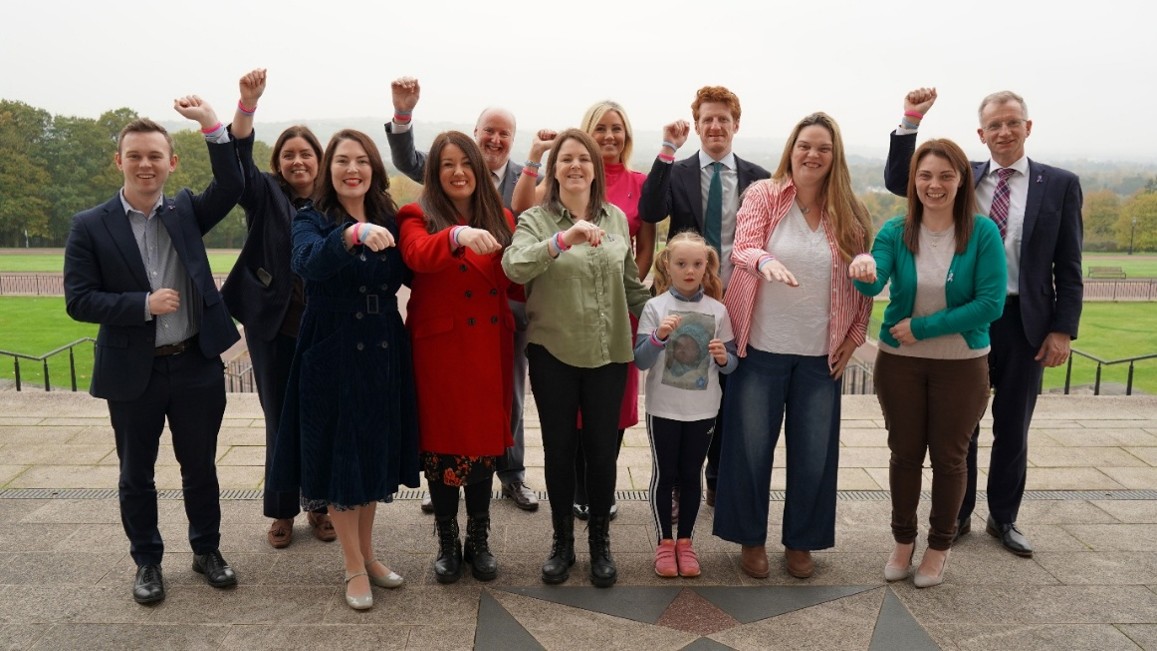
Members of the Committee, alongside the Forget Me Not Group, at an event to mark Baby Loss Awareness Week in October 2025.
Following an extensive Committee Stage, including consideration of written and oral evidence, online survey results and emotive personal testimony, the Committee was satisfied that the legislation was fit for purpose and would indeed offer the necessary level of support for people in the most difficult of circumstances. A notable achievement was the Committee receiving assurances, on numerous occasions, that charges would not be applied for Baby Loss Certificates unless the Assembly approved these through a draft Affirmative Resolution Statutory Rule - the highest level of Assembly control for delegated legislation.
Once Royal Assent was received, the Committee continued to press the Department for a rapid roll-out of the Baby Loss Certificate Scheme. The launch of the Scheme took place on 22nd June 2026 and was attended by three Executive Ministers as well as Members of the Committee, reflecting the spirit of cooperation between the Committee, Minister and Department and providing a concrete example of collaborative working between all parties. The success of the Scheme to date, evidenced by the substantial number of applications in the first few weeks of existence, only cements the value of the Committee’s work further.
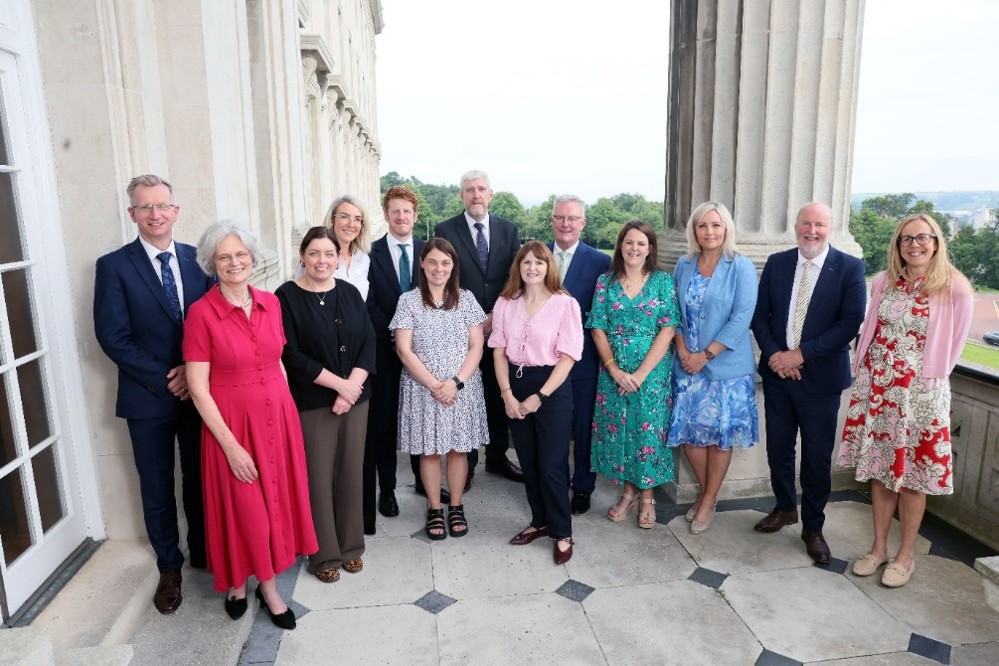
Members of the Committee, alongside Economy, Health and Finance Ministers, as well as stakeholders, at the launch of the Baby Loss Certificate Scheme on 22nd June 2026
Administrative and Financial Provisions Bill
On a semi-regular basis the Department of Finance needs to bring forward a Financial Provisions Bill comprising a number of legislative changes, generally on behalf of other Departments, to reconcile routine financial matters. Although the Committee was first briefed about this Bill in September 2024, there was to be a significant delay before the formal Committee Stage began.
Given the nature of this Bill, which contained provisions relevant to the remit of different departments, the Finance Committee directed other Statutory Committees to scrutinise those parts of the Bill which apply to their Departments. The Finance Committee sought and received assurances from other Committees that they had considered appropriate evidence and were satisfied with the relevant provisions of the Bill. However, in the interests of effective scrutiny, the Finance Committee also agreed to take oral evidence from the Department of Infrastructure and the Executive Office on a number of key policy areas.
As a direct result of the Committee’s work, there are a number of successes worth highlighting including securing the commitment that Regulations made under Clause 17 of the Bill would be done so using the Affirmative Resolution procedure – this would not only increase transparency but lead to further Assembly scrutiny, should the relevant Department decide to utilise the powers under this clause. Another success was obtaining assurances from the Department of Finance in relation to Clause 18 and securing amendments to the Explanatory & Financial Memorandum of the Bill which would ensure that there was appropriate notification to the Committee when an advance from the Consolidated Fund would be authorised. After extensive pressure from the Committee, Clause 20 was removed from the draft Bill as a direct result of engagement between the Department, Assembly Audit Committee and the Finance Committee. This reflected the agreed view of the Committee that suitable support arrangements and wider governance reforms were not in place at this time, before the clause was enacted.
Read the Committee Report on the Bill here.
Northern Ireland Fiscal Council Bill
As with the Administrative and Financial Provisions Bill, the Committee began its formal Call for Evidence in the previous session but scrutiny in earnest took place in this session. The Bill inserts the Fiscal Council into existing administrative and audit frameworks so the Council can function like any other statutory body and sets out the Council's main duties, which will be to independently assess the Executive’s budget and the sustainability of public finances each year. In addition to its Call for Evidence on the Bill and consideration of written and oral briefings, the Committee drew upon the findings of a previous Finance Committee’s Inquiry taking forward a number of themes and recommendations within.
The Committee was particularly keen to ensure that the Bill’s provisions were measured against the OECD principles for independent Fiscal Institutions and that there was adequate comparative evidence, considering evidence provided by both the Scottish and the Irish comparative bodies. The Committee rigorously examined all Clauses of the Bill – securing clarification from the Department as appropriate to ensure that the provisions were robust and the Bill fit for purpose. The Committee secured a number of important amendments to the Explanatory and Financial Memorandum of the Bill, including increasing the reporting arrangements for the Council and ensuring consultation with the Finance Committee before Regulations are made under Clause 5 of the Bill. All these amendments provide vital clarification, ensuring that the Finance Committee is informed and engaged with the work of the Council in the long term.
Read the Committee Report on the Bill here.
Marriage and Civil Partnership Bill
This Bill will see the minimum age for marriage raised to eighteen and will put into law temporary arrangements around non-religious belief marriage, putting these on the same footing as civil and religious marriages. The Committee had already received two briefings on the Bill in the last session, therefore, when the Bill reached Committee Stage on 21 April 2026, the Committee was more than prepared to launch its Call for Evidence and begin scrutiny in earnest in the later part of this session. To date, the Committee has considered a significant amount of written evidence on the Bill, as well as oral evidence from RaISe and the Youth Assembly. At the beginning of the next session, further oral evidence sessions are planned with stakeholders to examine the Bill’s provisions in greater depth and produce a Committee report on the Bill by the end of Committee Stage on 13th November 2026.
Delegated Legislation (Statutory Rules)
The Committee has considered twelve proposed Statutory Rules and twelve laid Statutory Rules. Members also noted 5 Statutory Rules which were not subject to any Assembly Procedure. Given the extensive remit of the Department of Finance, the range of subjects covered by delegated legislation is wide, covering areas such as technical financial accounting, Public Service Pensions, Rating Policy, and Civil Law matters. The Committee works closely with the Examiner of Statutory Rules and Departmental officials to ensure that the legislation is always progressed swiftly and with due diligence.
From January 2026, the Committee has implemented a new process in relation to the scrutiny of proposed statutory rules (SL1 stage). This new process aims to strengthen scrutiny. All statutory Committees now reserve the right to issue a “Call for Views” on each proposed SL1 through the use of a survey on the Citizen Space platform to seek views from the public on the accuracy and completeness of the proposed rules and whether or not there are any unintended consequences associated with them. This new process has minimum time periods built in, designed to give the Committee sufficient opportunity to consider any responses to the survey, and if necessary, time to engage with Departmental officials, before the Committee reaches its final decision on the policy merits of the SL1. To date however, responses to the Committee’s online survey have been limited, providing the Committee with little input.
Legislative Consent Motions (LCMs)
Legislative consent is the process by which the UK Parliament seeks the agreement of the Assembly to legislate on a subject matter which is devolved to the Assembly. Convention requires the agreement of the NI Assembly before the UK Parliament may pass such legislation. During this session, the Committee considered two such LCMs. The first was the Public Office (Accountability) Bill.
The Committee maintained a watching brief on this Bill throughout the session, considering numerous departmental updates and taking evidence from officials in November 2025. At the end of its deliberations, the Committee reached the conclusion that there remained a level of detail outstanding which was required to make a definitive decision on the matter. Therefore, Members agreed to reserve their position on the LCM and a report was published in January 2026, outlining the Committee’s deliberations on the Bill. This very much remains a live issue and the Bill’s progress in Westminster is ongoing. It is expected that further work will be undertaken in the next session.
The second UK Bill on which legislative consent was sought was the Cyber Security and Resilience (Network and Information Systems) Bill. After two oral briefings from Departmental officials and consideration of supplementary information provided by the Department, the Committee agreed that it was content with the proposal to extend provisions in Cyber Security and Resilience (Network and Information Systems) Bill to Northern Ireland by way of a Legislative Consent Motion. A report was subsequently published in June 2026. Reflecting on the Committee’s work in this regard, the Finance Minister welcomed the deliberations on the Bill and expressed his appreciation to all involved. Again, the Committee stands ready to play its role as the LCM progresses in the next session.
Inquiries
During this session, the Committee concluded its Inquiry into the Northern Ireland Banking and Financial Services Landscape Inquiry by producing a report in September 2025. Since that point, the Committee has monitored implementation of its Inquiry recommendations, pressing both the relevant Financial Authorities, Finance Minister, and Banking Sector Representatives to act on the issues identified. A follow-up evidence session with Departmental Officials took place on 29 April 2026 during which the Committee pressed officials for action on vital issues including cross-border banking, financial education, and digital inclusion. Members have committed to continuous engagement with the relevant stakeholders, not only by the Committee itself but also by others in key positions, to ensure that the issues identified in the report are acted upon for the benefit of all in Northern Ireland.
Committee Chairperson pictured with CEO of UK Finance at the launch of the Inquiry Report on 23rd September 2025.
In October 2025, the Committee launched its 2nd Inquiry – this time into the Performance and Culture of the Northern Ireland Civil Service (NICS). This has been prompted by ongoing concerns about the performance and culture of the NICS but focuses primarily on “People”, recognising that a modern, agile, and inclusive civil service is essential for the delivery of high-quality public services. Evidence gathering is currently at an advanced stage, drawing upon the experiences of a wide range of stakeholders including trade union representatives, academics, and the current Head of the Civil Service. This work will continue into the next session, until the end of the current mandate and potentially into the new mandate.
Watch video of the Chairperson and Deputy Chairperson outlining the rationale for the NICS Inquiry.
Budget Scrutiny
The Committee has taken on its role as responsible Committee for both the Department of Finance Budget and wider Executive Budget with its usual efficiency. Leading other Statutory Committees, circulating information and updates when appropriate and directing those other Committees to scrutinise their respective departments’ spending plans. For example, when the Committee receives its regular monthly briefings on the Outturn and Forecast Outturn data from all Executive Departments, they are shared with other Statutory Committees and the Assembly Audit Committee as a matter of course. Pointing those other Committees towards effective scrutiny and follow-up.
For the first time in the current mandate, discussions around a multi-year budget came to fruition with the Finance Minister launching a consultation on a draft Budget for 2026-2029/30 on 6th January 2026. The Committee had previously discussed a multi-year budget with the Minister, supporting his efforts to secure this; noting that with one in place, Departments could plan strategically, particularly around workforce planning, pay awards and long-term transformation. The latter allowing for efficiencies to be found and redirected to front-line public services.
The Committee has continuously supported calls for this, engaging with both the Minister and officials; taking evidence from both on many occasions on budget and budget-related matters such as Level of Need analysis and Fiscal Framework. Each opportunity was used to obtain assurances that every effort is made to ensure that Northern Ireland receives the best possible outcome from existing and potential budgetary resources. The Committee has also been proactive and obtained expert testimony and evidence from relevant stakeholders, taking evidence from NERI, UUEPC, Pivotal and the Fiscal Council. As the coordinating Committee for other Statutory Committees, the Finance Committee has directed others to review the anticipated impact of the 2026-29/30 budget on their respective Departments.
The culmination of its evidence gathering and that of other Committees was a Committee report on the Budget – this report highlighted the lack of Executive agreement and absence of full departmental analysis as well as the starkness of low allocations which would enable meaningful long-term planning. With many departments facing shortfalls in funding and limited discretionary spending, the Committee’s report highlighted a real risk to departmental programmes and frontline services.
The Committee was able to use this report as the foundation for a Plenary Debate on the draft Budget, highlighting the main themes within, allowing every MLA to use it as an evidence base for effective scrutiny. This debate took place on 11th May 2026 and gave all Members the opportunity to contribute. It also gave the Minister the opportunity to respond, assuring the House of his continued engagement with the UK Treasury and reinforcing his commitment to give full and due regard to the Committee’s findings as well as to continued work towards a fairer and more sustainable financial future.
However, despite the Minister’s confidence and officials’ evidence that a multi-year budget could be delivered, there remains stalemate at the time of drafting and agreement of same remains elusive. The Committee continues to press not only the Minister and wider Executive, also the wider UK Government on the matter and has written to the Secretary of State for NI and Chief Secretary to the Treasury on numerous occasions. At a recent hearing of the NI Affairs Committee, the deputy Chair (attending on behalf of the Finance Committee) also questioned the Secretary of State on the matter, urging him to work with the Northern Ireland Executive to find a solution to the current stalemate.
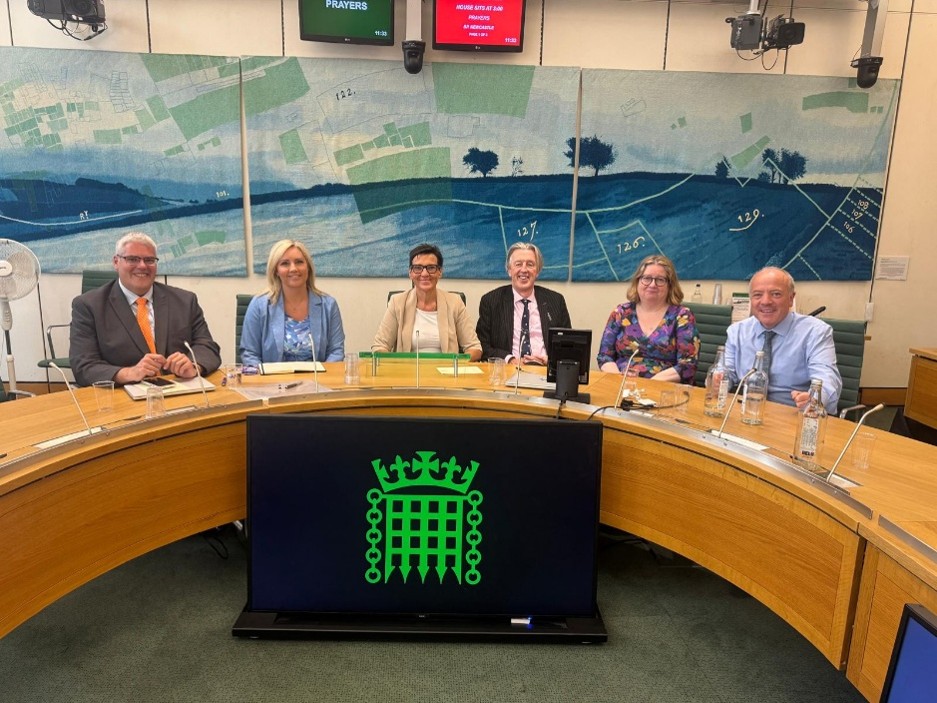
Deputy Chairperson of the Committee, Diane Forsythe pictured with Members of the NI Affairs Committee on 15th July 2026.
Policy Scrutiny
Despite having a heavy legislative workstream and progressing substantial Inquiry-related work, the Committee also kept a comprehensive watching brief on a range of diverse policy matters. In addition to raising numerous and varied written queries following each Committee meeting, the Committee was briefed on the following issues: Review of Arm’s Length Bodies, Procurement, NICS Estate Strategy, City & Growth Deals, Rating Policy, NICS People Strategy and Census 2031. The Committee also received high-level briefings from the Head of the Civil Service and Department of Finance Permanent Secretary. The Committee received two Ministerial briefings over the course of the session: securing considerable time from John O’Dowd on both occasions, questioning him on a variety of issues, pushing for action and responses on key Departmental policies and strategies.
EU Scrutiny
The Committee has maintained a watching brief on a number of issues related to the EU. This includes receiving updates on the Public Procurement Common Framework, and briefings on alternative EU Funding streams. The Committee has also considered the quarterly Brussels Report and correspondence from the NI Scrutiny Committee regarding EU related matters.
Engagement – Informal meetings/Visits
Following on from the previous session and carrying through a previous Finance Committee recommendation for improved Committee engagement outside of Parliament Buildings, Members held a number of informal meetings, and visits. On 14th January 2026, the Committee visited Land & Property Services (LPS), to gain an insight into LPS’ work to support the Executive and to see practical progress on the strategic priorities defined within the LPS Corporate Plan, including delivery of a modernised service. A tour of LPS’ headquarters took place prior to a formal Committee meeting. During the tour, Members were able to view the innovative and modernised services being progressed by LPS. Members also met the Senior Management Team and observed staff integration across business areas. The Committee saw for itself how paper-based processes are being transformed through new digital solutions and had the opportunity to learn more about LPS’s Strategic Asset Management approach and the Government Land and Property Register.
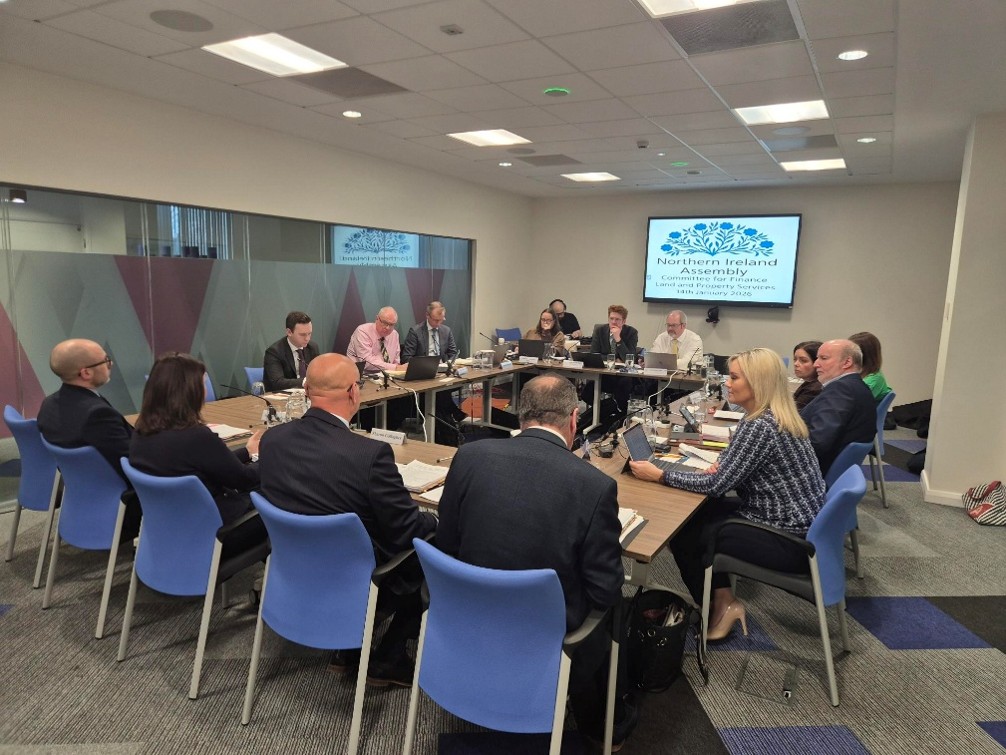
Formal Committee meeting, held in LPS Headquarters, 14th January 2026
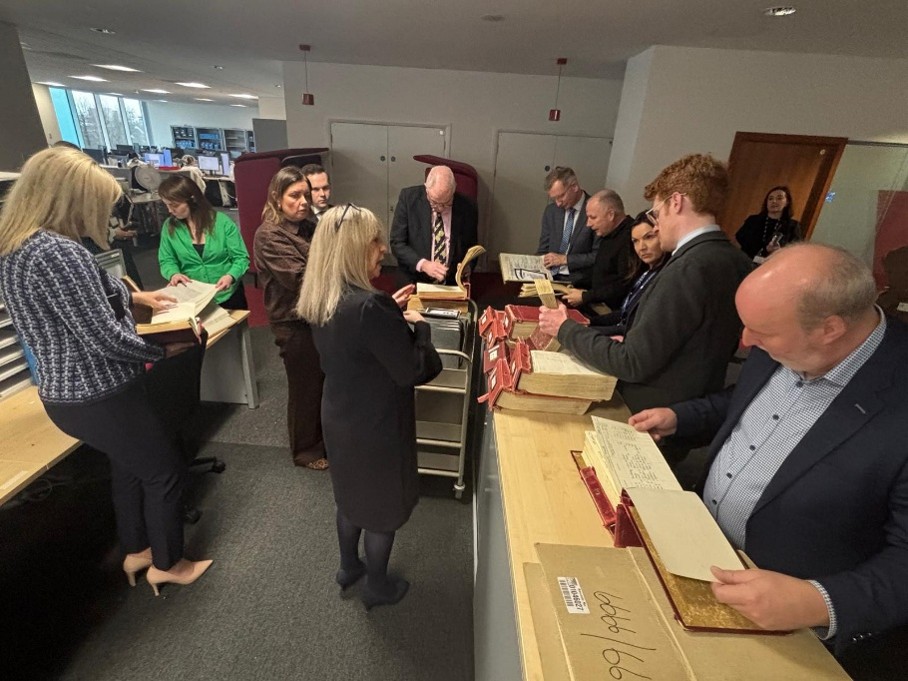
Committee Members viewing old LPS records on 14th January 2026.
On 22nd April 2026, the Committee visited Digital, Security and Finance (DSF) Shared Services. A formal Committee meeting was also held in Goodwood House, DSF’s location. The Committee met with the Interg8 Programme Team – hearing first-hand how the Team will enable transformation through the delivery of modern, flexible, and customer-focused Finance and HR services. Members also heard about the Programme’s progress and successes to date, questioning officials on upcoming milestones and delivery priorities. Members also viewed a technology demonstration of the integrated solution to support Finance and HR delivery, which will provide better information to support financial and workforce decision making by the NICS in the future.
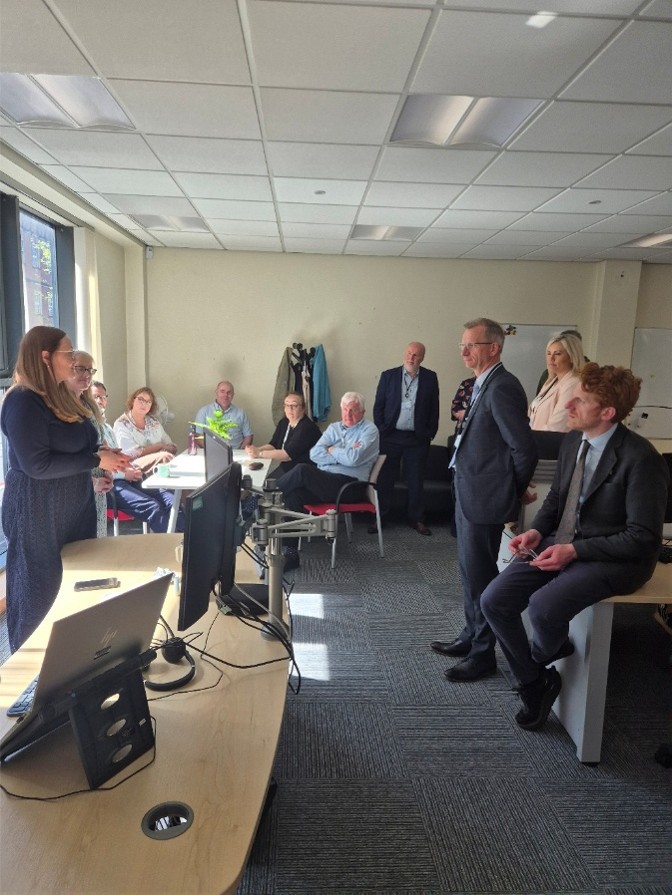
Members of the Committee meeting Interg8 officials in Goodwood House 22nd April 2026
On the 13th of May 2026, the Committee participated in its now annual trip to the Balmoral Show. This year, Members’ activities were based around media opportunities and surveying for the Marriage and Civil Partnership Bill.
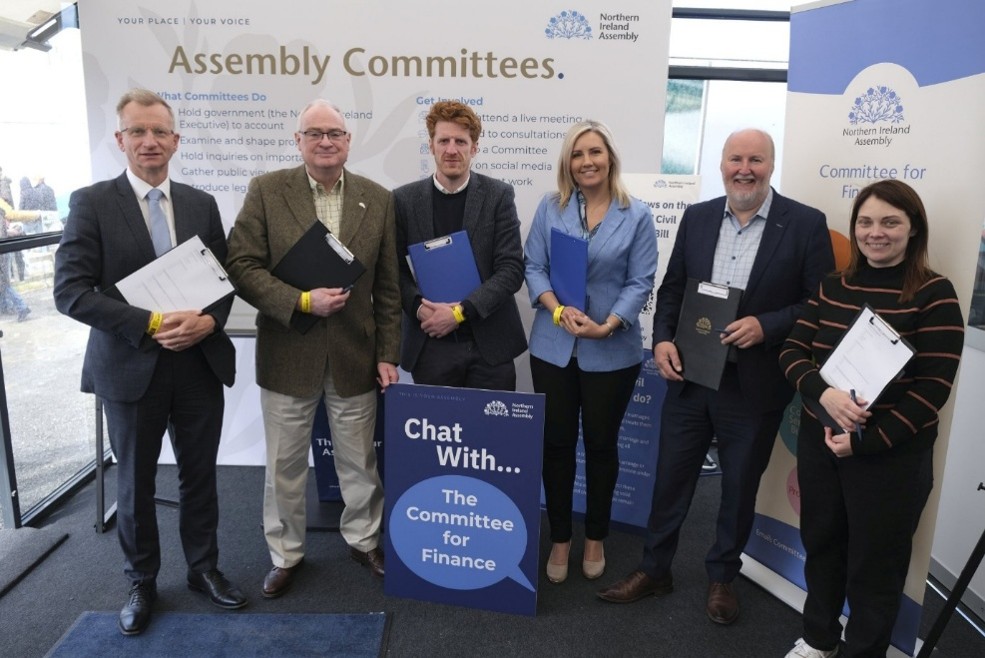
Members of the Committee in the Assembly Stand of the Balmoral Show 13th May 2026
Key priorities for next session
It is likely to be a busy session for the Committee as the end of the current Assembly mandate approaches. The remaining Committee Stage of the Marriage and Civil Partnership Bill will feature, as will the completion of deliberations on the NICS Inquiry. The Committee will also continue its scrutiny of Public Sector Transformation and other key Departmental Policies. Members, will of course, continue to monitor Budgetary developments, to ensure that every effort is made to secure the elusive multi-year budget.
Appendix 1 – Session facts and figures
Committee meetings & visits
|
Number of meetings held |
Percentage minutes public / closed[1] |
Number of meetings held outside Parliament Buildings |
Number of committee visits |
|
35 |
84.47 / 14.81 |
2 |
3 |
Committee Reports
|
Name of Report |
Date of Committee report (Ordered to print) |
|
Report on the Legislative Consent Memorandum on the Cyber Security and Resilience (Network and Information Systems) Bill |
24 June 2026 |
|
Report on the 2026-29/30 Draft Executive Budget |
15 April 2026 |
|
Report on the Northern Ireland Fiscal Council Bill |
20 March 2026 |
|
Report on the Administrative and Financial Provisions Bill |
13 March 2026 |
|
Report on the Legislative Consent Memorandum on the Public Office (Accountability) Bill |
23 January 2026
|
|
End of Session Report Feb 2024 – July 2025 |
08 December 2025 |
|
Inquiry into the Northern Ireland Banking and Financial Services Landscape |
23 September 2025 |
|
Report on the Deaths, Still-Births and Baby Loss Bill |
17 September 2025 |
Committee Inquiries
|
Name of report |
Committee Report (ordered to print) |
Date debated in Plenary (if applicable) |
|
Inquiry into the Northern Ireland Banking and Financial Services Landscape |
23 September 2025 |
N/A |
Appendix 2
Committee for Finance
Expenditure for the period 1 September 2025 – 31 August 2026
|
Budget area
|
Details |
Expenditure |
|
Committee Travel - committee members and staff travel and subsistence in relation to visits and meetings outside Parliament Buildings
|
Includes the cost of committee visits to:
and 2 meetings held outside Parliament Buildings |
£566:02 |
|
Printing of committee reports |
Includes the cost of committee reports . |
£0:00 |
|
Advertising – the cost of public notices relating to committee inquiries, the committee stage of Bills and meetings held outside Parliament Buildings |
Includes the cost of public notices in relation to:
|
£855.84 |
|
Specialist Advice - the cost of specialist advisers appointed by the committee and commissioned research, also the cost of drafting Standing Orders |
|
£0:00 |
|
Refreshments & Hospitality |
Includes the cost of all refreshments and hospitality provided by the Committee including Committee strategic planning session, informal meeting with Departmental Financial Directors and launch of Deaths, Still Births and Baby Loss Bill
|
£2064.34 |
|
General expenses |
Includes eye tests for staff members
|
£92:50 |
|
Total Expenditure |
£3578:70 |
|
Notes:
- It is not necessary to break down costs for individual visits, reports etc. These should be described under “details”, with only totals included in the “expenditure” column.
- It is not necessary to include budget areas on which there has been no expenditure.
- Committees may want to draw attention to any significant expenditure which has occurred and provide some background information, e.g. to highlight costs associated with broadcasting external meetings, or stakeholder engagement activities with harder to reach communities.
You may re-use this publication (not including images or logos) free of charge in any format or medium, under the terms of the Open Northern Ireland Assembly Licence.
Find out more about the Open Northern Ireland Assembly Licence.
This Report can be made available in a range of formats including large print, Braille etc. For more information please contact:
Committee for Finance
Peter Hall
Northern Ireland Assembly
Parliament Buildings
Ballymiscaw
Stormont
Belfast BT4 3XX
Telephone: 028 90 521799
Email: committee.finance@niassembly.gov.uk
Twitter: @NIAFinance
[1] Committee meetings are generally held in public session; however, the Committee does reserve the right to hold some sessions in closed session. The reasons for this can range from agreeing Committee reports, considering legal advice or consideration of evidence on commercial/sensitive matters.


