Strategic Review of Current SEN Provision and Transformation Agenda
Committee for Education
23092026 Strategic Review of Current SEN provision and Transformation Agenda -final.pdf (792.49 kb)
Ordered by the Committee for Education to be published 3 July 2026.
Report: [NIA 184/22-27] [Committee for Education].
Contents
Powers
Membership
List of Abbreviations and Acronyms used in this Report
Department of Education
Education Authority
Draft Summary of Recommendations Infographic
Committee Approach: Terms of Reference
Phase 1: Governance responses: September 2025
Phase 2: Stakeholder perspectives October- November 2025
Phase 3: Consideration and Reporting
Governance
Current Provision
Stakeholder Engagement Event
Challenges
Workforce and capacity
Processes
Inclusion and provision
Strengths of Current Provision
Shortcomings of Current Provision
Recommendations
System and process reform
Workforce and training
Early intervention and health‑education integration
Inclusion, equity, and long‑term outcomes
Transformation Agenda
Middletown Centre for Autism
NAHT effective early intervention
Children’s Law Centre
Independent Autism Reviewer
Committee Conclusions: Snapshot
SEN Support and Workforce
Irish-Medium Provision
SENCOs
Classroom Assistants
Early Years
Special Schools
Working with Health
Transitions/ Post-19
SEN Reform and Policy
Appendix 1: Memoranda and Papers from The Department for Education
Appendix 2: Memoranda and Papers from Others
Appendix 3: Minutes of Proceedings
Appendix 4: Minutes of Evidence
Appendix 5: Written submissions
Appendix 7: Other Documents relating to the report
Appendix 8: List of Witnesses that gave evidence to the Committee
Powers and Membership
Powers
The Committee for Education is a Statutory Departmental Committee established in accordance with paragraphs 8 and 9 of Strand One of the Belfast Agreement and under Assembly Standing Order No. 48. The Committee has a scrutiny, policy development and consultation role with respect to the Department of Education and has a role in the initiation of legislation.
The Committee has power to:
- consider and advise on Departmental budgets and annual plans in the context of the overall budget allocation;
- approve relevant delegated legislation and take the Committee Stage of relevant primary legislation;
- call for persons and papers;
- initiate inquiries and make reports; and
- consider and advise on matters brought to the Committee by the Minister of Education.
Membership
The Committee has 9 members, including a Chairperson and Deputy Chairperson, and a quorum of five members. The membership of the Committee is as follows:
- Mr Nick Mathison MLA (Chairperson)
- Mr Pat Sheehan MLA (Deputy Chairperson)
- Mr Danny Baker MLA
- Mr David Brooks MLA[1],[2]
- Mr Jon Burrows MLA[3],[4]
- Mrs Michelle Guy MLA[5]
- Ms Cara Hunter MLA
- Mrs Cathy Mason MLA
- Mrs Julie Middleton MLA[6],[7],[8],[9]
List of Abbreviations and Acronyms used in this Report
DE Department of Education
EA Education Authority
SEN Special Educational Needs
SEND Special Educational Needs and Disabilities
SENCO Special Educational Needs Coordinator
SPIM Specialist Provision in Mainstream
SPLM Special Provision for Learning – Moderate
RaISe Assembly Research and Information Services
ASD Autism Spectrum Disorder
EAL English as an Additional Language
MLD Moderate Learning Difficulties
SLD Severe Learning Difficulties
EOTAS Education otherwise than at school
HFA High Functioning Autism
SLCN Speech, Language and Communication Needs
FE Further Education
Executive Summary
- This report sets out the Committee for Education’s consideration of its Strategic Review of Current Special Educational Needs (SEN) provision and Transformation Agenda.
- The Committee sought to provide a snapshot of current provision and, through stakeholder evidence and engagement, assess whether the proposed transformation agenda meets needs and addresses systemic issues.
- The Committee has engaged widely and heard many perspectives. The Committee has relied on the Middletown Centre for Autism and the Independent Autism Reviewer to help calibrate its tone, understanding and expectations.
- The governance phase of the review showed significant effort to address recommended reforms, over an extended period of time and with declining resource.
- The stakeholder engagement phase took a 360° sweep of the system and raised concerns about workforce, excessive administrative emphasis, partnership with DoH, operational service delivery and statutory compliance.
- Trust was impaired by inappropriate or lack of placement, complexity of statementing and high success rate of appeals. These systemic gaps impacted not only confidence, but attendance and achievement.
- Consideration of operational aspects was protracted, as stakeholders struggled to adjust while EA sought to convince that reforms were rolling out successfully.
- The contribution of DE at the early stages of its transformation work was value-led. However, without confirmed sustainability and scalability of pilot programmes, the Committee is unsure that they will result in adequate service provision to schools.
- The Committee’s work seeks to inform the Department’s focus on early intervention and operational delivery as key priorities of reform.
- Before support ratios are reduced, schools must have access to comprehensive services and more flexible transition arrangements.
- Service provision to schools and mainstreamed early intervention must be investment priorities if SEN policy is to be truly inclusive.
- Service provision to Irish-medium schools may require additional planning given the very severe shortages of staff equipped to teach native speakers in an immersive learning environment.
Summary of Recommendations
- The Committee makes 15 key recommendations for the Department of Education and Education Authority:
Department of Education:
- Simplify SEN Reform – Reduce the complexity of the current reform programme and focus on a smaller number of clear, measurable priorities with published timelines.
- Address the Placement Crisis – Publish an action plan to ensure SEN placements are planned, appropriate, locally based where possible, and non-discriminatory.
- Develop and Publish an Inclusive Education Policy – Clearly define the role of mainstream schools, specialist provision within mainstream schools, and special schools.
- Invest in Workforce Skills – Enhance SEN training, professional development, and autism/neuro-affirming practice for all education staff.
- Support SENCOs – Review SENCO workload and provide protected time and practical support to make the role sustainable.
- Provide Universal Early Intervention – Make early intervention services available across all settings and ensure support begins as soon as need is identified.
- Ensure Equality in Early Years SEN Support – Provide consistent support across statutory and non-statutory settings, with safe staffing levels and classroom assistant access where needed.
- Tackle Inequity in Irish-Medium Education – Improve Irish-language assessment pathways, workforce planning, specialist provision, resources, and data collection.
- Issue Guidance on Restraint and Seclusion – Introduce child-rights-based guidance and review existing legislation on the use of force in schools.
- Create a Joint Health–Education Framework – Move to formal collaboration between Health and Education through shared planning, data-sharing, referrals, and accountability.
- Improve Transitions and Post-19 Support – Strengthen planning for young people with SEND moving into adulthood, including health, social care, education, and employment pathways.
- Reduce Bureaucracy – Streamline Local Impact Teams and referral processes so schools and families can access support more easily.
- Strengthen Local Impact Teams (LITs) – Invest in LITs, improve behavioural support, and publish data on effectiveness and outcomes
- Improve access to Educational Psychology Services – Clarify the role of educational psychologists and ensure timely access for schools.
- Professionalise Classroom Assistants – Improve pay, career progression, role clarity, and ensure 1:1 support is specified where required.
Education Authority:
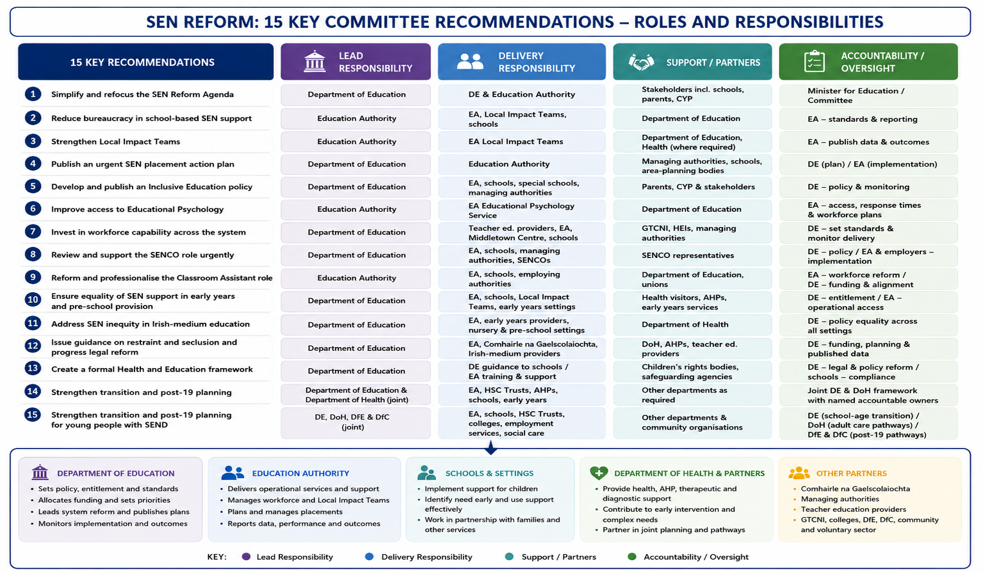
Draft Summary of Recommendations Infographic (click here for an accessible text version of the Draft Summary of Recommendations Infographic)
Introduction
- The Committee for Education began its inquiry into a Strategic Review of current SEN provision and Transformation Agenda in September 2025.
- The main objective of the review is to analyse and evaluate the challenges faced within current SEN support systems in schools and assess the extent to which the Department’s SEN Reform Agenda Delivery Plan is addressing these.
- The Committee received 51 written submissions, held an event on 11 November 2025 to hear the views of stakeholders and took oral evidence from:
-
- The Independent Autism Reviewer;
- Education Authority;
- Department of Education;
- Shine Autism Support Group;
- SEN Reform NI;
- Special Educational Needs Coordinators;
- Mr Chris Donnelly, Principal;
- The Minister of Education;
- Partnership for Inclusive Education;
- Children’s Law Centre;
- Middletown Centre for Autism;
- The Northern Ireland Commissioner for Children and Young People;
- The Curriculum Task Force Advisory Committee; and
- Caleb’s Cause
- The Committee also met informally with the following groups and individuals:
-
- Kingston Bryars
- Professor Victoria Graf, Professor Emerita Loyola Marymount University (LMU); director of the Special Education Program at LMU; and Vice Chair of the California Advisory Commission on Special Education (ACSE)
- Dr. Amy Hanreddy, California State University
- Comhairle na Gaelscolaíochta
- Bright Futures/PEACHES
- The Committee stakeholder event which took place on 11 November 2025 brought together Individuals, parents and representatives from:
-
- SEN Reform NI
- Diverse Youth NI
- Controlled Schools’ Support Council (CSSC)
- Independent Autism Reviewer
- Ema Cubitt
- Playboard
- Children’s Law Centre
- Integrated Alumni
- NASUWT
- Children in NI
- Scouts NI
- CCEA
- Integrated Education Fund
- Association of Educational Psychologists
- Action for Children
- UNISON
- Education Authority
- Special Educational Needs Advice Centre (SENAC)
- Governing Bodies Association NI
- RCSLT
- Comhairle na Gaelscolaíochta
- Transferors Representative Council
- Young Enterprise NI
- Thornfield House Special School
- Kingston Bryars
- Newcastle EBSA
- NAHT
- Equality NI
Committee Approach: Terms of Reference
- The Committee agreed and followed as far as possible the terms of reference below.
- “To analyse and evaluate the challenges faced within current SEN support systems in schools and assess the extent to which the Department’s SEN Reform Agenda Delivery Plan is addressing these.
Phase 1: Governance responses: September 2025
- Commission research briefing, context and suggested questions.
- Review recommended priorities for change in SEN delivery made by a succession of reports, beginning with update briefing from the Department and Education Authority’s accounting officers on progress with the Public Accounts Committee’s 2021 ‘Report on Impact Review of Special Educational Needs’ recommendations.
- Commission briefings from DE and EA on respective policy and operational approaches to reform.
- Request DE/EA correlation of recommendations with reform agenda actions.
Phase 2: Stakeholder perspectives October- November 2025
- Collate and consider SEN stakeholder feedback to Committee since 14 February 2024.
- Identify missing parental, school principal, SENCO, Ed psych, classroom assistant perspectives and invite their feedback; canvass stakeholders via engagement events, written and select oral submissions.
- Engage with the Independent Autism Reviewer and Mental Health Champion to learn about culture, terms, trends and priorities.
- Engage with RaISe for background briefing on e.g. literature review and definition of terms.
- Engage with the Health Committee on SEN transition and pupils with exceptional needs.
- Engage with DE to understand policy direction regarding inclusion, right support, right people, right time, right place delivery plan and outcomes framework; and effectiveness of funding allocation including 9 transformation projects.
- Engage with EA to understand statutory duty, statementing, provision of SEN pupil support services, transition, and issues re transport, workforce and vetting.
Phase 3: Consideration and Reporting
- Report on progress in respect of:
- Phase 1 system improvements subsequent to governance recommendations;
- Phase 2 stakeholder feedback;
- DE policy re inclusion;
- SEN Reform agenda: to what extent do the actions within the four pillars of right support, right people right time, right place delivery plan and outcomes framework address the challenges in the SEN system;
- Effectiveness of funding allocation including 13 transformation projects;
- EA statementing; appeals; pupil support; transition; transport; workforce; vetting; communication and information management;
- Recommendations (compile and consider Stakeholder recommendations); and
- Conclusions (Committee Review highlights to assist the development of policy).
Main Body of Report
- The Committee approached this very wide policy area from the perspectives of:
- Governance;
- Current Provision; and
- The Department’s Transformation Agenda
Governance
- The Committee commissioned research on several significant and relatively recent reviews of special educational needs; namely the 2021 Public Accounts Committee (PAC) ‘Report on Impact Review of Special Educational Needs’, and 7 other reviews of SEN provision in the jurisdiction.
- These reviews together resulted in over 200 recommendations, in response to which the Department of Education published the SEN End-to-End Review in 2023 and Reform Agenda, Delivery Plan and Outcomes Framework in February 2025. These documents cover the period 2025-2030.
- The Committee considered the range of conclusions and recommendations reached and then heard oral evidence from the Department and the Education Authority on the approach taken and the measures implemented to meaningfully address them.
- The Department advised the Committee that 5 of 7 recommendations of the PAC report had been implemented, while recommendations 2 and 6 are being addressed via the current transformation agenda.
- The Department mentioned that it did not underestimate the challenge it was undertaking.
- It is true that to map a path from current provision to inclusion without failing in statutory duties is a big ask. However, in terms of understanding people's experiences to develop solutions, it will be necessary to incorporate the feedback of stakeholders in improving processes for pupils, families, schools and practitioners.
- The Education Authority for its part reported its work against recommendation 3 on compliance with the statutory responsibilities on assessment and statementing. It raised from the outset that the final step of identification of placement was critical to meeting these statistical thresholds.
- In respect of recommendation 7, to better understand the increase in number of appeals and why the Education Authority concedes so many, the rationale given was that Education Authority received further information later in the process which was determining of needs.
- “During the 12-month period from 1 July 2024 to 30 June 2025, the Education Authority experienced a notably high rate of case concessions in response to appeals made to the Tribunal. Specifically, 751 cases were brought before the Tribunal, and of these, 460 cases—representing 61%—were conceded by the Education Authority prior to the hearing. Examining the circumstances surrounding these concessions reveals that out of the 460 cases conceded, 330 (or 72% of the total concessions) were the result of new information being provided after the appeal process had commenced. The emergence of new evidence at this late stage is beyond Education Authority’s control and directly contributes to the elevated number of concessions”.
- The Education Authority conceded that there is potential for improvement and advised that it is undertaking efforts to analyse why evidence is not provided at an early stage, with the goal of identifying strategies to reduce this occurrence in future Tribunal proceedings.
- The Education Authority provided further information on the matrices it uses to monitor implementation of recommendation 7.
- The Committee also followed up on these briefing sessions in detailed correspondence to explore governance responses in more detail. Correspondence is within this report at Appendix 1.
|
PAC Recommendations |
|
|
1 |
An independent review of the Education Authority |
|
2 |
An independent review of SEN provision and processes |
|
3 |
DE to implement a rigorous performance monitoring process |
|
4 |
The EA Board should satisfy itself as to the quality and relevance of the information provided to it |
|
5 |
Deficiencies in the management information held by the EA should be addressed urgently and the EA should collate data on the number of children identified as needing SEN support and waiting to be referred to the Educational Psychology Service |
|
6 |
A review of the effectiveness of the funding allocated to all stages of the SEN process |
|
7 |
A greater understanding of the factors behind the increase in the number of appeals is needed |
Current Provision
- After completing the governance review to rehearse progress against longstanding criticisms and approaches to resolve them, the Committee poke to staff, service users and pupils to understand their experiences of the SEN system and hear their views on how it is working.
- A range of stakeholders contributed in Committee, in correspondence and in a bespoke round-table event to illustrate their perspective of current provision.
- These included teachers, principals, SENCOs and classroom assistants; parents and former pupils; and ranged across special schools, Irish-medium schools and schools establishing specialist provision in mainstream (SPIMs).
- The vexed issue of placements went on to become a central strand of discussion of current provision and transformation in the inquiry.
- Stakeholders gave a number of reasons for why so many appeal cases are conceded by the Education Authority. It is clear that this long-running problem needs a thorough review of the statementing process to identify where things are going wrong and to rebuild confidence that the system is fair, transparent and easy to understand.
- The utility and scalability of 1:1 classroom support for statemented pupils was central to the debate in Committee. The Department provided good practice comparative literature to support moves toward a more shared support model, and one principal argued passionately for flexibility at school level to re-allocate the support of classroom assistants within a classroom. Parents and rights organisations did not however express readiness to concede 1:1 support in the absence of established and comprehensive provision of support services.
- The EA responded in subsequent evidence sessions and correspondence to these, and other operational matters raised including transitions; the acute needs of the Irish-medium sector; environment; transport; school meals; allergies (ARFID); non-attendance; prosecution of parents for non-attendance.
- DE also engaged in terms of the strategic policy direction underpinning operations.
Stakeholder Engagement Event
- A Stakeholder Engagement Event was held on 11 November 2025 to gather experience and views of current provision and the transformation agenda.
- Attendees at the event represented organisations including SEN Reform NI; Diverse Youth NI; Controlled Schools’ Support Council (CSSC); Independent Autism Reviewer; Playboard; Children’s Law Centre; Integrated Alumni; NASUWT; Children in NI; Scouts NI; CCEA; Integrated Education Fund; Association of Educational Psychologists; Action for Children; UNISON; Education Authority; Special Educational Needs Advice Centre (SENAC); Governing Bodies Association NI; RCSLT; Comhairle na Gaelscoaoíochta; Transferors Representative Council; Young Enterprise NI; Thornfield House Special School; Newcastle EBSA; NAHT; and Equality NI.
- Individual stakeholders and parents also attended and participated actively in discussion.
Stakeholder Event
Challenges
- Challenges described by participants were as follows:
Workforce and capacity
- shortages of educational psychologists, speech and language therapists, and classroom assistants.
- The role of SENCOs has expanded significantly, often unmanageable alongside teaching duties.
- Recruitment, retention, incentives, and career progression for classroom assistants are poor.
Processes
- Stakeholders view the system as process‑driven rather than child‑centred.
- Stakeholders indicated that they felt that paperwork (e.g. portals, forms, reviews) was excessive and took time away from meaningful support for children.
- Assessment timelines are long, with little or no support while assessments are ongoing.
- Data systems do not connect, leading to duplication and inefficiency.
Inclusion and provision
- Many representatives stated that the current model which relied on one-to-one support was unsustainable.
- Specialist Provision in Mainstream (SPiMs) are often seen as isolating rather than inclusive.
- Inconsistent access to early intervention and specialist services across regions.
- Concerns were raised about Irish‑medium provision, including estate shortages and lack of specialist expertise.
Strategic and systemic issues
- Lack of long‑term strategic planning and forward thinking.
- Poor co-ordination between Education and Health.
- Perception that EA does not listen to schools and imposes placements even when unsuitable.
- Transport costs (e.g. taxis) are seen as draining resources that could be invested in schools.
Strengths of Current Provision
- Strengths of current provision were described as follows:
- Annual review processes have improved administratively.
- Some localised good practice and peer sharing between schools exists.
- SEN helplines and pastoral support valued.
- Inclusive examples (e.g. specialist units within mainstream schools) can help normalise difference.
Shortcomings of Current Provision
- Shortcomings noted were as follows:
- Specialist services (RISE, LITs, speech and language support) are very difficult to access.
- Expertise, mentoring, and governance have been reduced due to service restructuring.
- Integrated services have become overstretched, with staff covering many more schools.
- Inconsistent quality of provision between schools and regions.
Focus on measurable outcomes (English & Maths, exam results) marginalises broader skills and SEN achievements.
Recommendations
- Stakeholder event recommendations were as follows:
System and process reform
- Reduce statementing timelines (e.g. from 26 to 22 weeks).
- Simplify paperwork and make the system child‑centred.
- Improve data sharing across DE, EA, CCEA, and Department of Health.
Workforce and training
- Improve recruitment, retention, pay, and career pathways for:
- Educational psychologists
- Classroom assistants (including use of the SILSA programme)
- Provide better training for teachers on using assistants effectively.
- Use expertise within teaching colleges more strategically.
Early intervention and health‑education integration
- Strengthen early years support and speech and language intervention.
- Improve referral pathways and restore continuity (health visitors, paediatrics).
- Closer cooperation and budget alignment between Education and Health.
Inclusion, equity, and long‑term outcomes
- Reduce over‑reliance on one-to-one support by investing in early and group interventions.
- Address inequalities between schools and regions.
- Plan better for post‑19 pathways, life skills, and employment for SEN young people.
- Broaden success measures beyond academic outcomes.
- Ensure reforms are co‑designed with teachers, parents, pupils, and support staff and not rushed.
Written Submissions
- The Committee received 51 written submissions to its call for evidence on the review with submissions coming from parents, teachers, support staff, charities, and specialist bodies. Stakeholders identified the following concerns:
- Mainstream settings lack the capacity to support complex needs with SPiMs sometimes used as a pressure valve with some children continuing to be placed in schools that cannot meet their needs. A nursery teacher stated in their response that “Inclusion is happening by default, but without sufficient resources”. It was also noted that some children with sensory impairments face inaccessible environments and difficulty accessing learning materials. Diverse Youth suggested that “Inclusion must go beyond placement to ensure belonging, cultural understanding, and safety”.
- Many submissions raised concerns about the need for early diagnosis and the lack of support for children while this process takes place. A nursery schoolteacher indicated that in their experience “Children often wait their entire nursery year without being seen”. The time taken for the assessment process was highlighted with stakeholders indicating that there are significant delays in assessment with many waiting 2+ years.
- Stakeholders describe the statementing process as adversarial, unclear, and often producing vague or inaccurate statements. Parents felt that the statementing process was a battle, overly focused on process and bureaucracy rather than outcomes, and many pointed to delays beyond the 26-week target. Parents indicated concerns that statements were not reflecting real needs (especially outside classroom hours) and that the annual review process was inconsistent. Concerns were also raised about the number of children starting school without statements.
- Many responses from staff and professional bodies pointed to shortages of qualified staff including Educational Psychologists, Speech and Language Therapists, Occupational Therapists, and specialist teaching staff. The Royal College of Speech and Language Therapists noted that “Northern Ireland now has more children waiting for speech therapy per head of population than any other UK region”.
- Many children are placed in settings that cannot meet their needs with stakeholders indicating that there are insufficient Moderate Learning Difficulty and Severe Learning difficulty places available with the Children’s Law Centre stating that “SPiMS are being used as a crisis response to a lack of suitable specialist placements”. The National Deaf Children’s Society highlighted the lack of pre-school resource provision for deaf children.
- Therapies are described as inconsistent, underfunded, and often unavailable. Concerns were raised about the reduction in face-to-face therapy and gaps in access to speech and language therapy particularly in specialist units. Angel Eyes referred to the barriers to independence faced by pupils with visual impairment and that assistive technology is underused due to lack of staff training.
- Stakeholders describe fragmented systems across education, health, and social care with unclear responsibilities, children falling between systems and parents having to act as coordinators. Stakeholders pointed out poor coordination between education and health leading to delays in diagnosis and support.
- A number of parents referred to concerns about transport and safeguarding for vulnerable children. They raised concerns about weak vetting processes for transport staff, inconsistent escort provision and the use of unsafe or unsuitable vehicles. The impact of long travel distances for some pupils and the resulting fatigue and missed learning was also highlighted.
- Funding pressures are described as severe and system wide with insufficient funding impacting staffing levels, specialist services, post 19 provision and schools being unable to meet needs within existing budgets. The Equality Commission for Northern Ireland suggested that the “Success of SEN Reform is dependent on significant and sustainable funding”
- Transitions are described by stakeholders as some of the most vulnerable points with some children being left without placements, a lack of continuity as a child moves from school to Further Education creating limited pathways for independence.
- The Department set out a clear linear continuum from governance reviews to transformation rationale, but the people reflecting their experience of current provision indicated that more work needs to be done to address their feedback and lived experience.
- DE advised that they would most meaningfully brief the Committee not on right time, right place, right person, right support aspects of the SEN Transformation Agenda but on their transformation pilot projects.
- During the Committee’s inquiry, the Department received transformation funding; piloted a number of projects; had the Transformation Board review its projects while they were still under way; and conserved the entire funding for a revised number of projects. The Committee has sought detailed costings.
- It was the Committee’s initial intention to take a quick snapshot of the SEN landscape with a view to informing the Department’s implementation of its SEN reforms. The request to consider the projects has extended the life of the Committee’s strategic review, and the Committee duly took the opportunity to ensure it had explored in its evidence sessions the full range of perspectives.
- Within written and oral submissions, the Committee heard analysis, discussion and recommendations from key stakeholders such as Middletown Centre for Autism, Children’s Law Centre and the Independent Autism Reviewer.
- Middletown Centre for Autism is an all-island centre of excellence for autism and partner in the Department’s SEN reform work, although it receives just 0.25% of the Department’s SEN budget. It offered a commentary on the potential of the reform agenda as follows:
Transformation Agenda
| Middletown Centre for Autism | |
|
System design; strength in neuro-affirming pedagogy |
Prevent burnout by providing consistent, evidence-based preparation to support increasingly complex needs, including autism, for teachers, classroom assistants and school leaders |
|
Momentum and delivery |
This must reinforce policy intention so confidence in the system can build |
|
Structured learning support delivery via formalised pathways for the education system |
MCA helps the system move faster and more safely by turning everyday practice into evidence-based capability (via whole school and training interventions). Build practical classroom capability, not additional bureaucracy via pathway to time and space for formalised continuing professional development (CPD) |
|
Reform agenda must embed consistency |
Policy acknowledges that autism-affirming practice improves outcomes, early support prevents escalation, training creates capability – need to mainstream these |
|
Identify and share pockets of best practice |
Via face-to-face approaches, best-practice days, or digital enhancements and learning platforms |
|
System-wide investment |
Investing in enhancement of capability will reduce waste and costs of escalation |
|
Build workforce capability |
Very positive that there are plans for career pathways for classroom assistants |
|
Change family expectations |
Currently, escalation may seem the fastest way to support make support consistent and accessible |
|
Managing complexity |
125 actions in the SEN reform plan; more than 70 actions in the outcomes-based accountability framework. What one to three actions will truly make a difference? Consistent training for all classroom assistants, teachers and professional educationalists |
- NAHTpresented to the Committee its May 2025 report on Effective Early Intervention and advised that having considered the Graduated Response Framework published by EA since then, it must conclude that the current statementing process and graduated response framework did not serve the needs of children in nursery schools, even if the school is identifying those needs.
- The authors advised that we need to move to a system that:
| NAHT effective early intervention | |
|
Provides an urgent response for children in crisis/presenting as unidentified with high level of need.
|
A mechanism to ensure early identification and appropriate placement for children who require or will require specialist provision or special school. A review of the deferral of P1to widen the criteria to beyond birth date and include other factors such as some SEN, trauma, abuse, bereavement of a sibling/parent, major illness (e.g. childhood cancers) and Looked After Children. |
|
Supports children identified as having a high level of need, 1-1support should be facilitated and in place whilst the 26 weeks statementing process is ongoing. |
Early intervention that meets the needs of children, not as a mechanism to delay a statement Statementing process that supports children with the highest level of need from point of identification. Structures in place with EA i.e. graduated response needs to be designed by educators currently in child facing roles, not those who have no or no recent experience of working continuously with a set group of children. |
|
Provides schools with easier access to Educational Psychology at a time best suited to meet children’s needs. |
Easier access to educational psychologists |
|
Make pathways more flexible |
Fund schools to provide appropriate support or find alternative placement if mainstream nursery is not the best place to meet the child’s needs. Remove the set pathway to allow for immediate support for children most in need. |
|
Build appropriate workforce now |
Review staffing levels in Nursery Schools and Classes (currently 1-13) now and bring them into line with the health minimum standards ratios of 1-8 – not wait until 2030 at the earliest (ELC draft strategy) Review career structure for Classroom Assistants – retain the best and most skilled working with our children – not leaving for better pay in other sectors such as retail. |
- Children’s Law Centre gave a very detailed report to the Committee which it will perhaps wish to clarify in light of receipt of the new draft Code of Practice which has issued since then.
- Detailed observations by Children’s Law Centre are listed below:
| Children’s Law Centre | |
|
LITs – gather specified data to enable monitoring and assessment |
Recommending comprehensive data about the operation of LITs, including both challenges and successes is published regularly on the EA’s website as transformation proceeds to enable proper scrutiny and constructive feedback. |
|
|
Data should include analysis of the effects of this significant policy shift in terms of impacts upon equality of opportunity for children within the section 75 groups, including in particular differential treatment and outcomes between children with disabilities and those without. |
|
(Make early interventions to prevent escalation) |
CLC, through its legal advice and casework service, has formed the view that the continuous escalation in the proportion of children with SEN who are requiring a statement, is to some extent being driven by unmet need at the earlier stages of the Code of Practice |
|
Calls for perseverance to ensure what it deems intentional impediments are remedied |
SEND provision is a matter of intense public interest, given the long-term individual and societal impacts when children’s special educational needs are left unmet by a system which has operated to place barriers to progress through the pipeline at every possible stage. It is essential that the ongoing transformation processes are subject to significant ongoing public scrutiny and that all interested parties are able to support positive change and exercise a level of patience with a complex transformation process. We must also raise concerns and influence change in the event that the new operational system is not aligning with legal requirements to deliver early and effective intervention for children with special educational needs and disabilities. |
|
RFI Portal – engage to reduce bureaucracy? |
such bureaucracy is disproportionate when one considers that the legislative thresholds for entry to the SEN system and crossing points from one stage to another within the Education (NI) Order 1996 and supported by the Code (1998) are relatively straightforward. |
- The Independent Autism Reviewer advised that the Transformation Agenda was a fragile opportunity, that the system was starting to respond, and the EA seemed to have the right attitude.
She made the following commentary, dealing in particular with culture, language and placements, and advised critical actions points as below:
| Independent Autism Reviewer | |
|
Terminology and attitudes |
Need to distinguish between true increases in prevalence and increases in identification; need for leadership in modelling positive and calling out hostile language and culture |
|
Need to change hostility in system |
SEN children not inherently vulnerable; system can make them more vulnerable and e.g. more likely to be punished |
|
Culturally, school system is not aligned with world of work which is more progressive |
Culturally lead a move away from punitive, inflexible structures in schools and school days and give our children and young people a bit of grace |
|
Early interventions can transform transition |
Will review finalized childcare strategy; has seen even high-support needs catered to by nursery providing outdoor education in nature with phenomenal results |
|
Transport must not preclude pupils accessing appropriate placement |
Transportation to school goes to sense of belonging and should not be interrupted or withheld |
|
Adequate reporting and compliance arrangements must be put in place for restricted timetables & informal exclusions |
Restricted timetables and informal exclusions are unlawful so schools will not inform EA of these – these are statistically invisible children without placement
|
|
DE and DoH must find ways to provide AHPs |
AHPs must be part of support for pupils - and for teachers who are not hired, trained or equipped to play medical roles |
Irish-medium Education
- The Committee heard from Comhairle na Gaelscolaíochta and Coláiste Feirste through meetings, engagement events and written evidence. Representatives from the Irish-medium sector strongly argued that the Department of Education and the Education Authority should develop a long term plan to provide these schools with staff trained in immersion pedagogy; plan realistically for accommodation needs for IME rather than focusing exclusively on current inadequate spaces; learn from more advanced bilingualism and immersion practices elsewhere; improve support by EA by providing a bespoke immersion module; and ensure the EA has dedicated resources to support Irish-medium pupils, particularly when they are moving between stages of education.
Inclusion
- The Department provided significant literature in response to the Committee’s request for comparative best practice briefing in relation to 1:1 ratios, which chimed with the key challenge of maintaining statutory compliance while moving towards an inclusive system.
- DE advised that “Inclusion is not a policy; it is a practice.
- “In the legislation and the code of practice, there is a presumption of mainstream. The European Agency has done quite a bit of work for us, under a technical support instrument, to look at how inclusive our entire legislation is. Then, it is looking not just at special educational needs but across every policy in the Education Department — whether it is youth policy, school improvement policy, admissions policy, or area planning policy — to see how inclusive it is”. DE, October 2025
- DE also advised that it will carry out training in “inclusive capacity building” using transformation funding.
- One principal who was incredulous at the increase in teacher bureaucracy as a means to meet additional needs brought the notion of community to the fore, noting that “The education bureaucracy is struggling to prioritise the protection of the school as the preeminent frontline institution best capable of positively impacting upon the development of children. The failure to appropriately utilise other public organisations, both within education and other Departments, continues to diminish the capacity of schools to function in an optimal manner”.
- Victoria Graf advised the Committee that general education in the US has for 50 years been inclusive of the vast majority of pupils.
- “Very few students cannot thrive in general education. Here many students with mild learning difficulties or autism, or indeed complex medical needs may be found in special provision, even though they could thrive in general education. For example, many physical conditions, such as cerebral palsy, do not impact a student’s cognitive abilities or learning capacity. So, the mindset and emphasis of inclusion prioritises general education to allow every student to achieve their full potential and values interaction with peers (precluding isolation later on).
- She advised that the practice in US was to, and the system here might helpfully “Focus not on disability, labelling and fear but on TPL and improving education system in the long term”.
- She also flagged the cultural point that separating children on behavioural grounds narrows what is acceptable to a very limited profile and implies that of their learning is less important than those who conform. This is not beneficial overall.
- Early in the Review, the Committee sought to understand the recent increase in the number of children with statements, and engaged with the EA to seek statistics and with RaISe to gain a better understanding of terms, categories, comparability, etc. Having gathered some helpful information, the Committee subsequently aligned its review primarily with the needs and best outcomes of the child as they present and just as they are.
- Professor Graf mentioned that indeed there is an observable increase in the number of students diagnosed with disabilities in various regions, including the United States and Scandinavia, as well as in Portugal, a country known for its inclusion efforts. She advises that “This rise can be attributed to a better understanding of neurodivergence and changes in diagnostic criteria, such as the broader definition of autism.
- Prof Graf concludes that “However, this situation should not be viewed negatively; instead, it calls for a re-evaluation of educational methods to accommodate diverse learning needs”.
- The Independent Autism Reviewer has engaged at several key points in the Committee’s Strategic Review, and has also discussed the importance of culture in extending belonging, participation, security via our systems for supporting pupils with SEN.
- Most recently, she wrote to the Committee with some high-level system conclusions and recommendations to assist with framing challenges most positively.
- The Autism Reviewer’s key findings based on a niche literature digest are as follows:
- Reform must be judged by children's experiences;
- Culture is the foundation of effective inclusion;
- Workforce capability is the critical enabler of reform;
- Children should not have to reach crisis before they become visible;
- Inclusion requires educational environments to adapt;
- Educational participation depends upon effective health and education integration; and
- Northern Ireland measures activity better than outcomes.
- Further, she offers key questions to measure success:
- How will the Department demonstrate that children are better off under the Enhanced Support Model than they were previously?
- For accountability in areas that require DE and DoH collaboration, who is the responsible owner of the outcome?
- Does the transformation agenda, like any reasonable educational process, comprise early identification, understanding of needs, immediate needs-led support, graduated support and review, access to specialist advice, escalation and accountability, transition planning and monitoring of outcomes?
- Kingston Bryars addressed the Committee in informal and virtual format, and advised on several key points from his experience:
- Expectations are low for disabled pupils in special schools; staff not trained or equipped adequately to help pupils achieve;
- Focus on physical disability precluded assisting with learning difficulties such as dyslexia, with consequences for exam performance;
- Prefers term “additional needs” to “special needs” terminology which leads to bullying;
- Transition support was significantly lacking; Kingston experienced a confusing and unsatisfactory transition from school.
Committee Conclusions: Snapshot
SEN Support and Workforce
- As a priority action, the current bureaucracy seen in the delivery of school-based SEN support, especially Local Impact Teams, must be reduced.
- A clear statement which clarifies the new role and responsibilities of Educational Psychologists should be provided.
- Enhanced investment should be provided to Local Impact Teams, with an urgent immediate focus on providing adequate behavioural support services.
- Discussion and planning should begin between Education and Health colleagues as soon as possible to understand how Allied Health Professionals can form part of the Local Impact Teams model.
- The current approach to SEN placements represents a crisis that is now normalised and a failure to address this issue places all other areas of wider SEN reform at risk. Priority should be given to resolving the annual placement crisis via the publication of an action plan that ensures placements are planned, appropriate, data informed and non-discriminatory.
- SEN placements should follow an area-based planning approach, where the assumption and preference is that children should be educated in their local community where possible.
- As part of Initial Teacher Education in Northern Ireland, all students should receive adequate SEN training, regardless of the institution they attend or pathway they have chosen. Consideration should also be given to the introduction of SEN PGCE.
- The Department of Education must urgently delivery fit for purpose and child-rights centred guidance on the use of restraint and seclusion in mainstream and special schools. Article 4(1) c of the Education (NI) Order 1998 which enables teachers to use force to stop pupils “engaging in any behaviour prejudicial to the maintenance of good order and discipline” must also be repealed as soon as possible. David Brooks MLA and Julie Middleton MLA recorded their position that they did not agree with the Committee’s call for the repeal of Article 4(1)c of the Education (NI) Order 1998 at this time.
- The Department of Education should bring forward the review of Middletown Centre for Autism as a priority action in order to ensure its role in educating and disseminating good practice is enhanced.
Irish-Medium Provision
- The Department of Education should work with Comhairle na Gaelscolaíochta and relevant stakeholders to develop a targeted plan to address SEN workforce challenges within the Irish-medium sector, including the recruitment, training and retention of Irish-speaking educational psychologists, SENCOs, classroom assistants, specialist teachers and allied health professionals.
- The Department of Education and Education Authority should ensure that children educated through the medium of Irish have equitable access to SEN assessment, intervention and support services, including the provision of Irish-language pathways where appropriate.
- As Specialist Provision in Mainstream (SPIM) expands across the education system, the Department of Education and Education Authority should ensure that children educated through the medium of Irish have equitable access to specialist provision, including consideration of Irish-medium specialist units and appropriate outreach support. This recommendation is made in the context of a wider accommodation crisis facing IME which directly impacts on the sector's ability to take on SPIMs.
- SEN training and professional development opportunities should be made available through the medium of Irish where appropriate, ensuring that staff working within Irish-medium settings can access high-quality professional learning without linguistic barriers.
SENCOs
- A review of SENCO workload should be undertaken urgently. This should include timely and practical interventions to address the sustainability of the SENCO role and workload.
Classroom Assistants
- Where 1:1 support from a classroom assistant is assessed as the best way to meet a child’s needs, this should be detailed and quantified on their statement and EA must be clear that new models of support.
- EA should also ensure that support detailed in statements of special educational needs is not limited to the offer of 1 – 1 classroom assistant support as the sole delivery mechanism to meet children's needs in every case. Statements should detail supports that are quantified but flexibility must be afforded to ensure a range of supports can be considered for inclusion in a statement
- The EA should urgently progress work to enhance the Classroom Assistant role. This should include clear job roles and descriptions, fair pay and conditions and the creation of professional pathways of progression within the role. This work is vital if other areas of SEN reform are to be a success.
Early Years
- Clear early intervention services should be established across the system, and these should not just be confined to pilot projects. This should include mechanisms to ensure that the right support is available for children at the point at which need is identified, the protection of the SEN Inclusion Fund and the availability of Classroom Assistants, as standard, to all nursery and pre-school classes.
- Pre-school settings should receive equality of SEN support, regardless of statutory or non-statutory status.
- The Graduated Response Framework should not act as a barrier to accessing support for those most in need at the very start of their education.
- The EA should review safe staffing levels in pre-school settings to ensure that the appropriate number of staff are in place to meet the growing complexity of need.
- Dedicated investment should be provided to develop and make available Irish-language SEN resources, assessment tools, early intervention programmes and parental support materials to ensure children can access support in their language of education from the earliest stage possible.
Special Schools
- The EA and Department of Education, in collaboration with the Department of Health, should urgently bring forward a policy on the future provision of nursing in special schools. The current disparity within provision across Northern Ireland risks unsafe provision and inequity of cover.
- As part of wider SEN reform, the EA should undertake regular dialogue and engagement with special school leaders on issues that directly impact them.
- The EA should adopt a more responsive approach to maintenance and estate issues, ensuring that works which are urgently required to provide safe services for children are prioritised.
Working with Health
- An action plan should be designed and implemented to improve data sharing between Health and Education, particularly within Early Years provisions.
- A formal mechanism should be introduced to refer children from Health services into appropriate Education support services.
- The Department of Health and the EA should move from the current process of co-operation by means of meetings and engagement, into a collaborative partnership which jointly plans and commissions shared SEN services. This should include clear actions and goals, with dedicated timelines for implementation.
Transitions/Post-19
- Transition planning should be appropriately aligned with local trust provisions and eligibility criteria for access. This should include consideration of the allocation of a social worker and the processes leading to diagnosis of intellectual disability, if appropriate, to enable access to local Trust services or direct payments
- The Committee supports the introduction of legislation in the next mandate for the provision of post-19 Health and Education plans. The EA must ensure that transition planning is effective and consistent.
- Effective cross-departmental working should begin between the Department of Education, the Department of Health, the Department for the Economy and the Department for Communities on ensuring the provision of adequate pathways for school leavers with SEND.
SEN Reform and Policy
- The SEN Reform Agenda and Action Plan are too complex. The Department of Education and EA must refine these down to a number of key actions that everyone in the system supports and understands. These should be appropriately invested in and delivered, with timescales for implementation easily available alongside regular updates on progress.
- An Inclusive Education policy should be published. This should clearly set out the roles of both mainstream provision, specialist provision in a mainstream setting and special schools within our system.
- The EA should be cognisant of the current level of pressure felt by all staff within our schools. Whilst schools are calling for reform and improvement, this must be delivered in a way that doesn’t further overwhelm an already fragile system. Reform must be delivered at a pace the system can reasonably manage.
- Whilst we acknowledge that the amount of spend on SEN support services has risen significantly, SEN reform should not be seen as a cost-saving exercise. Instead, it should be driven by ensuring our resources are used to deliver the best outcomes possible for children and young people. The committee hopes that if resource is utilised at the point of need, through effective early intervention measures, then this will prevent a further escalation of need.
- The Department of Education should collect, monitor and publish data relating to SEN prevalence, assessments, support provision, placements and workforce availability within the Irish-medium sector to ensure future planning and resource allocation are informed by need.
- The Committee recognises that becoming a more inclusive education system is a gradual process. Achieving this will require more training for staff, greater confidence among teachers and schools, a larger workforce, better cooperation between organisations, and changes in attitudes and culture.
- The Committee considers the lack of structural and systemic collaboration between DE and DoH as fundamental to this review and urges development of a framework for sharing of accountability between DE and DoH by end 2026.
- The Committee considers eye-watering transport costs a symptom of contorted area planning and recommends that capital efforts be directed to developing learning environments capable of delivering local provision.
- The Committee considers as priority transformation challenges: SEN placements; Health/Education joint accountability; early intervention; workforce capability; and simplification of SEN reform delivery.
- The Committee considers that clear ownership of roles and responsibilities is crucial. To avoid inordinate responsibility falling on schools, as a rule of thumb the Committee proposes that:
- The Department of Education should own policy, entitlement, funding priorities and system reform.
- The Education Authority should own operational delivery, workforce planning, placements and support services.
- Schools should implement support for children but should not be left carrying responsibility for systemic failures in assessment, placement, staffing or health input.
- The Department of Health should have formal responsibility where children’s needs require Allied Health, nursing, therapeutic, diagnostic or social care input.
- The Committee also urges the Department to check its progress via the Autism Reviewer’s questions, namely:
- How will the Department demonstrate that children are better off under the Enhanced Support Model than they were previously?
- For accountability in areas that require DE and DoH collaboration, who is the responsible owner of the outcome?
- Does the transformation agenda, like any reasonable educational process, comprise early identification, understanding of needs, immediate needs-led support, graduated support and review, access to specialist advice, escalation and accountability, transition planning and monitoring of outcomes?
Key Committee Recommendations
- Finally, the Committee makes 15 key recommendations as follows and requests that the Minister report on these on an annual and rolling basis throughout the life of the SEN transformation action plan.
- That DE simplify and refocus the SEN Reform Agenda by reducing the current complexity of actions into a smaller number of clear, measurable priorities, with published timelines and regular progress updates.
- That EA reduce bureaucracy in school-based SEN support, including Local Impact Teams and referral processes, so that support is easier for schools and families to access.
- That EA strengthen Local Impact Teams through enhanced investment, urgent behavioural support capacity, clear operational data, and regular public reporting on impact, equality and outcomes.
- That DE publish an urgent SEN placement action plan to address the annual placement crisis, ensuring placements are planned, appropriate, data-informed, non-discriminatory and based on local community provision where possible.
- That DE develop and publish an Inclusive Education policy setting out the respective roles of mainstream schools, specialist provision in mainstream settings, and special schools.
- That EA improve access to Educational Psychology by clarifying the future role of Educational Psychologists and ensuring schools can access support at the point of need.
- That DE invest in workforce capability across the system, including mandatory SEN training in Initial Teacher Education, consistent continuing professional development, autism/neuro-affirming practice, and practical classroom-based support.
- That DE review and support the SENCO role urgently, including workload, sustainability, protected time and the practical supports needed to make the role deliverable.
- That EA reform and professionalise the Classroom Assistant role, including clear job descriptions, fair pay and conditions, career progression, and quantified support in statements where 1:1 support is required.
- That DE establish clear early intervention services across all settings, not limited to pilots, ensuring support is available when need is first identified and that the Graduated Response Framework does not delay help for children with the highest level of need.
- That DE ensure equality of SEN support in early years and pre-school provision, including statutory and non-statutory settings, safe staffing levels, and access to classroom assistant support where required.
- That DE address SEN inequity in Irish-medium education, including Irish-language assessment pathways, workforce planning, specialist provision, training, resources and published data on need and provision.
- That DE issue urgent, child-rights-centred guidance on restraint and seclusion, and progress repeal of the current legal provision permitting force to maintain “good order and discipline.”[10]
- That DE create a formal cross-departmental Health and Education framework, moving beyond meetings to joint planning, data-sharing, referral mechanisms, Allied Health Professional input, shared commissioning and clear accountability.
- That DE strengthen transition and post-19 planning for young people with SEND, including effective cross-departmental pathways, alignment with Trust eligibility, social care planning where needed, and consideration of post-19 Health and Education plans.
Links to Appendices
Appendix 1: Memoranda and Papers from The Department for Education
View Memoranda and Papers supplied to the Committee by the Department Appendix 1: Memoranda and Papers from the Department for Education
Appendix 2: Memoranda and Papers from Others
View Memoranda and Papers supplied to the Committee from other individuals or organisations Appendix 2: Memoranda and Papers for Others
Appendix 3: Minutes of Proceedings
View Minutes of Proceedings of Committee meetings related to the report Appendix 3: Minutes of Proceedings
Appendix 4: Minutes of Evidence
View Minutes of Evidence from evidence sessions related to the report Appendix 4: Minutes of Evidence
Appendix 5: Written submissions
View written submissions received in relation to the report Appendix 5: Written Submissions
Appendix 6: Research Papers
View Research Papers produced by the Assembly’s Research and Information Service (RaISe) in relation to the report Appendix 6: Research Papers
Appendix 7: Other Documents relating to the report
View other documents in relation to the report Appendix 7: Other Documents relating to the report
Appendix 8: List of Witnesses that gave evidence to the Committee
Appendix 8: List of Witnesses that give evidence to the Committee
You may re-use this publication (not including images or logos) free of charge in any format or medium, under the terms of the Open Northern Ireland Assembly Licence.
Find out more about the Open Northern Ireland Assembly Licence.
This Report can be made available in a range of formats including large print, Braille etc. For more information please contact:
Committee for Education
Aoibhinn Treanor
Northern Ireland Assembly
Parliament Buildings
Ballymiscaw
Stormont
Belfast BT4 3XX
Telephone: 028 90 [Enter ext number]
Email: committee.education@niassembly.gov.uk
Twitter: @ [enter Committee twitter handle]
[1] With effect from 1 July 2025, Mr David Brooks replaced Ms Cheryl Brownlee
[2] With effect from 9 June 2025, Ms Cheryl Brownlee replaced Mr David Brooks
[3] With effect from 8 September 2025, Mr Jon Burrows replaced Mr Colin Crawford
[4] With effect from 7 October 2024, Mr Colin Crawford replaced Mr Robbie Butler
[5] With effect from 9 September 2024, Mrs Michelle Guy replaced Ms Kate Nicholl
[6] With effect from 5 May 2026, Mrs Julie Middleton replaced Mr Peter Martin
[7] With effect from 2 March 2026, Mr Peter Martin replaced Mr Gary Middleton
[8] With effect from 23 September 2025, Mr Gary Middleton replaced Mr Peter Martin
[9] With effect from 16 September 2024, Mr Peter Martin replaced Ms Cheryl Brownlee
[10] David Brooks MLA and Julie Middleton MLA recorded their position that they did not agree with the Committee’s call for the repeal of Article 4(1)c of the Education (NI) Order 1998 at this time.


