Committee for Communities
End of Session Report 2025-2026
Committee for Communities End of Session Report 2025-2026.pdf (722.57 kb)
Ordered to be published 25 September 2026
Contents
Delivery Against Strategic Priorities
Likely Key Priorities for 2026-27 Session
Remit, Powers and Membership
Remit
The Committee for Communities' remit is to scrutinise the work of, and assist in developing policy for, the Department for Communities. A key aspect of this role is to review and advise on proposed legislation and policy across the Department's portfolio, and the Committee actively engages with the public and stakeholders to inform its work. Its remit covers housing, homelessness and regeneration; social security, welfare reform mitigations and an Anti-Poverty Strategy; arts, culture, heritage and sport; the voluntary and community sector, local government and social inclusion; and strategies for the Irish and Ulster Scots languages and for sign language.
Powers
The Committee for Communities is a Statutory Departmental Committee established in accordance with Paragraphs 8 and 9 of Strand One of the Belfast Agreement and under Assembly Standing Order No 48. The Committee has a scrutiny, policy development and consultation role with respect to the Department for Communities and has a role in the initiation of legislation.
The Committee has power to:
- consider and advise on Departmental budgets and Annual Plans in the context of the overall budget allocation;
- approve relevant secondary legislation and take the Committee Stage of relevant primary legislation;
- call for persons and papers;
- initiate enquiries and make reports; and
- consider and advise on matters brought to the Committee by the Minister of Communities.
Membership
The Committee has nine members, including a Chairperson and Deputy Chairperson, and a quorum of five. The membership of the Committee is as follows:
- Colm Gildernew MLA (Chairperson)
- Nicola Brogan MLA (Deputy Chairperson)¹
- Andy Allen MBE MLA
- Kellie Armstrong MLA
- Paul Boggs MLA²
- Maurice Bradley MLA
- Pam Cameron MLA³
- Mark Durkan MLA⁴
- Sian Mulholland MLA
¹ Miss Nicola Brogan was appointed Deputy Chairperson on 15 September 2026, replacing Mrs Cathy Mason. Miss Brogan had previously served as Deputy Chairperson from 3 February 2025, when she replaced Mrs Ciara Ferguson, until 24 November 2025, when Mrs Mason succeeded her. Miss Brogan returned to the Committee as a member on 7 September 2026, replacing Mr Maolíosa McHugh.
² Mr Paul Boggs joined the Committee on 15 September 2026.
³ Mrs Pam Cameron replaced Mr Brian Kingston on 23 September 2025.
⁴ Mr Mark Durkan replaced Mr Daniel McCrossan on 8 September 2025.
Introduction
1. This report summarises the work of the Committee for Communities during the 2025-26 Assembly session, from 1 September 2025 to 31 August 2026. This was a demanding session during which the Committee balanced a substantial legislative workload with sustained scrutiny of the Department across its agreed strategic priorities.
2. The Committee concluded its Committee Stage scrutiny of the landmark Sign Language Bill, reporting in February 2026 having secured a series of amendments to the Bill as introduced. It reported on two Legislative Consent Memoranda, undertook pre-introductory scrutiny of four further Bills, and began the Committee Stage of the Charities (Amendment) Bill.
3. It published reports on Homelessness and the Supporting People Programme and on Engagement with Local Government on the draft Anti-Poverty Strategy, and on 26 May 2026 the Assembly passed the Committee’s motion calling for the recommendations of the latter to be implemented.
4. Committee expenditure for the period totalled £19,027.07, of which £10,367.70 was for BSL and ISL interpretation in support of the Committee’s work on the Sign Language Bill and its engagement with the Deaf community. A breakdown is provided at Annex A.
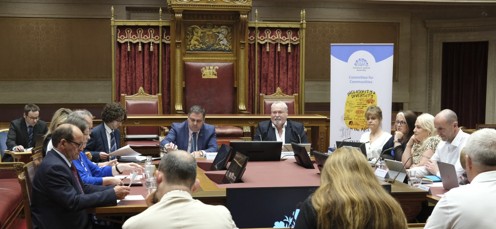
Members of the Committee hosting the Joint Oireachtas Committee on Social Protection, Rural and Community Development in the Senate Chamber
Delivery Against Strategic Priorities
5. The Committee’s strategic priorities for the mandate were agreed in May 2024 and reviewed in October 2024. At its first meeting of the session, on 11 September 2025, the Committee agreed to revisit them and, recognising that the volume of legislation expected in the remainder of the mandate could limit the time available for other scrutiny, asked the Department for a definitive list of the legislation it intended to bring forward. It reviewed and refreshed its priorities on 8 January 2026, and considered a further update on 26 February 2026. The Committee also reordered its agendas so that evidence sessions take place in advance of the Committee’s routine business items.
6. Among its highest priorities, the Committee concluded the Committee Stage of the Sign Language Bill; maintained a sustained focus on delivery of an effective Anti-Poverty Strategy; examined the pressures on homelessness services and the Supporting People Programme and reported with recommendations; pressed the Department on the Social Inclusion and language strategies; and scrutinised the Northern Ireland Football Fund and the governance of Sport NI. That work is set out below.
Meetings and Engagement
7. The Committee held 39 meetings between 11 September 2025 and 2 July 2026. Thirty-one were held in Room 29, Parliament Buildings, and six in the Senate Chamber. Two were held outside Parliament Buildings:
- The Skainos Centre, East Belfast (4 December 2025): held during Homelessness Awareness Week, when the Committee toured Hosford Community Homes and took evidence from the East Belfast Mission, the Committee Representing Independent Supporting People Providers and the Simon Community, which formed the basis of its subsequent report.
- Cardinal Tomás Ó Fiaich Library and Archive, Armagh (4 June 2026): where the Committee heard from the Library and Archive, the University of the Third Age, the Mellon Centre for Migration Studies and the Armagh Robinson Library on their work, funding and long-term sustainability.
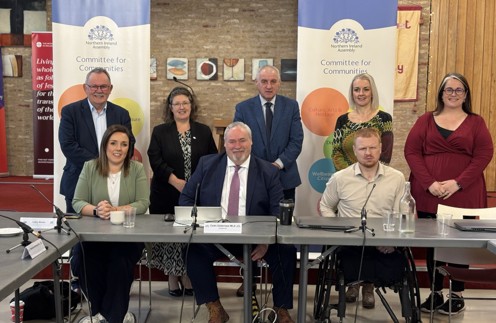
Members of the Committee during their offsite meeting at the Skainos Centre, East Belfast
8. On 21 May 2026 the Committee held a concurrent meeting with the Committee for Agriculture, Environment and Rural Affairs and the Committee for Infrastructure, taking a joint briefing from officials of the three Departments on the Shaping Sustainable Places consultation on regeneration and questioning them on cross-departmental collaboration, the role of local government, the funding model and a centre-first approach for rural towns.
9. The Committee held informal meetings on the Pension Schemes Bill Legislative Consent Motion (16 September 2025), with the Social Security Advisory Committee (20 November 2025), on the Universal Credit journal system (26 May 2026) and with Inspire Wellbeing (23 June 2026), together with four online briefings on the Pension Schemes Bill over the summer recess. It visited the Houses of the Oireachtas on 17 December 2025 and hosted the Joint Oireachtas Committee on Social Protection, Rural and Community Development in June 2026.
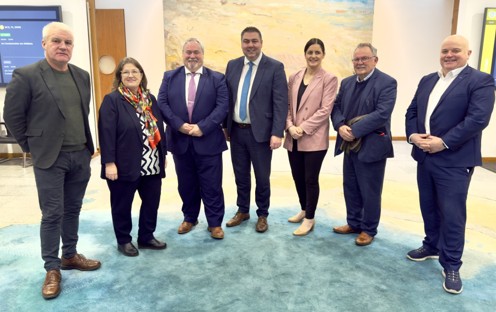
Members of the Committee during a visit to Leinster House, Dublin, with members of the Joint Oireachtas Committee on Social Protection, Rural and Community Development
10. Every meeting commenced in public session and no meeting was held entirely in closed session. Of the 39 meetings, 17 contained a period of closed session, across 20 periods ranging from 15 minutes to 1 hour and 49 minutes. Closed session was used only where required: for deliberations on the clauses of the Sign Language Bill with the Bill Clerk; for legal and procedural advice; for strategic planning; for a briefing held under embargo; for departmental briefings on the Northern Ireland Football Fund, fuel costs and Sport NI; and, on one occasion, for reasons of confidentiality due to ongoing legal proceedings.
Primary Legislation
Sign Language Bill
11. The Bill was introduced on 10 February 2025 and referred to the Committee after its Second Stage on 18 February 2025. It provides for official recognition of British Sign Language (BSL) and Irish Sign Language (ISL) and places duties on public bodies to promote the languages and provide accessible services. Northern Ireland is set to become the first part of these islands to legislate for both sign languages in a single Act.
12. Having completed most of its evidence gathering in the previous session, the Committee took stock of the evidence in September 2025, heard further evidence from Deaf OAP NI and the Christian Fellowship Church Sign Language Centre, received departmental briefings and legal advice, and held detailed clause-by-clause deliberations at six meetings between 6 November and 4 December 2025. Committee then wrote to the Department setting out the amendments it wished to see and seeking clarification on matters raised in evidence that fell outside the clauses, and asked the Bill Clerk to prepare amendment text for use in the event that the Department did not do so.
13. The Department brought forward amendments in response, which the Committee considered in January 2026 before completing its formal clause-by-clause consideration. It agreed its report on 5 February and the Committee Stage concluded on 12 February 2026 with publication of the Report on the Sign Language Bill (NIA 140/22-27), alongside producing signed summaries in BSL and ISL. The Committee’s scrutiny secured significant changes to the Bill as introduced, including:
- the upper age limit for young people’s access to sign language classes was raised from under 19 to under 25;
- changes to the list of public bodies subject to the duties, and rules on accreditation of teachers and interpreters, are subject to greater Assembly scrutiny;
- the Department must consult more widely than a single person or organisation from the Deaf community when implementing the legislation;
- any report on the operation and impact of the legislation must be laid before the Assembly; and
- the first such report is due after five years, allowing the legislation to embed, with subsequent reports every three years rather than five.
14. Throughout the Committee Stage, sign language users could submit evidence in their first language by video for translation, and live interpretation was provided at evidence sessions. This is a model for inclusive scrutiny the Committee considers could be applied more widely. Committee placed on record its thanks to the Deaf community, whose involvement was central to the quality of its scrutiny.
Charities (Amendment) Bill
15. Following a pre-introductory briefing in March 2026, the Bill was introduced on 15 June 2026 and referred to the Committee after its Second Stage on 23 June. The Committee agreed its Committee Stage arrangements on 25 June and took evidence from officials on 2 July, covering the audit threshold, reporting requirements for charities operating on an all-island basis, designated religious charities and anti-avoidance provisions. Committee then launched its call for evidence over the summer recess.
Members’ Bills
16. The Housing (Amendment) Bill, sponsored by the Committee Chairperson, seeks to extend the period within which a person is treated as threatened with homelessness so that preventative support can be provided earlier. The Committee took pre-introductory evidence from the Department in March 2026 and heard from the Bill sponsor on 2 July, with the Deputy Chairperson taking the Chair for that item.
17. The Conversion Practices (Criminalisation) Bill, sponsored by Eóin Tennyson MLA, was the subject of a briefing from the sponsor the same day, covering the practical effect of the Bill, safeguards, the relationship with existing domestic abuse legislation and protections for pastoral and faith-based organisations.
18. Unusually, the Committee agreed to launch calls for views on both Members’ Bills before their Second Stages so that the summer recess could be used productively: eight weeks for the Housing (Amendment) Bill and twelve for the Conversion Practices (Criminalisation) Bill. It also took pre-introductory briefings on the forthcoming Public Administration (Fraud, Error and Recovery) Bill, and the Executive Pensions Schemes Bill and the Executive’s own Housing (Amendment) Bill.
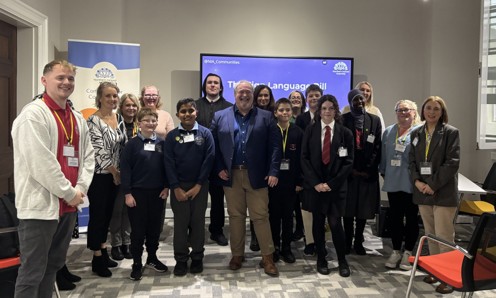
Members of the Committee meeting young representatives of the Deaf community as part of engagement on the Sign Language Bill
Legislative Consent Memoranda
19. The Committee considered and reported on two Legislative Consent Memoranda (LCMs).
20. Pension Schemes Bill: The Committee scheduled its work to report within the 15 days provided by Standing Order 42A(7). After an informal session with officials, it took formal evidence on 9 October 2025 — covering parity, the impact on people living in border areas and the implications of not consenting — and from the Association of British Insurers on 16 October. Its report (NIA 125/22-27) was published on 23 October 2025. Considering a subsequent LCM on the same Bill in January 2026, the Committee wrote to the Department for Work and Pensions to emphasise the need for adequate time to be built into the Westminster timetable for effective scrutiny of LCMs.
21. Universal Credit (Removal of Two Child Limit) Bill: The Committee received procedural advice in January 2026 and took evidence on 29 January from Departmental officials, Advice NI, the Law Centre NI and the Cliff Edge Coalition, covering the families who would benefit, communication with claimants and the interaction with local welfare mitigations and supplementary payments. Its report (NIA 143/22-27) was published on 6 February 2026.
Inquiries and Reports
22. In addition to the legislative reports detailed above, the Committee published two reports arising from its own engagement work, and agreed its End of Session Report for February 2024 to July 2025.
Homelessness and the Supporting People Programme
23. Drawing on the evidence taken at The Skainos Centre and written submissions gathered during Homelessness Awareness Week, the Committee published its Report on Homelessness and the Supporting People Programme (NIA 161/22-27) on 24 April 2026. It noted that, as of September 2025, 62,314 people were recorded as homeless and more than 90,000 were on the social housing waiting list, and that the Supporting People Programme, which supports around 20,000 people each year, faced an estimated £5.5 million of additional costs in 2025-26 without any corresponding budget uplift. The Committee made five recommendations:
- immediate agreement of a multi-year Supporting People budget, with annual inflationary uplifts;
- completion of a comprehensive review of homelessness legislation, with a stronger focus on prevention;
- extension of the period within which a person is treated as threatened with homelessness, in line with best practice elsewhere;
- establishment of a cross-departmental task force to address homelessness as a health, trauma and social issue; and
- improved use of data to reflect both statutory and hidden homelessness.
24. The Committee also wrote to the Minister for Communities in support of a consistent uplift to Supporting People funding across the incoming three-year budget, to the Minister of Finance on the pressures facing providers, and to the Executive Office seeking a coordinated cross-departmental approach. It later heard from Housing Rights on homelessness prevention and from the Housing Executive and Belfast City Council on implementation.
Engagement with Local Government on the draft Anti-Poverty Strategy
25. Delivery of an effective Anti-Poverty Strategy remained one of the Committee’s highest priorities. It agreed its response to the Department’s consultation in September 2025 and took evidence from the Women’s Support Network, the Northern Ireland Anti-Poverty Network, Save the Children, the Joseph Rowntree Foundation and the Child Poverty Action Group.
26. Recognising the specific role of councils in tackling poverty locally, it then heard from a panel of council officers in March and from the Northern Ireland Local Government Association in April 2026. Its report (NIA 162/22-27) was published on 5 May 2026 and sent to the Minister under the Committee’s advisory remit, with a request that the recommendations be incorporated into the revision of the strategy.
27. On 16 April 2026, the Committee agreed to table a motion for debate, and on 26 May 2026 the Assembly passed it: “That this Assembly notes the Committee for Communities’ Report on Engagement with Local Government on the draft Anti-Poverty Strategy; and calls on the Minister for Communities and the Executive to implement the recommendations contained therein.”
28. The Committee took evidence from the Minister on 14 May 2026, when it agreed to write urging that a significantly revised strategy be brought forward before the summer recess, offering to meet during the recess if necessary to avoid delay, and in July asked for a matrix setting out how consultation responses had been reflected in the revised strategy.
Subordinate Legislation
29. The Committee considered 27 proposals for statutory rules (SL1s) and 30 Statutory Rules, together with 14 retention and disposal schedules. Several proposals were considered at two or three meetings before the Committee was content, and it often sought further information, changes to Explanatory Memoranda or a call for views before making decisions. The rules included the up-rating of benefits and pensions, Universal Credit and Housing Benefit, registered rents, and the Local Government Pension Scheme. Two matters were of particular interest:
- Winter Fuel Payment: Following reinstatement of the payment for all pensioners from winter 2025-26, the Committee considered the SL1 and the Rule at successive meetings in September 2025, pressing the Department on entitlement in border areas, reciprocal arrangements, the treatment of people not ordinarily resident in Northern Ireland and the communication of opt-out arrangements.
- Home Heating Oil Support Scheme: At the Minister’s request, the Committee agreed in July 2026 to consider this proposal within a shortened timeframe, given the need to deliver assistance quickly. The scheme, funded by a UK Government allocation of £17.2 million and a further £19.2 million agreed by the Executive, is expected to benefit around 300,000 households through a prepaid card restricted to fuel purchases. The Committee was content, subject to amendments to the Explanatory Memorandum, and launched a call for views prior to taking any final decision in September 2026.
Budget and Policy Scrutiny
Budget Scrutiny
30. The Committee received a briefing on the 2025-26 budget position and future years in November 2025 and a financial position update in February 2026, when it agreed its response to the Committee for Finance on the Executive’s draft multi-year Budget for 2026-27 to 2029-30. It received quarterly updates from the Permanent Secretary and finance officials in April and from the Minister in June 2026. Key lines of inquiry included funding for new social housing; an inflationary uplift for the Supporting People Programme; the future of UK Shared Prosperity Fund money; and the decision not to publish a Child Rights Impact Assessment ahead of the budget.
Policy Scrutiny
31. Housing: The Committee scrutinised changes to the funding of new social homes, heard from the Northern Ireland Federation of Housing Associations and was briefed on the review of the Decent Homes Standard. It pressed the Housing Executive on building to accessible and lifetime-home standards, and examined building safety policy.
32. Welfare, Social Security and Social Inclusion: The Committee examined the Northern Ireland implications of the UK Government’s reforms to disability benefits, seeking NI-specific impact assessments, and forwarded its concerns about barriers to participation in the Timms Review of Personal Independence Payment to the Secretary of State. It pressed for a definitive timetable for the Social Inclusion Strategies and for meaningful engagement with the co-design groups, and scrutinised the Departmental Disability Action Plan 2025-2030.
33. Sport: The Committee scrutinised the Northern Ireland Football Fund on several occasions, pressing the Department on regional balance, the scoring and moderation of applications and the options presented to the Minister. It heard from Cricket Ireland, Ulster Hockey and Sport NI.
34. Languages, Culture and Heritage: The Committee wrote to the Executive Office and the Department when the trilingual logo was removed from Departmental correspondence, and heard from the Irish Language Strategy Co-Design Group, the Irish Language Commissioner and the Commissioner for the Ulster Scots and the Ulster British Tradition. It was briefed on the Place-Name Project, the Heritage, Culture and Creativity Programme and preparations for Fleadh Cheoil na hÉireann and Orangefest.
35. Community and Local Government: The Committee examined the Partnership Agreement between Government and the community and voluntary sector, the Community Infrastructure Fund and the review of the Rates Support Grant. Following a briefing from the Administrative Data Research Centre Northern Ireland, it asked the Minister of Finance to develop a data-sharing strategy for Northern Ireland, in line with those in Scotland, Wales and England.
Scrutiny and Access to Information
36. Effective scrutiny depends on the timely provision of information. In September 2025, the Committee wrote to the Speaker and to the Minister to express concern that Members were being bypassed when major announcements were made outside the Assembly. It took advice from Assembly Legal Services on the potential use of its powers under section 44 of the Northern Ireland Act 1998, and in November 2025 reminded the Department of its obligations under section 11 of the Functioning of Government (Miscellaneous Provisions) Act (Northern Ireland) 2021.
EU Scrutiny
37. EU-related matters featured principally through subordinate legislation on social security entitlement. The Committee considered the Social Security (Miscellaneous Amendments No. 2) Regulations, which provide a legal basis for the continued payment of disability and carer benefits to a cohort of claimants not explicitly covered by the EU Withdrawal Agreement; the Social Security (Residence in an EEA State or Switzerland) (Amendment) Regulations (Northern Ireland) 2025; and amendments to the habitual residence and past presence rules. In its scrutiny of the Charities (Amendment) Bill and its briefing on administrative data, it also asked questions in relation to arrangements for co-operation with counterparts in the Republic of Ireland and in other EU territories.
Likely Key Priorities for 2026-27 Session
38. The 2026-27 session will be the final session of the mandate and will be truncated by dissolution in spring 2027 ahead of the Assembly election. With a shorter session and a heavy programme of Bills, Committee Stages will dominate and scrutiny in other areas will need to be sharply focused. Key priorities will include:
- completing the Committee Stage of the Charities (Amendment) Bill and taking the Committee Stages of the Housing (Amendment) Bill and the Conversion Practices (Criminalisation) Bill;
- scrutinising further expected Executive and Members’ Bills introduced in the remaining time, together with the steady stream of important delegated legislation
- holding the Department to account for delivery of a revised Anti-Poverty Strategy, reflecting the Assembly’s resolution of 26 May 2026, and pursuing the recommendations of the Committee’s report on homelessness and the Supporting People Programme;
- monitoring preparations for implementation of the Sign Language Act, and continuing to scrutinise the Social Inclusion and language strategies, the Northern Ireland Football Fund, the governance of Sport NI and the allocation of resources under the multi-year budget; and
- preparing a legacy report to inform the work of its successor Committee, drawing together outstanding issues and recommendations from across the mandate.
Annex: Committee Expenditure
Committee for Communities: Expenditure for the period 1 September 2025 – 31 August 2026
|
Budget area
|
Details |
Expenditure |
|
Committee travel and subsistence |
Travel expenses (taxi and mileage) for witnesses attending evidence sessions |
£85.20 |
|
|
Committee staff mileage allowance, principally for the external meeting in Armagh on 4 June 2026 |
£107.80 |
|
|
Committee staff passenger allowance for the external meeting in Armagh |
£4.70 |
|
|
Coach hire for the Committee’s visit to the Houses of the Oireachtas, Dublin, on 17 December 2025 |
£640.00 |
|
Subtotal: travel and subsistence |
£837.70 |
|
|
Advertising |
Public notices inviting evidence on the Charities (Amendment) Bill, the Housing (Amendment) Bill and the Conversion Practices (Criminalisation) Bill |
£2,758.85 |
|
Printing |
Printing of the Report on Homelessness and the Supporting People Programme and the Report on Engagement with Local Government on the draft Anti-Poverty Strategy; roll-up banners for Committee meetings and events |
£645.00 |
|
Media monitoring |
Transcripts of broadcast interviews given by the Minister for Communities and others on matters within the Committee’s remit |
£535.00 |
|
Specialist services: sign language interpretation |
British Sign Language and Irish Sign Language interpretation for Committee meetings, evidence sessions, engagement events with the Deaf and DeafBlind communities, the translation of survey questions and video evidence, and the BSL and ISL summaries of the Committee’s Report on the Sign Language Bill |
£10,367.70 |
|
Hospitality |
Working lunch hosted for the Joint Oireachtas Committee on Social Protection, Rural and Community Development during its visit to Parliament Buildings on 25 June 2026 |
£745.47 |
|
Refreshments |
Refreshments for Committee meetings and informal sessions throughout the session, including catering for the external meeting at The Skainos Centre on 4 December 2025 |
£3,137.35 |
|
Total expenditure |
£19,027.07 |
|
You may re-use this publication (not including images or logos) free of charge in any format or medium, under the terms of the Open Northern Ireland Assembly Licence. To find out more about this licence visit: http://data.niassembly.gov.uk/license.aspx
This Report can be made available in a range of formats including large print, Braille etc. For more information, please contact:
Committee for Communities
Emer Boyle
Northern Ireland Assembly
Parliament Buildings
Ballymiscaw
Stormont
Belfast BT4 3XX
Telephone: 028 90 521895
Email: Committee.Communities@niassembly.gov.uk
X (formerly Twitter): @NIA_Communities


