Brexit and Beyond
09 February 2026

In what was a busy week for discussion and debate on UK-EU relations in Westminster, we take a closer look at the Northern Ireland Affairs Committee’s evidence session on Economic growth in Northern Ireland: new and emerging sectors, as well as evidence to the Culture, Media and Sport Committee on Performing arts touring in the EU.
In Assembly Round-up, we report back on EU and Brexit related issues discussed in the Assembly last week and look forward to what’s on this week’s agenda.
Our regular ‘Parliamentary Planner’ section highlights upcoming debates and discussion topics at other legislatures next week, and as always, we link you through to news stories and items of interest you may have missed.
- Case for the defence: UK security cooperation with Europe
- Northern Ireland Affairs Committee takes evidence from Intertrade UK and InterTradeIreland
- Committee told: “Brexit has placed British performers in a cultural cul-de-sac”
- Assembly Round-up
- Economy Committee receive update on Clustering Strategy
- This week in the Assembly
- Parliamentary Planner
- While you’re here…
- In case you missed it…
Case for the defence: UK security cooperation with Europe
On Monday, the Minister for Defence Readiness and Industry, Luke Pollard MP responded to an oral question on what discussions he has had with his EU counterparts on UK access to the Security Action for Europe (SAFE) fund. The Minister told the House that: “We entered negotiations on SAFE participation in good faith; however, no agreement was possible that met our national interests.”
Welcoming new defence partnerships with EU partners, including France and Germany, he added that the government would: “…continue to explore co-operation with the EU and its member states that strengthens European security and underpins our NATO-first policy.”
Mr. Pollard argued that closer partnership benefits EU member states, continuing: “We are an important player on the international defence scene, and it is important that UK businesses are able to access markets, not just for the purposes of economic growth, but because that keeps European Union member states safe.”
Northern Ireland Affairs Committee takes evidence from Intertrade UK and InterTradeIreland
Continuing its evidence sessions on Economic growth in Northern Ireland: new and emerging sectors, last Wednesday the Northern Ireland Affairs Committee heard from Baroness Foster of Aghadrumsee DBE, Chair, Intertrade UK and Colin McCabrey Director of Trade at InterTradeIreland.
Opening the session, Baroness Foster set out the role and remit of Intertrade UK, by telling Members that the organisation advises: “…the Secretary of State about internal barriers that we come across and how we think they can be dealt with to promote trade internally within the UK and, if there are problems, how we can fix them and encourage people to trade across the United Kingdom.” She added that they also look at infrastructure, citing current engagement with: “…Belfast port and Larne port to see what better connectivity there is for Northern Ireland and the rest of the UK.”
Raising what he termed as: “…the complexities that flow out of the Windsor framework”, and citing Lord Murphy’s Review, Robin Swann MP asked Baroness Foster about her influence and involvement in trying to get answers to the challenges that businesses are facing. Baroness Foster said: “When there are changes at European Union level that are applicable to Northern Ireland, we are concerned about whether there is a good level of knowledge within the business community about what is required.” She added: “…Intertrade UK is about trying to find practical solutions. We are not there to solve all the problems of our exit from the EU.”
In his opening remarks to the Committee, Colin McCabrey, the Director of Trade at InterTradeIreland, explained that InterTradeIreland was established under the Belfast/Good Friday Agreement and was: “…the only organisation with a direct legislative mandate to lead economic development across the island of Ireland.”
Asked by the Committee Chair, Tonia Antoniazzi MP, how he saw InterTradeIreland’s role in relation to that of Intertrade UK, Mr. McCabrey told the Committee that while they were separate bodies with different remits: “In working together, we see great opportunities. The trade statistics show that trade across the island, north-south, and east-west trade are equally important. It is about growing trade across the island.”
Responding to a question from Simon Hoare MP on how Northern Irish businesses can better leverage their position on the island of Ireland to support growth, Mr. McCabrey said: “Our research tells us, and businesses tell us, that with so much geopolitical uncertainty across the globe, businesses are opting for stability… but I think that, in time, the dual market access opportunities will be realised.”
Mr. McCabrey pointed out growth in cross-border and east-west trade of goods and services and observed that, while this was not necessarily a consequence of Brexit and the Windsor framework: “…businesses are looking at how they can diversify their markets to remain more resilient in the context of wider geopolitical challenges.” He added that: “Dual market access is a very interesting opportunity for Northern Ireland, but it is good for GB and Northern Ireland trade as well.” You can watch the evidence session in full here:
Committee told: “Brexit has placed British performers in a cultural cul-de-sac”
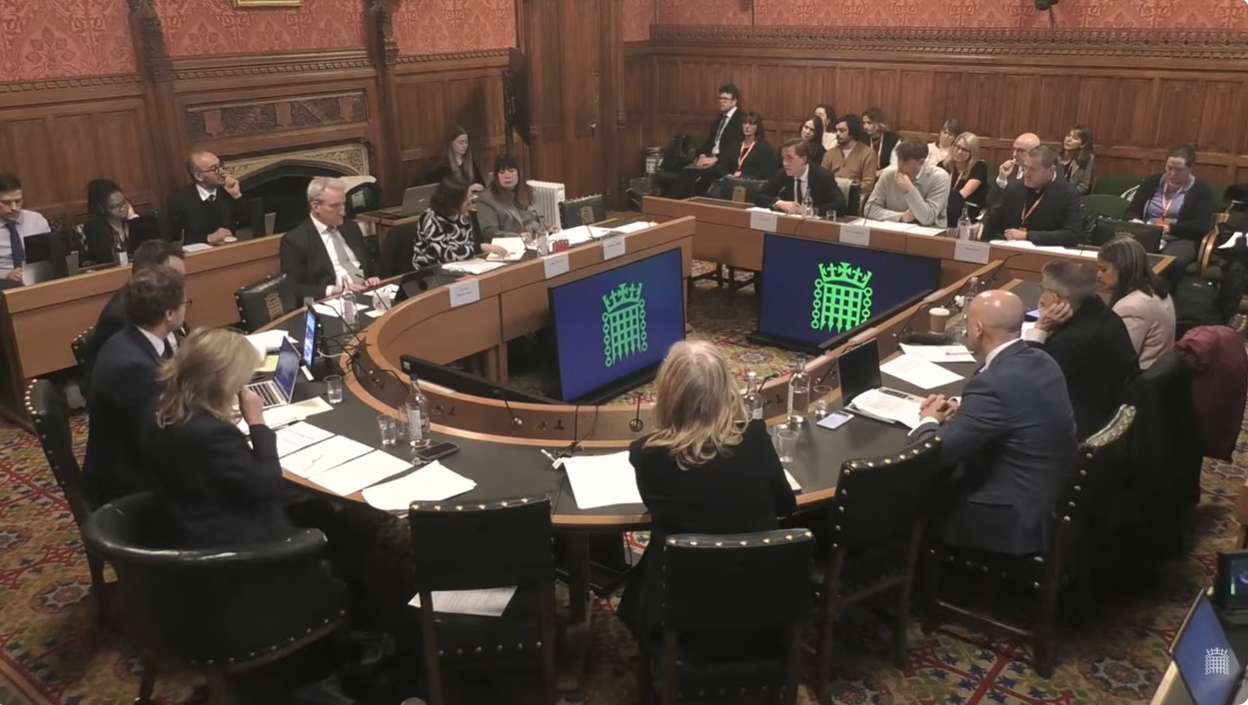
Meanwhile on Tuesday, 3 February, the House of Commons Culture, Media and Sport Committee heard evidence on the current state of play regarding performing arts touring in the EU.
Matt Hood, Managing Director at Spotlight told the Committee that: “Brexit has placed British performers in a cultural cul-de-sac.” He said that while he didn’t think the volume of work in Europe has changed dramatically since Brexit, “They are filtering out British performers or making sure that they are only calling for performers who hold a European passport already.”
Mr. Hood further noted that in the film and television area, more productions which could have been based in the UK were basing themselves in Ireland, in order to access both the UK and EU market.
Asked what solutions he would like to see to the current challenges, Mr. Hood said: “A more generous and more consistent Schengen visa waiver for the performing arts is important. In the meantime, having a consistent source of advice for the performing arts around the visa situation that is easily accessible is vital.”
Providing stats from a 2024 survey of Musicians’ Union Members, the Union’s General Secretary, Naomi Pohl told the Committee that: “75% of respondents who had previously worked in the EU prior to Brexit had seen a decline in their income, with 59% saying that EU touring was no longer viable for them and 54% saying merchandise sales had been affected.”
Witnesses also discussed the issue of cabotage limits, which means UK touring vehicles are only permitted to make limited stops within the EU before returning to the UK, increasing costs and complicating logistics. The session further explored the difficulties and additional expense incurred through ATA Carnets, as well as what difference a possible future UK-EU agreement on reciprocal visa waivers could make for touring artists. You can watch the meeting in full here:
Assembly Round-up:

During Members’ Statements in the Assembly last Monday, Sinéad McLaughlin MLA spoke about the global economy, referring to the previous week’s Executive Office Committee, when Members heard from the Directors of the Executive’s three overseas bureaux in Brussels, Beijing and Washington DC. Ms. McLaughlin told Members: “As the global landscape shifts, the case for rejoining the European Union is clearer now than ever before, and social democracy must sit at the heart of how we respond, because diversification is not just an economic strategy but a political one.” She said that while Trade Missions and overseas offices are important: “…they must be matched by delivery at home, a planning system that works, infrastructure that enables growth and an Executive who understand that resilience comes from balance, not dependency.”You can read the full statement here:
On Tuesday, the Minister for Communities, Gordon Lyons MLA provided a statement to the Assembly on the recent meeting of the North/South Ministerial Council (NSMC) language body, which was held at the Monaghan Peace Campus on 3 December 2025.
Mr. Lyons told the Assembly that the Council had noted the key achievements of the language body which included: “…the first tranche of online entries for the Irish language's first comprehensive monolingual dictionary; the provision of support to over 90 groups to promote the Irish language in the arts sector; the supporting of tuition in Ulster-Scots music and dance in over 200 community settings and 100 schools across Ulster; and the delivery of 36 talks promoting the Ulster-Scots language to schools and community groups, which reached more than 1,000 people.” You can read the full statement as well as questions from Members here:
Economy Committee receive update on Clustering Strategy
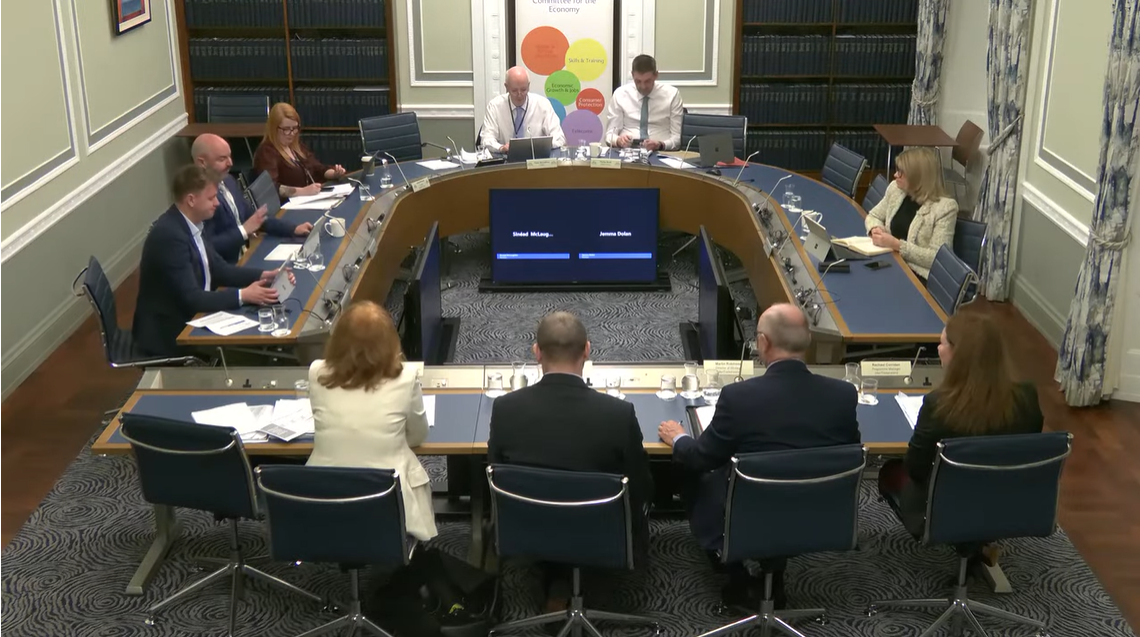
On Wednesday, the Committee for the Economy took evidence from representatives from the Department of the Economy, Invest NI and InterTradeIreland on the development of a ‘Clustering Strategy’. Opening the evidence session, Alan Ramsey from the Department for the Economy explained to Members that clustering in this context is when “…businesses come together to adopt a structured approach to collaboration that can lead to increased productivity and competitiveness.”
Mr. Ramsey highlighted a number of applicable funding programmes across the UK and Ireland, including: the Shared Island Enterprise Scheme; the Enhanced Investment Zone Programme, PeacePlus and the Local Innovation Partnership Fund which he said were: “…all about enhancing collaboration between industry, government and researchers.”
Further discussion centred upon the work of InterTradeIreland’s Synergy Project and the support it has provided to initiatives such as ‘The Fintech Corridor’ in developing the cross-border cluster. Martin Robinson, Director of Strategy at InterTradeIreland highlighted the organisation’s Trade Hub which provides resources and guidance for businesses on cross-border trade between Ireland and Northern Ireland. The Committee also heard more about the Invest NI Cluster Acceleration Programme (CAP).
Members asked witnesses a number of questions relating to: the delay in publishing the Department’s clustering policy; the difficulties and opportunities experienced through North-South working and collaboration; if clustering could help support apprenticeship programmes; and on the benefits of dual market access and how critical that could be to the success of clusters. You can watch the meeting in full here:
This week in the Assembly
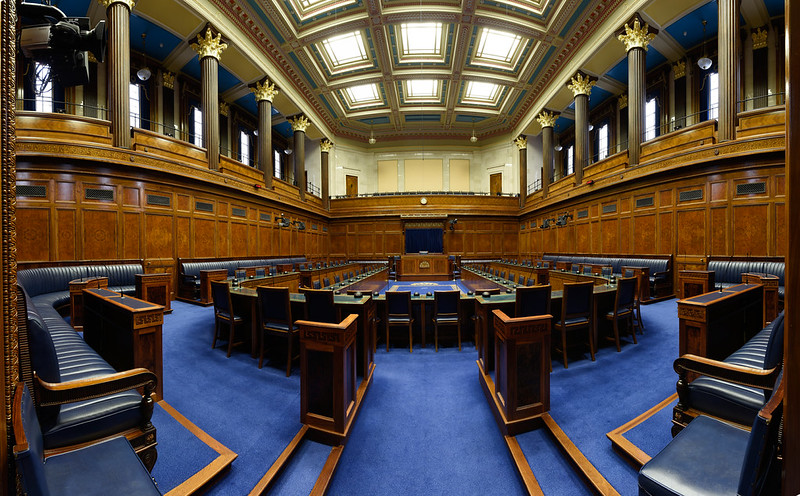
Today, the Minister for the Economy made statements to the Assembly on the recent North South Ministerial Council (NSMC) Trade and Business Development and the NSMC Tourism Sectoral Meetings.
Meanwhile, this afternoon during Private Members’ Business, the Assembly will debate a motion on a UK-EU Customs Union. The motion calls on: “… the UK Government to commence negotiations with the European Union on establishing a UK–EU customs union, or equivalent comprehensive customs arrangement, in order to address remaining Brexit-related trade bureaucracy and build on the foundations provided by the Windsor Framework.” You can read the full wording of the motion here:

Today, in the House of Commons there will be a general debate on the UK-India free trade agreement.
During questions to the Department for Energy Security and Net Zero on Tuesday, the Minister is expected to provide an update on the UK Emissions Trading Scheme to reflect the carbon abatement costs of major projects. A further tabled question asks the Minister what steps he is taking to help improve energy interconnection between the UK and the EU.
On Tuesday afternoon, the Business and Trade Committee will hold an oral evidence session on UK trade with the US, India and EU.
While you’re here…
We’re redeveloping the Northern Ireland Assembly website - and we would love to hear your views and ideas.
Whether you use the site to follow Assembly business, read reports, learn how the Assembly works or to access news and updates about UK-EU relations and interparliamentary affairs, your experience matters.
Take our short survey (around 5-10 minutes) and help us shape a clearer, more accessible website for everyone.
Closing date: Sunday 15 February 2026
In case you missed it…

-
A Politico article published on 3 February, reports on an address to the Spanish Senate by European Parliament President Roberta Metsola, in which she called for closer ties with the U.K. You can read President Mesola’s speech in full here.
-
The Guardian and the Independent reported over the weekend that Post-Brexit sales of British farm products to EU fell by 37% in the five years since 2019. Both outlets cite analysis of HMRC data by the National Farmers’ Union.
-
On Thursday, 5 February, the Irish News published an article stating that: New car registrations in Northern Ireland down 11% in January amid diverging EU and UK regulatory landscape.
-
On the 3 February, the BBC reported: ‘EU has 'open mind' on UK customs union debate, says commissioner.’ The article quotes the European Commissioner for finance, Valdis Dombrovskis as saying: the bloc was "ready to engage" if the UK wanted to explore the move.
-
On Saturday, 8 February, a Press Association report published in the Newsletter says: £35 million funding boost for cross-community and cross-border initiatives. The report references that the support comes through the EU Peace Plus programme and is "designed to help communities strengthen local relationships and build lasting connections".
-
A policy brief issued on 3 February by the Centre for European Reform asks: EU-UK relations: Will 2026 be the year to reset the reset?
-
Professor Anand Menon discusses progress on the reset in a blog for the University of Glasgow Centre for Public Policy, published 4 February: The promised UK/EU reset
-
On 4 February, the Cabinet Office issued a draft Explanatory Memorandum on a European Commission recommendation authorising the opening of negotiations between the European Union and the UK, regarding the United Kingdom’s participation in the internal electricity market of the Union and on a financial contribution of the United Kingdom towards reducing economic and social disparities between the regions of the Union.
-
The Vet Times reported on 3 February, that New BVA boss vows to act if NI faces medicine problems.
-
A Bloomberg article published on 2 February, UK Warns EU ‘Made in Europe’ Plan Risks Disrupting Car, Tech Supply Chains, reports that the UK Government “is lobbying the EU against restricting market access for British businesses under the bloc’s ‘Made in Europe’ initiative” (Behind a paywall)


