Brexit and Beyond
02 February 2026

In this week’s edition, we cover today’s meeting of the Withdrawal Agreement Joint Committee, including its decision to add a new EU Act to the Windsor Framework.
In Assembly Round-up, we take an in-depth look at an Assembly debate on Economic Trends on the Island of Ireland, which saw discussions in relation to Brexit and the Windsor framework brought to the fore. We also report on the Executive Office Committee’s evidence session last week with the Directors of the Executive’s three overseas bureaux in Brussels, Beijing and Washington DC.
In Westminster Brief, we provide an overview of last week’s debate in the House of Lords on the case for a UK-EU customs union and in our regular Parliamentary Planner, we highlight upcoming debates and discussion topics at other legislatures this week.
- Meetings of the Withdrawal Agreement Joint Committee and Trade and Cooperation Agreement Partnership Council.
- Withdrawal Agreement Joint Committee decision on adding new EU Act to the Windsor Framework.
- Assembly Round-up.
- Education Minister's Statement on North/South Ministerial Council (NSMC) in the education sector.
- Assembly debates motion on Economic Trends on the Island of Ireland.
- Questions to the Minister of Agriculture, Environment and Rural Affairs.
- Health Minister’s Statement on North/South Ministerial Council health and food safety sectoral meeting.
- Executive Office Committee updated on work of overseas bureaux.
- Case for a UK-EU customs union debated in the House of Lords.
- Westminster Brief.
- This week in the Assembly.
- Parliamentary Planner.
- In case you missed it…
Meetings of the Withdrawal Agreement Joint Committee and Trade and Cooperation Agreement Partnership Council
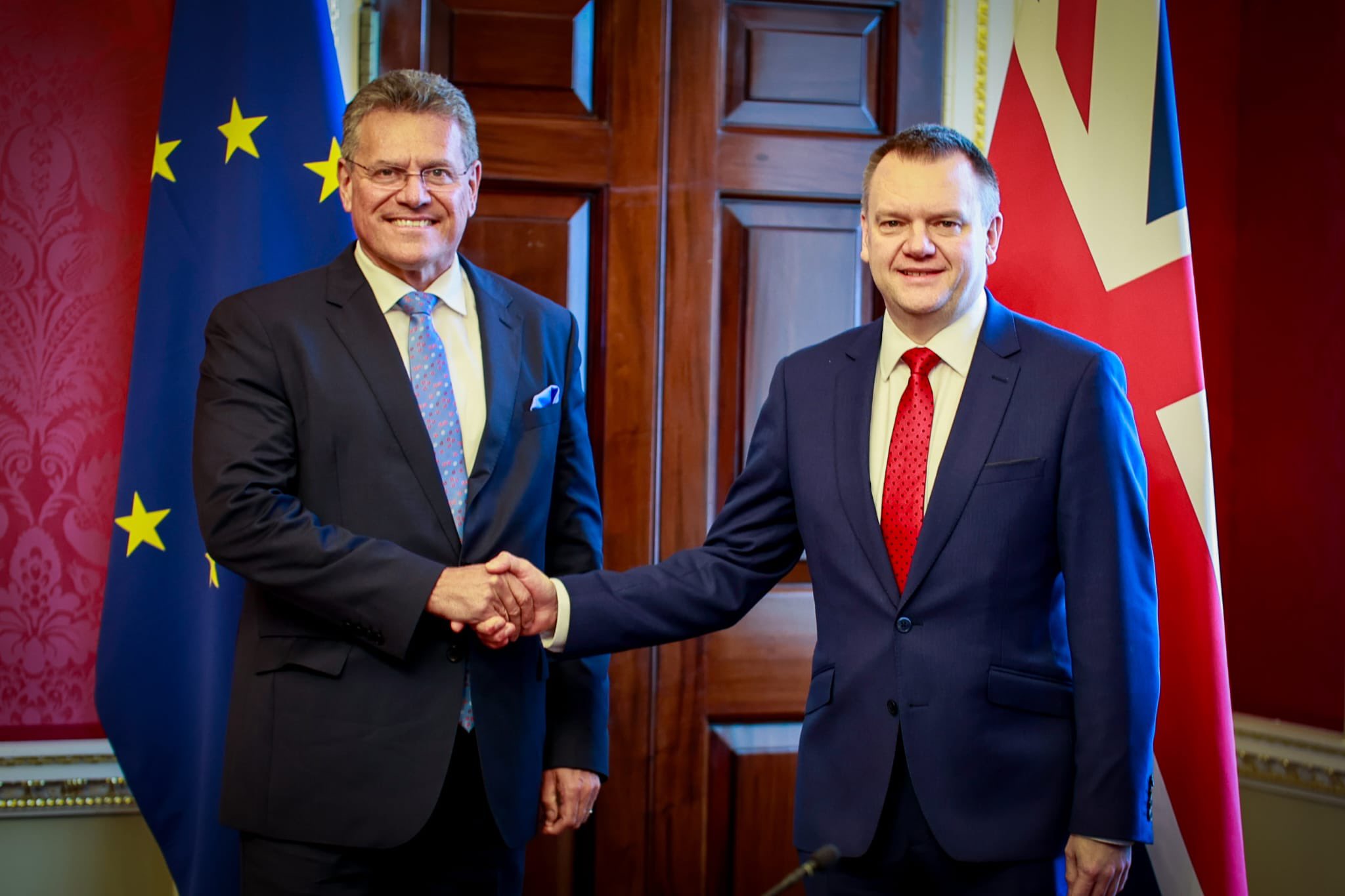
This afternoon, the UK Minister for the Cabinet Office Nick Thomas-Symonds and the European Commissioner, Maroš Šefčovič issued a joint statement following meetings of the Withdrawal Agreement Joint Committee and Trade and Cooperation Agreement (TCA) Partnership Council in London.
The Joint Committee considered the state of play of the implementation of the Withdrawal Agreement including the Windsor Framework. The co-chairs welcomed the positive trajectory in the implementation of the Windsor Framework and highlighted new milestones reached, including new simplified customs arrangements since May 2025 and reduced sanitary and phytosanitary checks since December 2025.
The co-chairs also noted the transition to veterinary medicines arrangements in January 2026 as well as positive developments in the delivery of safeguards for the protection of the EU Single Market, including customs IT access to all relevant UK systems and progress on sanitary and phytosanitary aspects. They agreed to continue work swiftly on delivery of all remaining safeguards.
You can read the full statement by the co-chairs regarding both meetings here:
Withdrawal Agreement Joint Committee decision on adding new EU Act to the Windsor Framework
At today’s meeting, the Withdrawal Agreement Joint Committee also agreed to add a new EU act to the Windsor Framework. Regulation (EU) 2025/14 establishes a harmonised framework for road safety type-approval for mobile machinery that is occasionally used on public roads.
The Paymaster General and Minister for the Cabinet Office, the Rt Hon Nick Thomas-Symonds MP, informed the House of Commons in a Written Statement on 28 January, setting out the UK Government’s assessment that the Regulation would not create a new regulatory border between Great Britain and Northern Ireland.
The statement was made in accordance with paragraph 18(3) of Schedule 6B to the Northern Ireland Act 1998, to explain why the Minister is of the opinion that the necessary conditions have been met to add a new EU act to the Windsor Framework without the requirement for the Assembly to indicate support by passing an applicability motion.
The Secretary of State, the Rt Hon Hilary Benn MP, also wrote to the Speaker of the Northern Ireland Assembly on 28 January providing more detail on the Government’s decision.
The UK Government’s Explanatory Memorandum on the Regulation sets out the Government’s assessment of potential policy impacts and the relationship to UK Government policy and can be read in full here.
Assembly Round-up
It was another busy week in the chamber for Brexit, EU and North/South related affairs.
Education Minister's Statement on North/South Ministerial Council (NSMC) in the education sector
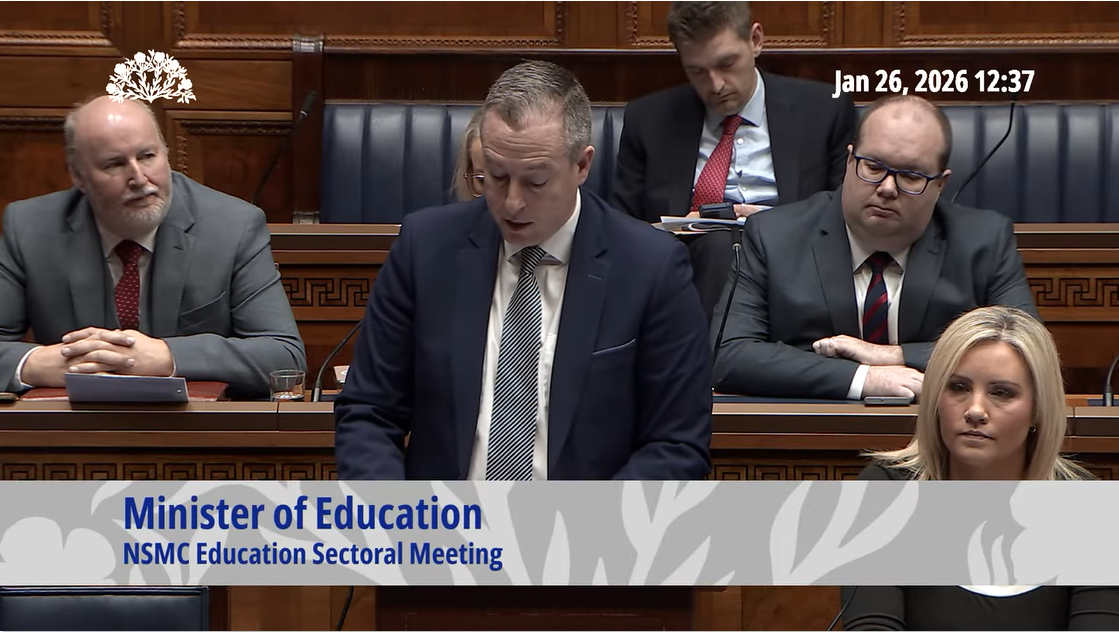
On Monday, the Minister of Education, Paul Givan MLA delivered a statement on the meeting of the North/South Ministerial Council (NSMC) in the education sector, held at the Monaghan Peace Campus on Friday 23 January.
Mr. Givan told Members that attending Ministers had: “…welcomed the continued progress and cooperation by both Departments [ Department of Education and Youth and the Department of Education in Northern Ireland] on implementation of the agreed programme of cooperation on educational attainment, supported through an allocation of up to €24 million from the Government of Ireland’s Shared Island Fund.”
Assembly debates motion on Economic Trends on the Island of Ireland
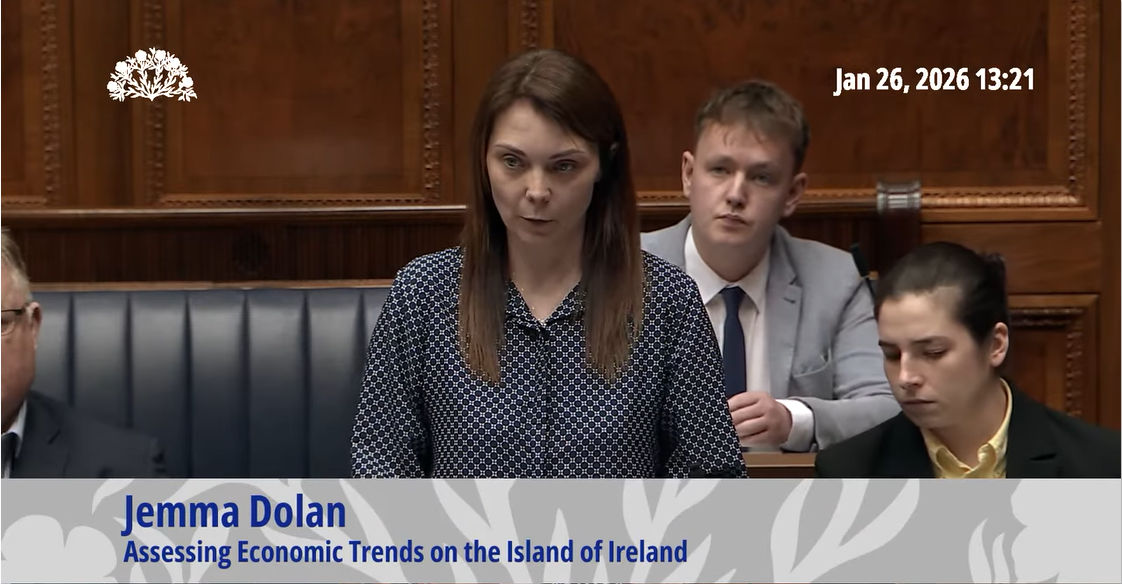
Also on Monday, a Private Members’ Business motion on Economic Trends on the Island of Ireland called on the Assembly to recognise the significance of the Economic and Social Research Institute’s December 2025 report. The ensuing debate saw issues in relation to Brexit and the Windsor Framework brought to the fore.
Moving the motion, Jemma Dolan MLA told Members that the Economic and Social Research Institute (ESRI) 2025 report: “…shows that the South outperforms the North in almost all the key indicators that are used to measure the health and well-being of our citizens.” She added that: “Several of the economic measurements indicate that the gaps between the two jurisdictions on our island are continuing to grow, primarily because the North is tied to a failing economy in Britain following Brexit and a decade and a half of austerity measures.”
Responding to Ms. Dolan, Phillip Brett MLA argued that: “Northern Ireland benefits from cooperation, where it makes sense; openness to trade; and constructive relationships across these islands. That does not, however, require us to pretend that two very different economies are, in fact, one.”
David Honeyford MLA said that the Northern Ireland Economy was growing by 2.8%, a fact he said that was referenced in the report. He added that: “Some 51% of trade is now with UK. Trade with the South has grown to 26%, and trade with the EU and the rest of the world has also grown. Those are all good news stories; it is not a choice between one or the other, as has been said…”
Citing the recent work of the Ulster University economist Dr Esmond Birnie, on the growth of North/South trade, Diana Armstrong MLA said that his analysis shows: “…that the growth is driven largely by trade diversion and a rerouting of supply chains in response to post-Brexit frictions.”She added that: “Our trade with Great Britain is still several times larger. Our UK internal market remains the backbone of our economy, our supply chains and our consumer base. That is not a political slogan; it is an economic reality and a fact.”
In his winding-up speech, Pádraig Delargy MLA told Members that the report’s data: “…shows that the all-Ireland economy is not only real but growing.” Regarding the Windsor Framework, he said that it is: “...the opportunity that has resulted in economic benefit in the North. It has protected our businesses and constituents and has continued to show economic growth and upward economic trends.” In his concluding remarks, Mr Delargy said: “…the report is hugely beneficial. It offers huge policy opportunities, and it shows the benefits of collaboration, cooperation and working together.”
The Assembly voted, resulting in 46 Ayes in support of the motion and 32 Noes against. You can read the full debate here:
Questions to the Minister of Agriculture, Environment and Rural Affairs
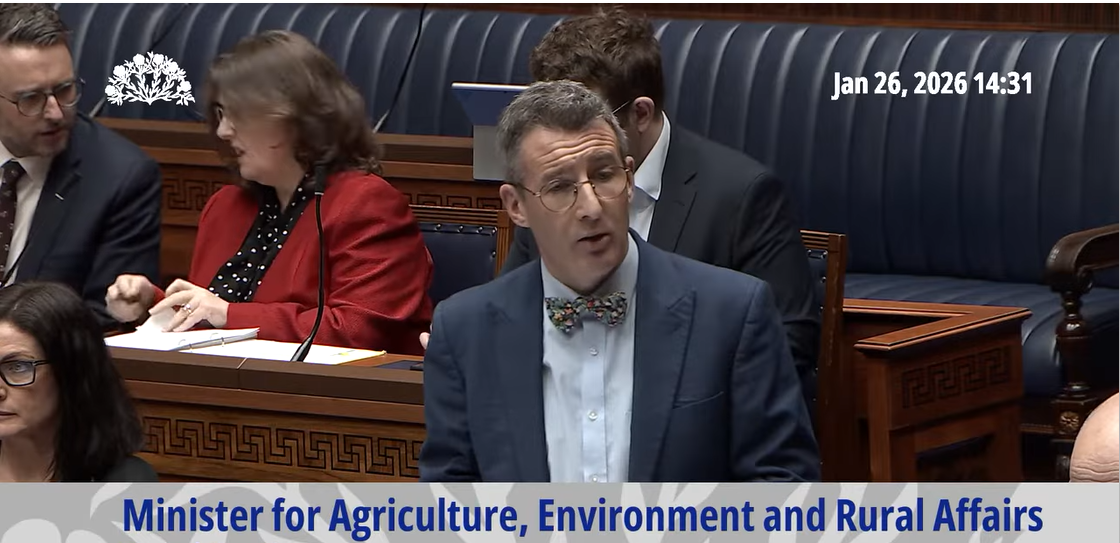
The Minister of Agriculture, Environment and Rural Affairs, Andrew Muir MLA was in the chamber on Monday for Question Time. Asked how the roll-out of Farming with Nature supported farmers to look after nature and the environment, the Minister said that he was conscious that: “…agri-environment support reduced post the EU exit” and that he was seeking to restore that.
Mr. Muir told Members that whilst the development of a new rural policy framework was ongoing, his department was continuing to address the needs and to develop the assets of rural communities: “… by delivering significant Executive priorities in partnership with the Special EU Programmes Body and councils.” He said that this included: “…delivering PEACE PLUS funding of €80 million and £31 million of city and growth and complementary funding initiatives, alongside a range of initiatives under the tackling rural poverty and social isolation framework.”
Health Minister’s Statement on North/South Ministerial Council health and food safety sectoral meeting
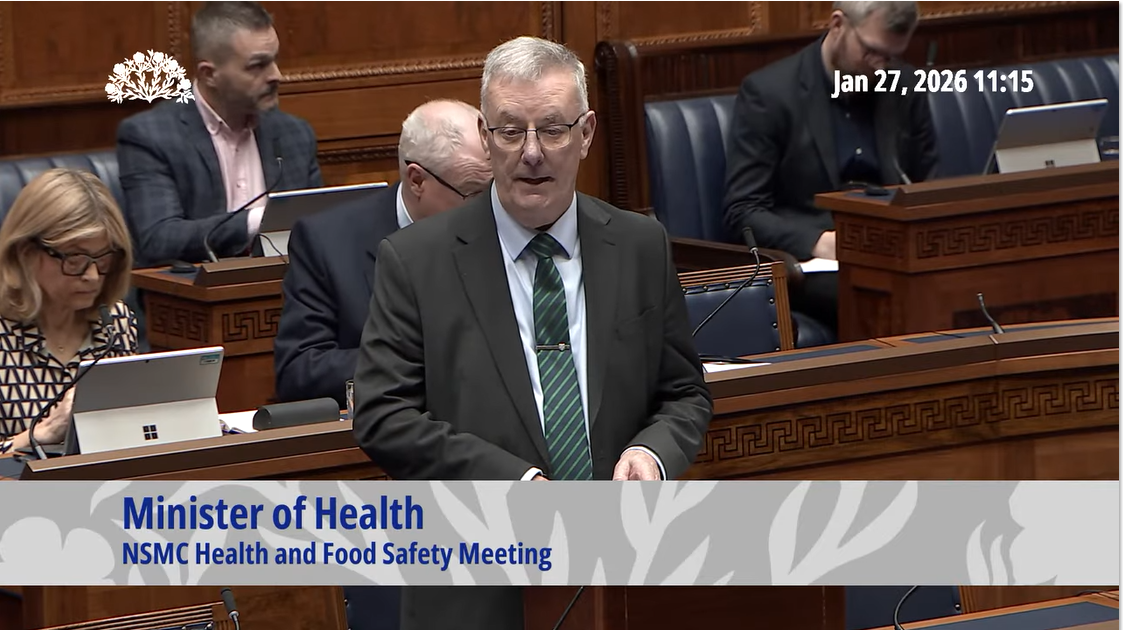
On Tuesday, The Minister of Health, Mike Nesbitt MLA gave a statement on the twenty-seventh North/South Ministerial Council (NSMC) health and food safety sectoral meeting, which was held in Armagh on Wednesday, 14 January.
The Minister told Members that the Council had welcomed the progress made to date on: “… implementing its work programme in the health sector and noted that both Departments of Health have identified additional areas where there is potential for further development and collaboration between the health authorities in both jurisdictions.”
Mr. Nesbitt noted that 10 cross-border healthcare PEACE PLUS-funded projects have launched and are in their start-up phase, as well as ongoing work by the North/South cancer policy and strategy group on progressing the delivery of cross-border cancer services.
He also updated Members on cross-border initiatives including the work of the all-Ireland rare diseases interdisciplinary research network, and research carried out by Safefood on topics including obesity, food poverty and health inequalities.
Executive Office Committee updated on work of overseas bureaux
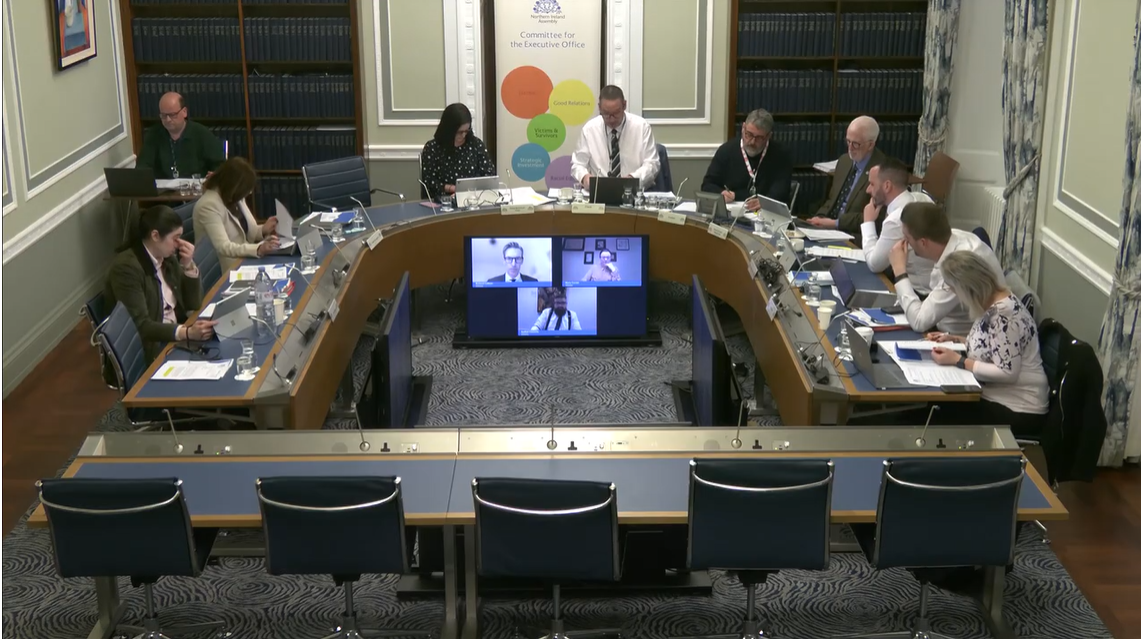
At its meeting on Wednesday, 28 January, the Executive Office Committee heard evidence from the Directors of the Executive’s three overseas bureaux in Brussels, Beijing and Washington DC.
Opening the evidence session, the Directors provided Members with an overview of the work of each bureau, including: support of relevant Northern Ireland Government Departments, the promotion of Northern Ireland business, arts, university and industry sectors, as well as collaboration with a number of organisations such as the Arts Council and Invest NI.
Aodhán Connolly, Director of the Northern Ireland Executive Office in Brussels discussed the importance of early engagement on EU legislative proposals and on how the office was widening the monitoring and engagement of NI Executive departments with their scrutiny Committees in the Assembly.
In relation to EU specific issues, Aodhán Connolly responded to questions on the freedom of movement for young people within the EU and on whether or not he felt that the Bureau had an opportunity to contribute meaningfully to discussions between the UK and Brussels. Further questions centred upon the current geo-political climate, particularly in relation to tariffs and trade, and how bureaux expenditure delivers ‘value for money’. You can watch the meeting in full here:
Case for a UK-EU customs union debated in the House of Lords
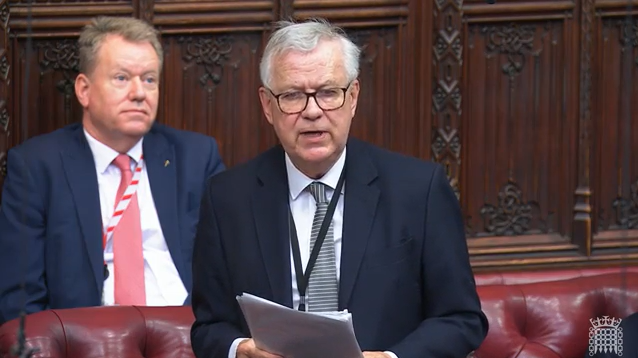
On Thursday, 29 January in the House of Lords, Lord Newby moved a ‘Motion to take Note’ on the case for a UK-EU customs union and the impact of connections with the EU single market on the United Kingdom economy.
Opening the debate, Lord Newby cited estimates by the Office for Budget Responsibility, the US National Bureau of Economic Research, and other research findings to illustrate negative impacts of Brexit on the UK economy. He described the UK Government’s reset of relations with the EU as: “...a few tentative steps in the right direction”, but argued that: “It is therefore for the UK now to set out clearly and unambiguously its long-term aspirations for a renewed relationship with the EU, and to prosecute that policy energetically and with urgency.”
Speaking against the motion, Lord Dodds said that: “Under a customs union, the EU would strike deals in its own interests, while the UK would be required to apply those terms automatically, without any guarantee of reciprocal access or consideration.” He argued that the Windsor Framework: “…formalises a reality in which internal trade within the United Kingdom is governed by rules made abroad and enforced with no democratic control.”
Responding to the motion on behalf of the Government, Baroness Anderson of Stoke-on-Trent told the house that the Government was elected with a clear manifesto commitment: “…to reset relations with our European partners, to tear down unnecessary barriers to trade, and to increase national security through strong borders and greater international co-operation, all without returning to the single market, the customs union or freedom of movement...” She added that an SPS agreement would be highly beneficial to Northern Ireland, stating that: “It will remove a broad and wide-ranging set of requirements for goods and plants moving from Great Britain to NI because the same regulations will be followed across the UK.”
The motion was agreed. You can read the full debate here:
Westminster Brief
The House of Commons Public Administration and Constitutional Affairs Committee took evidence last Wednesday, 28 January, from the Rt Hon Nick Thomas-Symonds MP, Paymaster General and Minister for the Cabinet Office, Hermione Gough, EU Director at Cabinet Office and Cabinet Office Officials.
The Minister responded to questions regarding ongoing negotiations with the EU on a Sanitary and Phytosanitary (SPS) agreement as well as the UK’s re-accession to the Erasmus+ programme in 2027 and participation in the internal electricity market. You can watch the Committee meeting in full here:
Meanwhile on Thursday, responding to a question on increasing trade with the EU, the Minister of State (Department for Business and Trade), Chris Bryant MP told the House of Commons that the government was in the process: “ … of fine tuning the deal that we reached last year on food and drink, and negotiating on joining the single electricity market. We want to improve business mobility and secure the mutual recognition of professional qualifications.”
This week in the Assembly
On Wednesday, the Executive Office Committee will take evidence from the First and deputy First Ministers on the work of the Northern Ireland Executive Office. You can watch the meeting live on niassembly.tv.
Parliamentary Planner

Coming up this week:
In the House of Commons today, the Ministry of Defence is expected to respond to a question on what discussions the Minister has had with his EU counterparts on UK access to the Security Action for Europe fund.
On Wednesday, the House of Commons: Northern Ireland Affairs Committee will continue its inquiry into Economic growth in Northern Ireland: new and emerging sectors. Members will take evidence from the Rt Hon. the Baroness Foster of Aghadrumsee DBE, Chair at Intertrade UK, and Colin McCabrey, Director of Trade at InterTradeIreland.
Also on Wednesday, the House of Commons: Culture, Media and Sport Committee will take evidence on the current state of play regarding performing arts touring in the EU.
In case you missed it…

-
In an opinion piece, published in the Belfast Telegraph on 30 January, the Parliamentary Under-Secretary of State for Northern Ireland, Matthew Patrick MP, argues: Politicians who touted fantasy solutions to Brexit border conundrum were wrong then and they are wrong now (behind a paywall).
-
In a 29 January article, the Guardian reports: ‘Food sector calls for transition period if UK and EU agree post-Brexit rules reset’.
-
A Reuters article on January 30 reports: ‘ EU says no post-Brexit energy deal without UK payments’.
-
The Guardian reported on 31 January: ‘UK and EU to explore renewed talks on defence cooperation’.
-
A Politico article on January 30 states: ‘Starmer vows to take UK deeper into EU single market’
-
Over the weekend, the Financial Times reported: ‘ We will use EU summit to further unwind Brexit, vows Keir Starmer’ (behind a paywall)
-
Meanwhile in an article on Friday 30 January, the Irish Times asks: Whisper it, but is Keir Starmer quietly reversing Brexit? The article states that ‘Six years after leaving the EU, the UK is navigating a delicate balancing act on trade and diplomatic ties with Brussels, as well as with Washington and Beijing’. (behind a paywall).
-
A new ‘UK in a Changing Europe’ blog post: ‘The boundless mystery of Assimilated EU Law?’ published on 27 January, explores the issues that the UK faces in managing the legislation it adopted during its time as a member state of the EU.
-
In a further blog from ‘UK in a Changing Europe’, Anand Menon and Joël Reland argue that geopolitical tensions make the UK’s choices post-Brexit increasingly difficult, even when it comes to regulatory divergence.
-
The Interministerial Group for Trade issued a communiqué on 27 January about its recent meeting on the 8 January, which was chaired by the Minister of State for Trade, Sir Chris Bryant MP.
-
A further Communiqué on the meeting of the Interministerial Group on UK-EU Relations on the 21 January, was published last Wednesday, 28 January.
-
A number of media outlets, including the Guardian and the BBC reported last week on the free-trade agreement between India and the EU.
-
The Scottish Parliament Information Centre (SPICe) published a quarterly update on Intergovernmental Activity, covering the period October to December 2025.
-
On 30 January, the UK Government published an Explanatory Memorandum on a proposal to amend EU regulations on AI rules. Specifically, the Explanatory Memorandum relates to a proposal amending EU regulations 2024/1689 and 2018/1139 as regards to the simplification of the implementation of harmonised rules on artificial intelligence (Digital Omnibus on AI).


